

Documentation Burden and Burnout in Emergency Medicine
Emergency physicians face a documentation burden that is qualitatively different from any other specialty. Studies tracking time-motion data in academic EDs consistently show that attendings spend up to 44% of their shift time on documentation and EHR-related tasks — time that competes directly with patient contact, clinical reasoning, and team coordination.
The consequences are measurable. Research led by Tait Shanafelt at Stanford Medicine found that emergency physicians had three times the odds of burnout compared with physicians in other specialties, and were half as likely to report satisfaction with their work-life balance. That figure situates the ED at the acute end of a profession-wide crisis, not as an outlier.
This context matters for evaluating AI scribe technology because it explains why adoption pressure is high even when the evidence base is thin. The case for ambient documentation support in the ED is not primarily about efficiency metrics — it is about whether physicians can sustain practice in an environment where the cognitive and administrative load is structurally excessive.
- Up to 44% of ED shift time spent on documentation and EHR tasks, based on time-motion studies in academic emergency departments.
- Emergency physicians report 3× higher burnout odds compared with physicians in other specialties.
- EPs are approximately half as likely to report satisfaction with work-life balance relative to other specialty physicians.
- Documentation time competes with direct patient contact in a specialty where throughput, acuity shifts, and simultaneous patient management are constant.
How Ambient AI Scribes Work: ASR, LLMs, and ED Deployment Models
Ambient AI scribes use a two-stage pipeline. In the first stage, automatic speech recognition (ASR) converts the spoken clinical encounter — physician questions, patient responses, and clinician narration — into a text transcript in near real-time. In the second stage, a large language model (LLM) processes that transcript and generates a structured clinical note, typically organized into sections matching the EHR template: history of present illness, review of systems, physical examination, assessment, and plan.
The physician reviews the draft note, edits as needed, and signs it. The intended workflow is that the physician never types a note from scratch — the AI draft becomes the starting point for attestation rather than the end product.
Several platforms have documented presence in emergency department deployments. DAX Copilot (Microsoft) was the platform used in the Brown University JMIR Formative Research 2026 pilot. Abridge was the platform evaluated in the Mayo Clinic Annals of Emergency Medicine 2026 AI-versus-human-scribe comparison. Other platforms — including Freed, ED Scribe AI, Ambience Healthcare, and Abridge's ED-specific module — explicitly advertise emergency medicine configurations, though the published evidence base for most of these ED-specific versions remains limited.
ED-Specific Clinical Deployment Evidence: What the Studies Show
Most published evidence on ambient AI scribes comes from ambulatory and primary care settings — large retrospective cohorts from Mass General Brigham, Permanente Medical Group, and Intermountain Health that document documentation-time savings and self-reported burnout reductions. Those findings are real, but they were generated in environments with scheduled single-patient encounters, minimal background noise, and verbal patients who could participate in a standard history-taking format. The ED is none of those things.
Three ED-specific studies published in 2025 and 2026 provide the current primary evidence base. Each has significant methodological constraints that must be understood before drawing operational conclusions.

Annals of Emergency Medicine 2026: Adoption and Documentation Time (n = 8,740)
The largest ED-specific study to date examined 8,740 eligible encounters at an academic tertiary emergency department. Of these, only 11.2% used ambient AI — a figure that signals low penetration despite tool availability. Thirty-five of 92 attending physicians (38%) used the tool at least once, but usage was highly concentrated: nine physicians accounted for 70.5% of all AI-assisted encounters.
When ambient AI was used, the time savings were measurable. Median on-shift documentation time fell from 3:50 minutes to 2:45 minutes — a 28% reduction. Total EHR time per encounter fell 16% (10:21 to 8:39 minutes). AI-assisted notes were also shorter overall (median 9,233 vs. 10,142 characters).
Critically, adoption clustered in lower-acuity zones — specifically telemedicine and vertical care areas — and was significantly less common in encounters involving interpreters or higher-acuity patients. This pattern suggests that physicians themselves are identifying the boundaries of where the tool performs adequately, even in the absence of formal guidance.
JMIR Formative Research 2026: Physician Experience Pilot (n = 14 EPs)
Despite its size, the Brown University pilot provides the most granular qualitative data on ED physician experience currently available. Among 14 respondents (87.5% response rate from 16 EPs): 64.3% reported being satisfied or very satisfied with the ambient scribe overall. But satisfaction did not translate to trust in clinical accuracy: only 42.9% trusted the accuracy of AI-generated notes, compared with 75% of those who had experience with in-person human scribes.
Usefulness was narrowly distributed. Only 23.1% found the ambient scribe helpful for physical examination documentation. Only 35.7% found it helpful for medical decision-making (MDM) — the two note components that carry the highest clinical and liability weight in emergency medicine.
Mayo Clinic Annals of Emergency Medicine 2026: AI vs. Human Scribes (n = 710 Visits)
A quality improvement pilot at Mayo Clinic Rochester compared AI scribes (Abridge) against human scribes across 710 ED visits involving five early-adopter physicians over approximately six weeks. This is the only published study that directly compares AI and human scribe performance in an emergency department.
The results challenge the assumption that AI scribes are a straightforward substitution for human scribes. Physicians using AI scribes spent more time in the EHR notes section per patient (adults: 4.3 vs. 1.8 minutes with human scribes; pediatric: 3.5 vs. 1.6 minutes). Physicians also contributed significantly more characters to AI-assisted notes (60.1% vs. 30.8% for adults), suggesting more active editing was required.
Note quality, measured using the PDQI-9 instrument, was similar for adult encounters but lower for pediatric patients when AI scribes were used (41.36 vs. 42.25 PDQI-9 score). The study's limitations are substantial: five physicians, single site, non-randomized assignment, and an early-adopter cohort. These findings cannot be generalized, but they do complicate the narrative that AI scribes are equivalent or superior to human scribes across all ED contexts.
ED-Specific Workflow Integration Challenges
The adoption pattern in the Annals of Emergency Medicine study — clustering in telemedicine and vertical care, avoiding ESI-2 bays and interpreter encounters — is not a coincidence. It reflects a set of structural features of ED work that current ambient AI scribe technology was not designed to handle. These challenges were systematically identified in the JMIR Formative thematic analysis and elaborated in a 2026 perspective published in npj Digital Medicine.
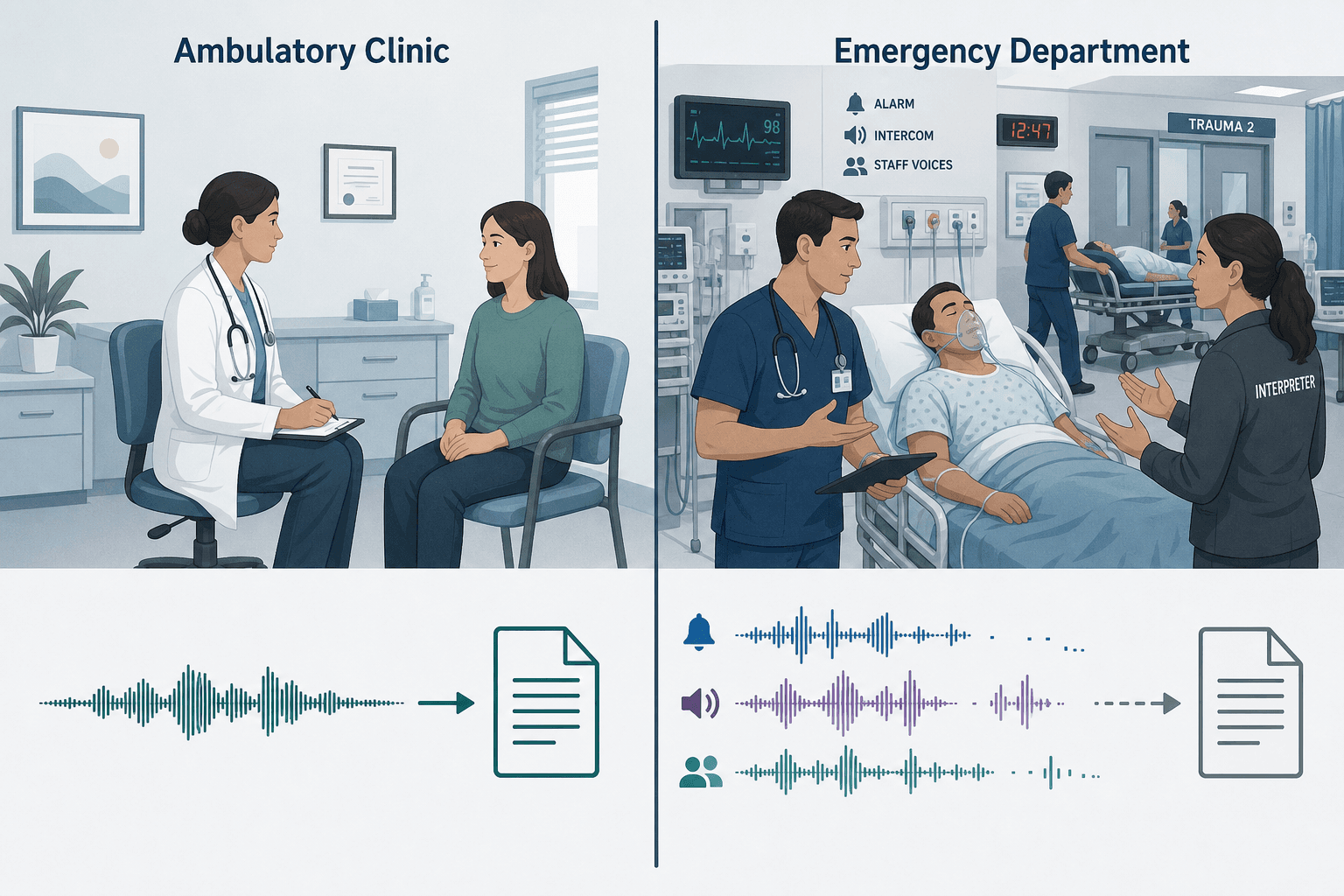
Acoustic Environment
Emergency departments are acoustically complex environments. Cardiac monitor alarms, overhead intercoms, code announcements, ventilator sounds, and simultaneous conversations between physicians, nurses, technicians, and family members create a continuous audio background that ASR systems were not optimized for.
Even in a quiet and controlled environment, available AI scribe products are unable to consistently identify or distinguish between multiple speakers. Emergency situations can easily involve simultaneous conversations between multiple physicians, and allied health staff, and patient companions, limiting the ability of a single device to accurately capture and distinguish all conversations.
This is not a minor technical limitation. Speaker diarization — the ability to attribute speech to the correct person — is a prerequisite for generating accurate notes in multi-provider encounters. Current commercial platforms have not demonstrated reliable performance in this domain under real ED conditions.
Patient Population Barriers
Ambient AI scribes are designed around the assumption that a patient can verbally participate in a clinical encounter. A significant proportion of ED patients cannot. Critically ill patients, intubated patients, patients with altered mental status, patients in acute pain, and patients with severe cognitive impairment all present scenarios where the verbal history component — the primary input to the AI pipeline — is absent or severely degraded.
DAX copilot has been difficult to use in a busy ER setting given the noise in the department, elderly patient population, and nonverbal communication such as nodding.
It is tough for physical exam and MDM, and it is not that helpful when patient is non-verbal or critically ill.
Interpreter Encounters
Encounters requiring language interpretation introduce additional complexity that current AI scribe systems handle poorly. The Annals of Emergency Medicine study found that ambient AI adoption was significantly lower in interpreter encounters — consistent with physician recognition that the tool performs inadequately when the conversation involves a third-party interpreter, code-switching between languages, or telephone-based interpretation services.
This matters for equity: patients with limited English proficiency are disproportionately represented in ED populations and are already at higher risk of communication-related errors. A tool that performs less reliably in these encounters — or is simply not used for them — may widen existing documentation quality gaps along language lines.
MDM and Physical Examination Documentation Gaps
Medical decision-making and physical examination are the two most clinically and legally consequential sections of an ED note. They are also the sections where physician satisfaction with AI-generated content is lowest. In the JMIR Formative pilot, only 23.1% of EPs found the ambient scribe helpful for physical exam documentation, and only 35.7% found it helpful for MDM.
Physical examination findings are often communicated through brief, nonverbal, or gestural cues that do not register in an audio stream. A physician who palpates an abdomen and says nothing, or who communicates findings through body language during a trauma assessment, generates no capturable audio. MDM — which requires synthesizing findings, risk stratification, differential diagnosis, and disposition reasoning — demands a level of structured clinical articulation that many ED physicians do not verbalize explicitly during the encounter.
Acuity-Zone Adoption Skew and Note Bloat
The concentration of AI scribe use in telemedicine and vertical care zones — where encounters are more linear, lower acuity, and closer in structure to an ambulatory visit — reflects a pragmatic physician judgment about where the tool is actually useful. Resuscitation bays, trauma activations, and high-acuity care areas remain largely outside the current scope of effective AI scribe use.
The Annals study found that AI-assisted notes were shorter on average (9,233 vs. 10,142 characters), which could be interpreted as efficiency or as undersynthesis. The npj Digital Medicine perspective raises the concern of note bloat in the opposite direction — AI systems that generate verbose, formulaic documentation to cover all possible bases, reducing note clinical utility without reducing physician review burden.
Safety Considerations: Errors, Hallucinations, Automation Bias, and Consent
Documentation safety is the most consequential and least well-characterized dimension of AI scribe deployment in the ED. The available safety data comes primarily from a simulation study conducted in ambulatory conditions — not from ED-specific research — and the findings are serious enough to warrant careful attention before drawing conclusions about real-world ED performance.
Error Rates in Simulated Ambulatory Encounters
With that caveat stated clearly: the simulation study evaluated five ambient documentation platforms across 14 clinical scenarios. The mean error rate across platforms was 26.3% of key clinical elements. On average, 3.0 errors per case carried potential for moderate-to-severe patient harm (AHRQ harm scale ≥2). Only 35.8% of clinical elements were correctly captured consistently across all five platforms — meaning that no single element could be assumed to be reliably documented regardless of which platform was used.
- Errors of omission were the most common error type, comprising 76.3% of all errors — information present in the encounter that did not appear in the generated note.
- Medication errors were observed across all five platforms and were the most clinically significant error category.
- Hallucinations — fabricated clinical content with no basis in the recorded encounter — included invented test results and subjective commentary not stated by the physician.
- The only error designated as carrying risk of death involved a sepsis case where one platform stated that antibiotics 'would only be initiated if infection confirmed,' omitting any antibiotic agent, dose, or urgency framing.
- Misgendering and substitution errors (incorrect clinical values or findings) were also identified across multiple platforms.
Automation Bias and the Note Review Problem
A well-documented risk in AI-assisted clinical workflows is automation bias — the tendency of clinicians to reduce critical scrutiny of AI-generated outputs over time, particularly when the outputs are usually correct. In the AI scribe context, this manifests as physicians signing notes without fully reading them, accepting AI-generated content as accurate by default, and gradually reducing the active editing behavior that the safe use of these tools requires.
The JMIR Medical Informatics 2025 editorial identifies this as a compounding risk: initial evaluations typically involve early adopters who are motivated to review carefully, but real-world deployment at scale will include physicians who are tired, time-pressured, and less inclined to treat every AI draft as provisional. The editorial also raises the concept of 'cognitive debt' — the possibility that repeated reliance on AI for documentation may gradually attenuate the clinical articulation and synthesis skills that generate the underlying knowledge in the first place.
Consent and Privacy in the ED Context
Ambient AI scribes record audio of clinical encounters. In most ambulatory settings, a verbal or written consent process can be completed before the encounter begins. The ED presents scenarios where this is not possible.
Patients who are unconscious, intubated, acutely psychotic, severely intoxicated, or in extremis cannot provide meaningful consent to audio recording of their care. Pediatric patients add guardian consent requirements that may be unavailable in time-critical situations. In jurisdictions with two-party consent laws for audio recording, the legal exposure for recording without consent is not theoretical — it is a compliance obligation that may be practically unenforceable in high-acuity ED scenarios.
In jurisdictions requiring two-party consent, the use of ambient scribes must be disclosed and agreed upon explicitly. However, this is often impractical in situations where patients are unable to provide informed consent, such as being unconscious or cognitively impaired.
Liability Ambiguity and the Governance Gap
When an AI-generated note contains an error that contributes to a patient harm event, the question of attribution — to the physician who signed it, the institution that deployed the tool, or the vendor who built it — has not been resolved in case law or regulatory guidance. The physician's signature on the note establishes legal responsibility for its contents, but the mechanisms that produced the error may lie entirely outside the physician's ability to detect or control.
More fundamentally, as the JMIR Medical Informatics editorial notes, there is currently no systematic framework for collecting data on clinical errors or adverse patient outcomes attributable to AI scribe use. Without that infrastructure, the field cannot distinguish between tools that are performing safely at scale and tools that are generating harms that go undetected because no one is looking.
Evidence Quality Assessment: What the Current Literature Can and Cannot Support
The evidence base for AI scribes in emergency medicine is active but methodologically immature. Understanding what the current literature can and cannot support is essential for making defensible deployment and governance decisions.
- All three primary ED-focused studies (Annals EM 2026, JMIR Formative 2026, Mayo Clinic Annals EM 2026) are single-center and observational. None was randomized.
- No randomized controlled trial on AI scribe use in the ED with downstream patient outcome measures has been published. The field's primary evidence for clinical benefit rests on documentation-time metrics and self-reported satisfaction, not patient outcomes.
- The largest ED study (Annals EM 2026, n = 8,740) did not assess documentation quality or patient outcomes — only time-on-task metrics and note character counts.
- The JMIR Formative pilot (n = 14 EPs) had no power calculation, enrolled self-selected early adopters, evaluated a single platform, and cannot support generalizations about ED physician experience with AI scribes broadly.
- The Mayo Clinic safety simulation used 14 ambulatory scenarios in a quiet room — not ED scenarios. The 26.3% mean error rate represents a controlled best-case environment; real-world ED conditions are acoustically and clinically more complex.
- The Mayo Clinic AI-vs-human-scribe comparison (n = 5 physicians, 710 visits) is too small and too concentrated among early adopters to support conclusions about comparative effectiveness at scale.
- No published study has systematically tracked adverse patient events attributable to AI scribe errors in any clinical setting, including the ED.
Deployment and Governance Considerations for ED Settings
The combination of modest but real documentation-time benefits, low adoption in high-acuity zones, documented error rates in controlled conditions, and absent ED-specific safety data creates a specific governance obligation: institutions that deploy ambient AI scribes in emergency departments should do so within a structured framework rather than as a general rollout.
Pre-Deployment Validation
Ambulatory validation data from a vendor — even from large multi-site ambulatory studies — does not constitute validation for ED use. Before broad deployment, institutions should conduct local pilot testing in the specific ED environment, across the range of encounter types and acuity levels present in that department. Pilot evaluation should include structured assessment of note quality (not only time-on-task) across physician specialties, acuity zones, patient populations, and encounter types including interpreter-mediated encounters.
Monitoring Frameworks
Published frameworks for evaluating AI scribe implementation — including SCRIBE and RE-AIM — provide structured approaches to tracking adoption patterns, physician workflow impact, and documentation quality over time. These frameworks can be adapted to generate the ED-specific performance data that the current literature lacks. Monitoring should include ongoing note quality audits, physician-reported error tracking, and structured incident reporting for documentation discrepancies.
Institutional Policy on Consent
Institutions operating in two-party consent jurisdictions must develop explicit policies for how ambient recording consent is handled when patients cannot provide it — including unconscious, intubated, severely altered, and pediatric patients without an available guardian. These policies should be developed in consultation with legal counsel, patient advocacy representation, and ethics review, and should be in place before deployment, not after an incident.
Staff Training on Automation Bias and Active Review
Training programs for AI scribe deployment should explicitly address automation bias — the documented tendency to reduce critical review of AI outputs over time. Physicians should be trained to treat every AI-generated draft as provisional, with particular attention to medication documentation, MDM synthesis, and physical examination findings. Institutions should establish clear expectations that signing an AI-generated note carries the same attestation responsibility as signing a self-authored note.
ED-Specific Performance Benchmarks
Vendor-provided performance benchmarks derived from ambulatory settings are not appropriate reference standards for ED deployment. Institutions should develop ED-specific benchmarks for note quality, error rates, and physician review time — and should not assume that ambulatory performance levels represent a floor for ED performance. Given the acoustic and clinical complexity of the ED environment, the opposite assumption is more defensible.
Summary of Key ED-Focused Studies
| Study | Design | Sample | Setting | Key Outcome Measures | Key Limitations |
|---|---|---|---|---|---|
| Annals of Emergency Medicine 2026 (Preiksaitis et al.) | Retrospective observational | 8,740 eligible encounters; 976 (11.2%) used ambient AI; 35/92 attendings | Single academic tertiary ED | Adoption rate 11.2%; on-shift documentation time −28% (3:50 → 2:45 min); total EHR time −16%; AI notes shorter (9,233 vs. 10,142 characters); adoption clustered in telemedicine and vertical care zones | Single-center; selection bias (physicians chose when to use AI); no documentation quality or patient outcome assessment; lower-acuity encounter skew |
| JMIR Formative Research 2026 (Brown University Health) | Cross-sectional mixed-methods pilot survey | 14 EPs (87.5% response rate from 16); 4 EDs | Brown University Health emergency departments | 64.3% satisfied overall; 42.9% trusted AI accuracy vs. 75% for human scribes; 23.1% found AI helpful for physical exam; 35.7% helpful for MDM; 5 qualitative themes identified | n = 14 EPs; no power calculation; single platform (DAX Copilot); self-selected early adopters; not generalizable to other platforms or ED populations |
| Annals of Emergency Medicine 2026 — Mayo Clinic (Morey et al.) | Quality improvement pilot (non-randomized) | 710 visits; 5 early-adopter physicians; ~6 weeks | Mayo Clinic Rochester ED | AI scribes associated with more EHR notes-section time (adult: 4.3 vs. 1.8 min); more physician note contribution (60.1% vs. 30.8%); similar adult PDQI-9 scores; lower pediatric PDQI-9 scores with AI | 5 physicians; single site; non-randomized; early-adopter cohort; short duration; not generalizable |
| Mayo Clinic Proceedings: Digital Health 2025 (Anderson et al.) — Safety Simulation | Simulation study (controlled, non-ED) | 5 ADS platforms; 14 ambulatory clinical scenarios | Quiet room; prerecorded ambulatory audio — not ED scenarios | Mean error rate 26.3%; avg. 3.0 errors/case with AHRQ ≥2 harm potential; 35.8% of elements consistently captured across all platforms; medication errors most common; hallucinations included fabricated test results | Ambulatory scenarios only; quiet-room conditions; not real-world; not ED-specific; results likely underestimate real-world ED error rates |
Comments
Join the discussion with an anonymous comment.