
Scale and Growth: Cardiology's Position in the FDA AI Device Landscape
Cardiology is the second-largest clinical specialty in the FDA-cleared AI/ML medical device landscape, trailing only radiology. Of the 1,016 FDA-cleared AI/ML devices reviewed through early 2025, 277 — or 27.3% — had cardiology applications, according to the scoping review by Hussain et al. published in Heart. The Sardar et al. analysis, using a December 2024 cutoff and narrower inclusion criteria, identified 209 cardiovascular devices from the same 1,016-device base — a difference that reflects methodology, not error.
The growth trajectory is steep. Hussain et al. found that 98.9% of cleared cardiology AI devices received authorization after 2016; Sardar et al. reported that 85% were approved in the last six years relative to their December 2024 cutoff. This post-2015 surge aligns with the broader expansion of the FDA's digital health regulatory infrastructure and the maturation of deep learning applied to cardiac imaging and signal processing.
The FDA's own device list, updated through early 2026, confirms that new cardiovascular-panel clearances continued issuing throughout 2025 — including devices from Abbott, Medicalgorithmics, Apple, Tempus, HeartFlow, Anumana, and Eko, among others. This means the aggregate figures from both primary studies represent a snapshot, not a ceiling. Any adoption or procurement decision should verify current clearance status directly against the FDA's AI-Enabled Medical Devices list.
Subspecialty Distribution: Where Cardiology AI Is Concentrated
The two primary studies approach subspecialty distribution from different angles — Hussain et al. categorizes devices by clinical domain, while Sardar et al. focuses on application type — and together they provide a layered picture of where cleared cardiology AI is actually deployed.
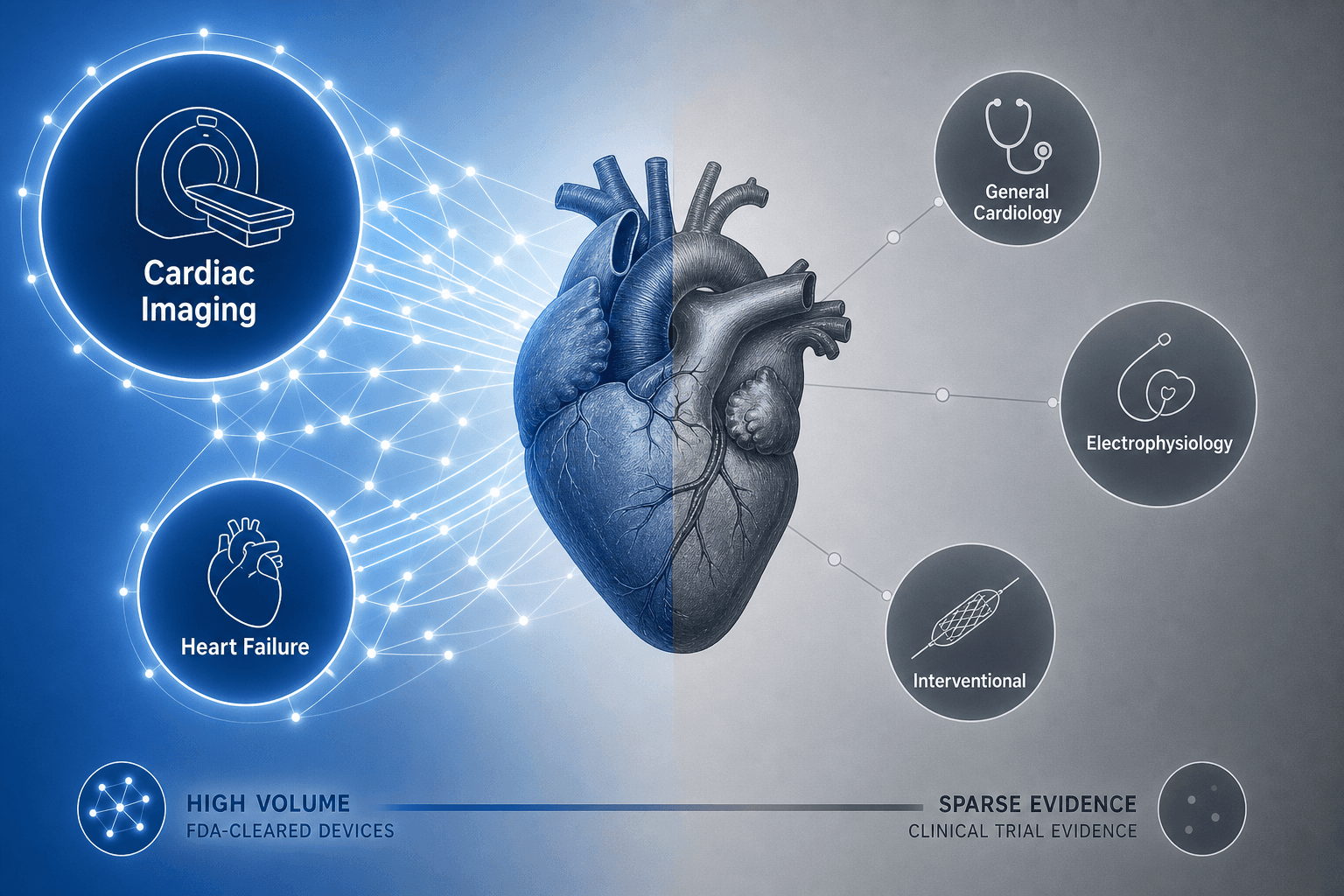
Using the domain-level breakdown from the Hussain et al. scoping review (277 devices, March 2025 cutoff), cardiac imaging dominates at 65.3% of all cardiology AI devices. Electrophysiology follows at 16.6%, with general cardiology (7.2%), heart failure (6.1%), and interventional cardiology (4.7%) accounting for the remainder.
| Subspecialty Domain (Hussain et al.) | Share of Cardiology AI Devices | Application Type (Sardar et al.) | Share of CV AI Devices |
|---|---|---|---|
| Cardiac Imaging | 65.3% | ECG-based arrhythmia detection | 21.1% |
| Electrophysiology | 16.6% | Echocardiography | 16.7% |
| General Cardiology | 7.2% | Coronary artery disease detection/evaluation | 16.7% |
| Heart Failure | 6.1% | Hemodynamics / vital signs monitoring | 15.8% |
| Interventional | 4.7% | Cardiovascular imaging (combined) | 25.4% |
The Sardar et al. analysis (209 devices, December 2024 cutoff) provides complementary application-level granularity: ECG-based arrhythmia detection is the single most common application at 21.1%, followed by echocardiography (16.7%) and coronary artery disease detection or evaluation (16.7%), with hemodynamics and vital signs monitoring at 15.8%. These figures reflect a device landscape built primarily around signal interpretation and structural imaging — the areas where deep learning has had the longest development runway and the most available training data.
The two studies differ in how they classify devices — Hussain et al. casts a wider net that includes radiology-assigned devices with cardiovascular applications, while Sardar et al. applies stricter cardiovascular-panel criteria. Neither set of figures is wrong; they answer slightly different questions. Hussain et al. is more useful for understanding the full scope of AI tools a cardiologist might encounter; Sardar et al. is more useful for understanding what the FDA's cardiovascular device panel specifically reviews.
What Cleared Cardiology AI Actually Does: The DDPP Functional Framework
Beyond subspecialty distribution, Hussain et al. applied a descriptive/diagnostic/predictive/prescriptive (DDPP) framework to characterize what cleared cardiology AI devices actually do in clinical practice. The results reveal a pronounced skew toward the lower end of the functional spectrum.
| Functional Category | Share of Cardiology AI Devices | Clinical Role |
|---|---|---|
| Diagnostic | 64.3% | Identifies or classifies a condition from data |
| Descriptive | 29.6% | Characterizes or quantifies a finding without classification |
| Predictive | 5.4% | Estimates future risk or outcome |
| Prescriptive | 0.7% | Recommends or guides a specific action or treatment |
Viewed from the clinical pathway perspective, 79.4% of cleared cardiology AI devices are focused on the diagnosis stage. Screening accounts for just 5.4%, inpatient monitoring for 9.0%, intraprocedural guidance for 3.6%, treatment planning for 2.2%, and follow-up for a negligible 0.4%. This means a cardiologist looking for AI support in post-diagnosis management, treatment selection, or longitudinal monitoring will find very few cleared options.
The prescriptive category — tools that actively recommend a clinical action — contains only two cleared devices as of the Hussain et al. study period: UltraSight AI Guidance, which provides real-time acquisition guidance for echocardiography, and FEops HEARTguide, which supports structural heart intervention planning. The 15 predictive devices identified include 11 targeting hemodynamic compromise, reflecting the area where outcome prediction has the most developed evidence base.
The 510(k) Pathway and the Predicate Creep Problem
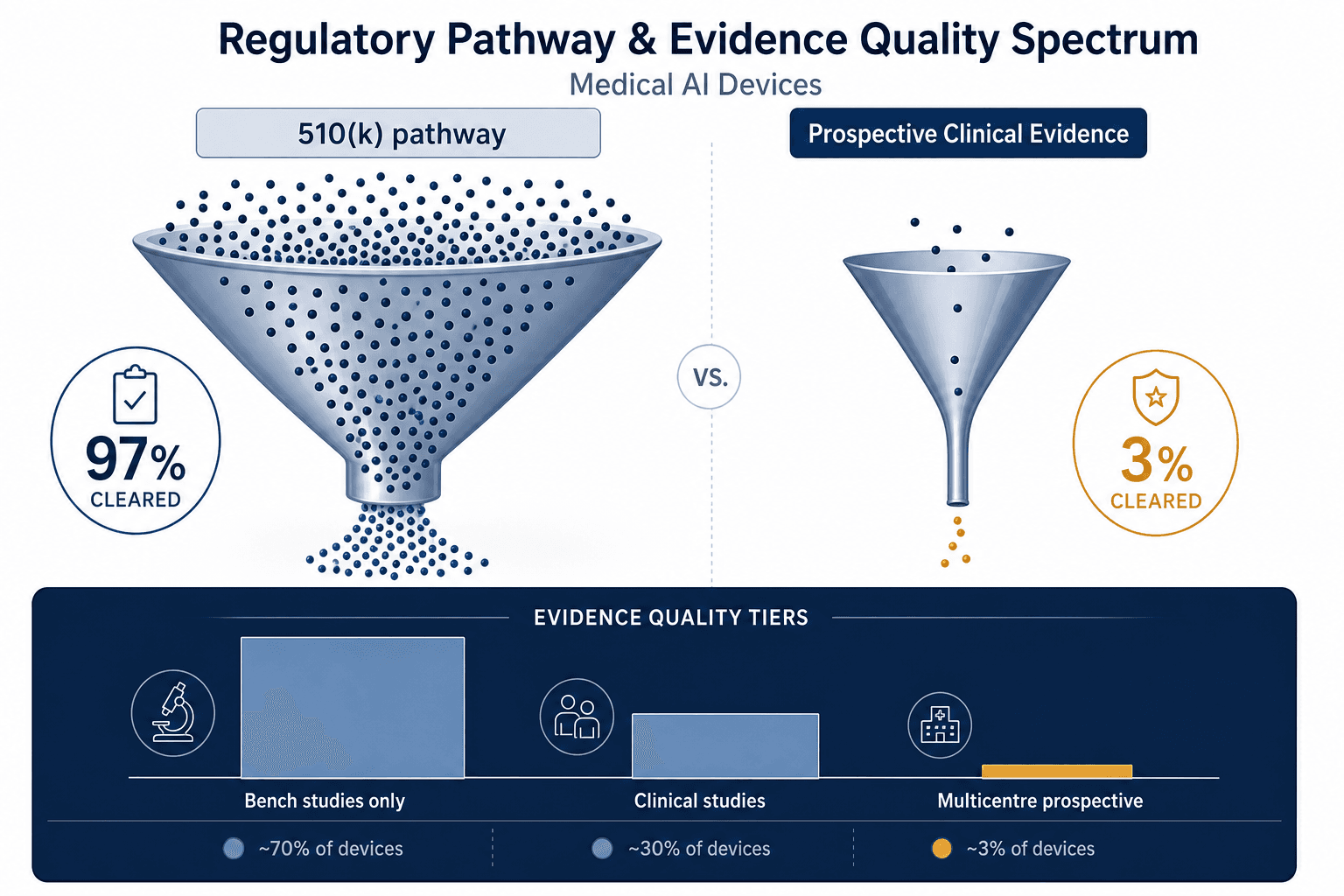
The regulatory pathway through which a device is cleared shapes the evidence it must provide before reaching market. In cardiology AI, that pathway is overwhelmingly the 510(k): Hussain et al. found that 97.1% of cardiology AI devices received 510(k) clearance, with only 8 devices authorized via the De Novo pathway. Sardar et al. reported similar figures — 200 of 209 devices (95.7%) via 510(k), with 9 via De Novo.
The 510(k) pathway does not require randomized controlled trial evidence or prospective clinical validation. It requires a manufacturer to demonstrate that a new device is substantially equivalent to a legally marketed predicate device in terms of intended use and technological characteristics. When the predicate is well-matched and the technology is similar, this is a reasonable standard. The problem arises when the predicate relationship is strained.
Hussain et al. analyzed predicate creep — a pattern in which a device is cleared based on a predicate with meaningfully different intended use, different technology, or both — and found that 52.2% of 510(k)-cleared cardiology AI devices were at high risk. Of those, 50% used a non-AI device as their primary predicate. This means a substantial portion of cleared cardiology AI tools reached market by demonstrating equivalence to devices that were neither AI-based nor designed for the same clinical task.
- High-risk predicate creep is defined by Hussain et al. as substantial divergence including changes in both technology type and intended use — not merely incremental updates.
- 50% of high-risk-predicate-creep devices used a non-AI primary predicate, meaning the baseline device the AI tool was compared against was a conventional, non-algorithmic medical device.
- Only 8 cardiology AI devices received De Novo authorization — the pathway designed for novel devices without a suitable predicate, which typically requires more substantive evidence of safety and effectiveness.
Clinical Evidence Quality: What the Validation Studies Actually Show
The evidence quality data from Hussain et al. represents the most consequential finding in the landscape for clinical decision-making. Of 277 cardiology AI devices reviewed through March 2025:
| Validation Type | Share of Cardiology AI Devices |
|---|---|
| Bench studies only | 69.3% |
| Clinical studies (any type) | 30.7% |
| Prospective multicentre studies | 3.2% (9 devices) |
Bench studies — which evaluate device performance on pre-existing datasets in controlled conditions, without prospective patient enrollment — account for the validation basis of more than two-thirds of cleared cardiology AI tools. Only 9 devices, representing 3.2% of the total, were supported by prospective multicentre studies at the time of clearance.
Cleerly ISCHEMIA (FDA submission K231335) is the worked example Hussain et al. cite for high-quality evidence: it was validated by the CREDENCE trial, a prospective multicentre study enrolling 612 stable subjects, making it one of the few cleared cardiology AI tools with a published prospective clinical study directly supporting its authorization.
The Sardar et al. analysis adds corroborating detail from a different angle: only 5.7% of the 209 cardiovascular devices it reviewed cited clinical trial data supporting the approved device, and only 9.0% included results from prospective studies of any kind. Just 56.5% provided comprehensive, detailed performance study results in their submissions.
Cross-specialty context from the Muralidharan et al. scoping review in npj Digital Medicine (covering 692 FDA-approved AI devices from 1995–2023 across all specialties) reinforces the pattern: only 1.9% of device approvals across the entire AI device catalog included a link to a scientific publication with safety and efficacy data, and only 9.0% contained a prospective study. These are cross-specialty averages, not cardiology-specific statistics, but they establish that the evidence gap in cardiology is not an outlier — it reflects a systemic feature of the FDA AI device authorization process as currently structured.
Demographic and Technical Transparency Gaps in FDA Submissions
Even where clinical studies were conducted, their utility for generalizability assessment is constrained by systematic reporting omissions. Sardar et al. found that across 209 cardiovascular AI device submissions:
- Only 10.0% reported race/ethnicity of study participants.
- 76.6% did not report participant age.
- 78.5% did not report gender.
- 61.0% of device requests originated from North America, raising questions about geographic and population representativeness.
Hussain et al. identified parallel gaps at the technical level: the type of AI technology used in the device was unspecified in 58.8% of clearance summaries. Without knowing whether a device uses a convolutional neural network, a gradient-boosted model, or a transformer architecture, it is difficult to assess its susceptibility to distribution shift, its interpretability characteristics, or its behavior in edge cases. Hussain et al. also found that 79% of clearance summaries were rated as poor quality on an adapted Newcastle-Ottawa Scale — a validated instrument for assessing study quality.
The Muralidharan et al. cross-specialty review provides additional context: 99.1% of AI device approvals across all specialties provided no socioeconomic data, and 81.6% did not report the age of study subjects. The review attributes these gaps not to the FDA's application template — which does stipulate disclosure of risks impacted by sex, gender, age, race, and ethnicity — but to applicants' failure to track or report this information. This is a submission practice problem, not solely a regulatory design problem.
Reading FDA Clearance Against Clinical Effectiveness: What Adoption Decisions Require
FDA clearance via the 510(k) pathway confirms that a device is substantially equivalent to a predicate and meets the FDA's safety profile requirements for market authorization. It does not certify that the device performs as claimed in real-world patient populations, that it generalizes beyond the validation dataset, or that it improves clinical outcomes. These are distinct questions that clearance alone cannot answer.
This distinction matters practically. A cardiologist or health system administrator evaluating a cleared cardiology AI tool for adoption is not evaluating the same question the FDA evaluated during the clearance process. The FDA asked: is this device substantially equivalent to an existing predicate and does it meet safety requirements? The clinical adopter needs to ask: does this device perform well enough, in populations like mine, to change clinical practice in a way that benefits patients?
The evidence quality data above shows why these questions often have different answers. When evaluating a cleared cardiology AI device for clinical use, the following questions go beyond what clearance status can answer:
- What was the validation dataset? Was it a bench study using archived data, or a prospective clinical study with enrolled patients? What was the sample size?
- Was there external validation? Was the device tested on a dataset independent of the training data, and ideally from a different institution or patient population?
- Were demographics reported? Does the submission or any supporting publication report the age, sex, race, and ethnicity of study participants? Does the patient population match yours?
- Is there a published prospective study? Has the device been evaluated in a peer-reviewed prospective study, and is that study independent of the manufacturer?
- What is the predicate relationship? If cleared via 510(k), what was the predicate device? Was it an AI device with similar intended use, or a conventional device in a different clinical context?
- What AI technology is used? Is the underlying model architecture disclosed? Is there any published information on model drift, calibration, or performance degradation over time?
The Innovation Gap: Where Predictive and Prescriptive Cardiology AI Is Absent
The DDPP functional analysis reveals a structural gap that goes beyond evidence quality: the cleared cardiology AI landscape is almost entirely built around identifying and describing existing conditions, not predicting future risk or guiding treatment. With 94.6% of devices falling into the diagnostic or descriptive categories, the cleared device space has essentially not addressed several of the highest-value clinical problems in cardiology.
Risk stratification tools — which could identify patients at elevated risk for heart failure decompensation, sudden cardiac death, or adverse procedural outcomes before those events occur — make up only a small fraction of the 15 cleared predictive devices, most of which target hemodynamic compromise. Treatment guidance tools, which could support decisions about device implantation, medication titration, or intervention timing, are represented by only two cleared prescriptive devices.
No generative AI or multimodal foundation models had received FDA clearance for cardiology applications as of the study periods covered by either primary analysis. This is notable given the pace of development in these architectures outside the regulatory context — it reflects both the evidence generation demands of the clearance process and the relative immaturity of deployment-ready multimodal cardiology AI.
- Predictive tools for longitudinal risk stratification (e.g., identifying patients at risk for progression to advanced heart failure) remain largely absent from the cleared device landscape.
- Intraprocedural guidance AI represents only 3.6% of cleared devices, despite the potential value in structural heart interventions and electrophysiology ablation.
- Post-discharge follow-up tools account for 0.4% of the cleared landscape — a striking gap given the clinical burden of heart failure readmissions and post-ACS monitoring.
- Post-market surveillance infrastructure for adaptive AI tools — particularly those that may update their models after deployment — remains an identified gap. The FDA's Predetermined Change Control Plan (PCCP) framework provides a mechanism for limited model updates without full resubmission, but its application to cardiology AI tools is still developing.
For researchers, the innovation gap identifies where prospective evidence generation is most needed: predictive and prescriptive cardiology AI tools that target the post-diagnosis, monitoring, and treatment phases of care. For health system planners and administrators, it signals that the current cleared device landscape cannot yet support AI-assisted cardiology across the full care continuum — and that workflow integration strategies built around diagnostic AI will need to be reassessed as the predictive and prescriptive device categories mature.
Discussion
Clinical experience, implementation questions, and workflow observations from clinicians and administrators are welcome.
Comments
Join the discussion with an anonymous comment.