
Diabetic retinopathy (DR) is the leading cause of preventable blindness among working-age adults in the United States, responsible for more than 24,000 new cases of vision loss each year. The clinical pathway to prevention is well established: annual dilated fundus examination for all adults with diabetes. The adherence reality is not. Despite more than fifteen years of public health effort, fewer than half of Americans with diabetes complete recommended annual eye exams. The barrier is structural, not informational—patients in rural areas, federally qualified health centers, and underserved urban clinics often have no timely access to an ophthalmologist or optometrist capable of grading retinal images.
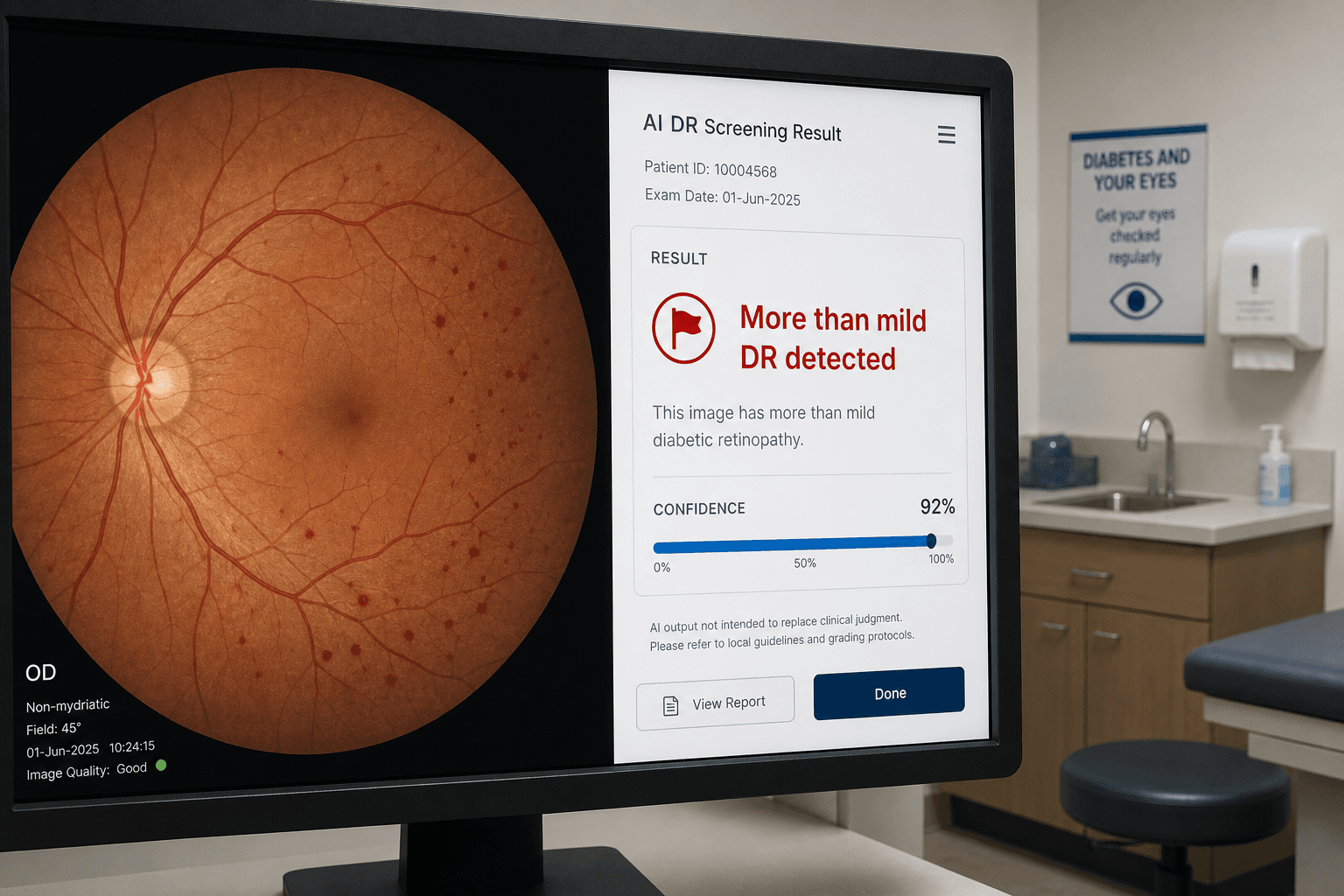
IDx-DR was designed to address that structural failure directly. Rather than routing patients through a specialist referral chain, the system enables a primary care operator with four hours of training to capture retinal images at the point of care and receive a binary clinical decision—without any specialist reviewing the images. That autonomous output is what distinguishes IDx-DR from the broader category of AI-assisted diagnostic tools, and it is what made its FDA authorization in April 2018 a landmark event in the regulation of medical AI.
This article provides a device-specific, evidence-grounded review of IDx-DR: its regulatory pathway, pivotal trial design and results, post-market real-world performance, systematic review synthesis, equity evidence, and scope constraints. Readers seeking a broader orientation to AI across clinical domains should consult the site's overview of AI clinical applications across key medical specialties before proceeding here.
How IDx-DR Works: Algorithm Architecture and the Autonomous Decision Framework
IDx-DR operates as a two-component system. The first component is an Image Quality AI that evaluates each captured retinal image across multiple dimensions before any diagnostic processing occurs: focus sharpness, color balance, exposure level, and field coverage. Images that do not meet quality thresholds are rejected and the operator is prompted to recapture—a design choice that reduces the likelihood of diagnostic error from technically inadequate inputs.
The second component is the Diagnostic AI. Rather than using a single end-to-end neural network that maps raw pixel inputs to a disease label, IDx-DR uses lesion-specific convolutional neural network detectors trained separately to identify the three primary lesion classes associated with diabetic retinopathy: microaneurysms, hemorrhages, and exudates. The outputs of these detectors are then fused by a separately trained machine learning classifier that produces the final binary clinical decision.
This architecture is described by its developers as "physiologically plausible"—meaning the system's decision pathway corresponds to the actual pathological lesions that define diabetic retinopathy, rather than learning arbitrary image features that happen to correlate with disease labels in a training dataset. The practical implication is relevant to equity: lesion-specific detectors are less likely to encode spurious correlations with skin tone or other demographic features that can emerge in end-to-end black-box models trained on non-diverse datasets.
FDA De Novo Authorization: DEN180001 and the Predicate-Free Regulatory Pathway
On April 11, 2018, the FDA granted De Novo authorization to IDx-DR under De Novo number DEN180001. The device was classified as a "diabetic retinopathy detection device" under regulation number 886.1100, assigned product code PIB. The requester was IDx, LLC, of Iowa City, Iowa, with Michael D. Abramoff listed as the contact. The application was received on January 12, 2018, and the Ophthalmic Advisory Committee reviewed the submission before the decision was granted.
| Field | Value |
|---|---|
| De Novo Number | DEN180001 |
| Device Name | IDx-DR |
| Classification Name | Diabetic retinopathy detection device |
| Regulation Number | 886.1100 |
| Product Code | PIB |
| Requester | IDx, LLC — Iowa City, IA |
| Date Received | January 12, 2018 |
| Decision Date | April 11, 2018 |
| Decision | Granted (DENG) |
| Advisory Committee | Ophthalmic |
| Pathway Type | Direct De Novo (predicate-free) |
The De Novo pathway is used for novel, low-to-moderate risk devices for which no legally marketed predicate exists. Because IDx-DR had no prior FDA-authorized autonomous AI diagnostic system to reference as a predicate, a standard 510(k) clearance was not available. The De Novo process required the FDA to evaluate the device's safety and effectiveness on its own merits and, upon granting authorization, to establish a new device classification that would serve as the predicate for future substantially equivalent devices.
The historical significance of DEN180001 extends beyond ophthalmology. IDx-DR's authorization marked the first time the FDA had authorized any autonomous AI diagnostic system in any field of medicine. The regulatory framework established by this De Novo decision has since been applied to AI diagnostic devices across other specialties. For context on how the De Novo pathway has been used in radiology AI, see the site's analysis of FDA-cleared radiology AI devices and the clinical evidence gap; for cardiology AI, see the subspecialty landscape of FDA-cleared cardiology AI devices.
Pivotal Trial Design and Results: NCT02963441
The pivotal trial supporting the De Novo authorization (ClinicalTrials.gov identifier NCT02963441, published in npj Digital Medicine in 2018) enrolled 900 participants across 10 US primary care sites between January and July 2017. The study used an intent-to-screen design, meaning all enrolled participants were included in the primary analysis regardless of whether technically adequate images were obtained—a more conservative analytical approach than excluding poor-quality cases after the fact.
The reference standard was fundus photography reading center (FPRC) widefield stereoscopic photography combined with macular optical coherence tomography (OCT)—a rigorous gold standard substantially more detailed than the non-mydriatic photography used by the AI system itself. Operators at the primary care sites received only four hours of training before using the system, reflecting the intended deployment context.
| Endpoint | Pre-specified Threshold | Observed Result | 95% Confidence Interval | Met? |
|---|---|---|---|---|
| Sensitivity | >85% | 87.2% | 81.8–91.2% | Yes |
| Specificity | >82.5% | 90.7% | 88.3–92.7% | Yes |
| Imageability Rate | Pre-specified | 96.1% | 94.6–97.3% | Yes |
A logistic regression model found no statistically significant effects of sex, race, ethnicity, HbA1C level, lens status, or site on either sensitivity or specificity. One subgroup finding was statistically significant: specificity was higher in participants over 65 years of age (p=0.030). Additionally, 76.4% of participants did not require pharmacologic dilation to obtain imageable photographs, which is operationally relevant for primary care deployment.
Post-Market Real-World Evidence: Four Key Studies
The post-market evidence chain for IDx-DR spans multiple countries, care settings, and comparator conditions. Four studies are particularly informative for understanding how the system performs outside the controlled pivotal trial environment.
Hoorn Diabetes Care System Validation (Netherlands, 2018)
The Hoorn Diabetes Care System (DCS) study, published in Acta Ophthalmologica, validated IDx-DR in a Dutch diabetes care population. This was an early external validation in a non-US setting and provided initial evidence that the system's performance was not exclusively a product of the US primary care sites used in the pivotal trial.
Austrian Prospective Outpatient Study (Huber et al., 2025, n=996)
A prospectively planned analysis at a specialized tertiary diabetes outpatient clinic in Austria enrolled 996 patients (53.1% female; median age 61.1 years) between March 2021 and October 2022. IDx-DR detected diabetic retinopathy in 26% of patients; of those, 73.1% were newly diagnosed with retinopathy without any prior history (p<0.001). In multivariate logistic regression, insulin use (OR=1.735) and diabetes duration independently predicted DR, while age and sex were not significant predictors. The study demonstrated real-world screening utility in a European tertiary care context, though the tertiary care setting may have enriched the population for more complex diabetes cases compared to a general primary care population.
Polish Head-to-Head vs. RetCAD (Grzybowski et al., 2025, n=758)
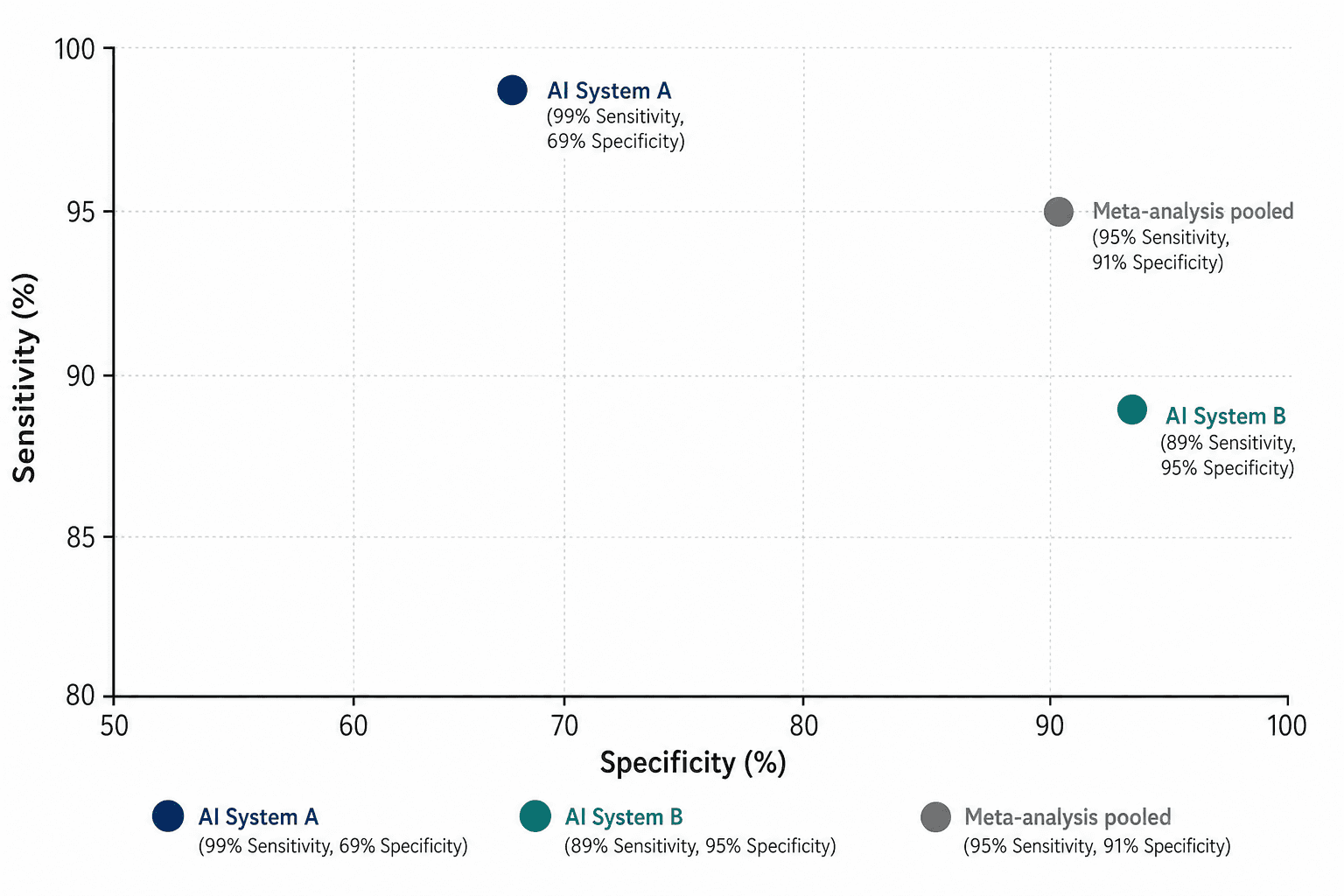
A study using retinal images from 758 patients with diabetes at clinics in Poland evaluated IDx-DR and RetCAD independently on the same dataset. The results illustrate a fundamental operating-parameter tradeoff between the two systems. IDx-DR achieved sensitivity of 99.3% but specificity of only 68.9% for referable DR detection. RetCAD achieved sensitivity of 89.4% and specificity of 94.8%. The positive predictive value was 48.1% for IDx-DR versus 96.4% for RetCAD; the negative predictive value was 99.5% for IDx-DR versus 83.1% for RetCAD.
These figures reveal that IDx-DR's operating parameters are calibrated to minimize false negatives—the system is designed to avoid missing a case of referable DR at the cost of generating a substantial false-positive burden. In a population of 758 patients, IDx-DR's 68.9% specificity means roughly 31% of patients without referable DR would receive a positive result requiring ophthalmology referral. Health system administrators evaluating IDx-DR must account for this referral volume impact in their deployment planning.
German Diabetes Clinic Real-World Performance (Hunfeld et al., 2026)
A 2026 study published in Scientific Reports (PMID 41611862) examined IDx-DR's real-world performance and the factors that confound its output in a German diabetes clinic setting. The study contributes to understanding how system performance varies by patient and clinical characteristics in routine care. Readers should access the full text directly for the complete German clinic dataset and confounder analysis, as the full article was not available for detailed review during preparation of this digest.
Systematic Review and Meta-Analysis: What 13 Studies and 13,233 Participants Show
The most comprehensive synthesis of IDx-DR evidence to date was published in the American Journal of Ophthalmology in 2025. The Khan et al. systematic review and meta-analysis (PMID 39986640) searched the literature through October 5, 2024, and identified 13 eligible studies involving 13,233 participants. Using a bivariate random-effects model, the analysis reported pooled sensitivity of 0.95 (95% CI: 0.82–0.99), pooled specificity of 0.91 (95% CI: 0.84–0.95), and an area under the summary receiver operating characteristic (SROC) curve of 0.95.
| Metric | Pooled Estimate | 95% Confidence Interval |
|---|---|---|
| Sensitivity | 0.95 | 0.82–0.99 |
| Specificity | 0.91 | 0.84–0.95 |
| AUC (SROC) | 0.95 | — |
| Studies included | 13 | — |
| Total participants | 13,233 | — |
These pooled figures represent a strong overall diagnostic accuracy signal. However, they require careful contextualization. The 13 pooled studies were conducted across varied clinical settings—not exclusively US primary care—and used different reference standards, some less rigorous than the FPRC Level I prognostic standard used in the pivotal trial. The pooled specificity of 0.91 sits well above the 68.9% observed in the Polish head-to-head study, illustrating how population characteristics, prevalence rates, and reference standard choices can produce wide performance variation across studies that all nominally evaluate the same system.
Equity Evidence and AI Adoption Bias: The Remaining Barrier
A 2024 study published in npj Digital Medicine (NCT05808699) evaluated an improved autonomous AI system using the handheld rv700 camera (LumineticsGo) specifically to address equity concerns. The trial enrolled 626 participants at 8 US primary care sites, with a demographic composition designed to reflect underserved populations: 50.8% male, 45.7% Hispanic, 17.3% Black. Diabetic retinal disease (DRD) prevalence in the enrolled population was 29.0%.
All prespecified non-inferiority endpoints were met against a Wisconsin Reading Center Level I prognostic standard: sensitivity 81.5% at the participant level (p=0.006) and specificity 82.2% (p=0.008). No racial, ethnic, or sex bias was detected in any outcome parameter. The Population Achieved Sensitivity break-even ratio of 1.07x (95% CI: 1.02–1.15) indicates that deploying the rv700 in a given population at only 1.07 times the adoption rate of the desktop NW400 predicate would result in more true DRD cases identified—a figure intended to quantify the population-level benefit of expanding access through the lower-cost handheld form factor.
The study's primary equity finding is not that the AI system performs differently across demographic groups—it does not. The primary equity finding is that the technology itself is not reaching the populations that most need it. Under-resourced clinics serving racially minoritized, rural, and low-income patients lag in adopting AI screening tools despite proven clinical efficacy. The authors term this "AI adoption bias," and identify it as the primary remaining equity barrier in autonomous DR screening.
- No racial, ethnic, or sex bias detected in diagnostic accuracy across a majority-Hispanic and majority-minority enrolled population.
- Non-inferiority endpoints met for both sensitivity and specificity against a rigorous Wisconsin Reading Center reference standard.
- Population Achieved Sensitivity break-even ratio of 1.07x favors wider handheld rv700 adoption to maximize population-level case detection.
- AI adoption bias—not algorithmic bias—identified as the primary equity barrier: under-resourced clinics are not adopting the technology at rates that would close the screening gap for their patient populations.
Scope Constraints, Limitations, and What IDx-DR Cannot Do
IDx-DR's authorized indication is precisely bounded. The system is cleared for detection of more-than-mild diabetic retinopathy (ETDRS severity level ≥35) and diabetic macular edema in adults 22 years of age and older who have no prior diagnosis of diabetic retinopathy. These constraints are not minor operational details—they define what the system is and is not permitted to do in clinical practice.
- IDx-DR does not detect glaucoma. A retinal image analyzed by IDx-DR that returns a negative result provides no information about glaucomatous optic nerve changes. Patients with diabetes are at elevated glaucoma risk; a negative IDx-DR result does not substitute for comprehensive eye examination.
- IDx-DR does not detect age-related macular degeneration (AMD). AMD is a leading cause of vision loss in older adults, including older adults with diabetes. The system's output is specific to diabetic retinopathy and DME.
- IDx-DR is not authorized for patients with a prior DR diagnosis. The system is a screening tool for incident disease detection, not a monitoring tool for patients already under ophthalmic management.
- IDx-DR is not authorized for patients under 22 years of age. Pediatric and young adult patients with diabetes require standard ophthalmic evaluation.
- Real-world specificity is highly variable. The documented specificity range across post-market studies spans 68.9% to 98.7%. A specificity of 68.9%—as observed in the Polish head-to-head study—means roughly one in three patients without referable DR will receive a positive result. Health systems must model referral volume implications before deployment.
The industry funding structure of the evidence base is a material limitation that applies across the entire IDx-DR evidence chain. Both the 2018 pivotal trial and the 2024 bias mitigation trial were funded by the manufacturer, with the same principal investigator holding financial relationships to the company in both studies. The post-market studies from Austria, Poland, and Germany were conducted independently, but they evaluated performance in European populations that may differ from the US primary care populations that represent IDx-DR's primary deployment context.
For a broader framework on evaluating the quality of AI diagnostic evidence—including reference standard selection, external validation requirements, and the significance of industry funding in AI device trials—see the site's analysis of what the clinical evidence for AI medical diagnosis actually shows.
Product Evolution: From IDx-DR to LumineticsCore and LumineticsGo
Digital Diagnostics Inc.—the company formerly known as IDx LLC—now markets the platform under two product names. LumineticsCore refers to the desktop system using the NW400 non-mydriatic camera, which is the direct descendant of the original IDx-DR system authorized under DEN180001. LumineticsGo refers to the handheld system using the rv700 camera, evaluated in the 2024 bias mitigation trial.
- LumineticsCore (NW400 desktop camera): The primary care tabletop system. Higher image quality in controlled settings; requires a fixed clinical space and higher capital cost.
- LumineticsGo (rv700 handheld camera): A portable form factor designed for deployment in under-resourced settings, mobile health units, and clinics without dedicated imaging rooms. Lower cost and greater portability are the primary rationale for the handheld design, aligned with the AI adoption bias mitigation goal.
The rebranding from IDx-DR to LumineticsCore and LumineticsGo does not alter the underlying regulatory authorization. The original De Novo classification (DEN180001, regulation 886.1100, product code PIB) remains the regulatory basis for the platform. Clinicians and procurement teams reviewing IDx-DR literature should recognize that references to IDx-DR, LumineticsCore, and LumineticsGo may describe the same underlying authorized device class at different points in its commercial history or in different hardware configurations.
The handheld form factor has clinical rationale beyond cost reduction. In mobile health deployments, federally qualified health centers, and rural clinics without dedicated imaging infrastructure, the rv700 camera can be used in standard examination rooms without a fixed camera stand. The 2024 trial's Population Achieved Sensitivity break-even ratio of 1.07x was specifically designed to quantify the population-level benefit of accepting any marginal performance tradeoff in exchange for substantially expanded access.
Discussion
Clinical experience, implementation questions, and workflow observations from clinicians and administrators are welcome.
Comments
Join the discussion with an anonymous comment.