

The EHR Documentation Burden: Why Ambient AI Scribes Emerged
Physicians in the United States routinely spend up to two hours on EHR tasks for every hour of direct patient contact. That ratio has not improved meaningfully since the widespread adoption of electronic health records — if anything, increasing regulatory documentation requirements and inbox volume have widened the gap. The result is a well-documented pattern: clinicians finishing patient schedules only to spend evenings completing notes, a phenomenon often called "pajama time."
Physician burnout, which documentation burden is consistently identified as a primary driver, carries measurable downstream consequences: higher turnover, reduced patient access, and declining care quality. Ambient AI clinical documentation tools emerged directly from this context — not as a speculative future technology, but as a targeted response to a problem that health systems have been unable to solve through EHR interface redesign or workflow optimization alone.
For readers seeking broader context on how ambient documentation fits within the wider landscape of AI-assisted clinical workflows, the site's overview of AI in clinical workflows across medicine provides that category framing. This article is specifically scoped to ambient AI clinical documentation and its deployment within Epic EHR environments.
How Ambient AI Clinical Documentation Works: Technology and EHR Integration Models
Ambient AI scribes follow a four-stage pipeline. During a clinical encounter, the tool passively listens to the conversation between clinician and patient. The audio is transcribed in real time. A language model then interprets the transcription and generates a structured draft clinical note — typically in SOAP format or a specialty-appropriate template. That draft is presented to the clinician for review, editing, and final sign-off before it enters the medical record.
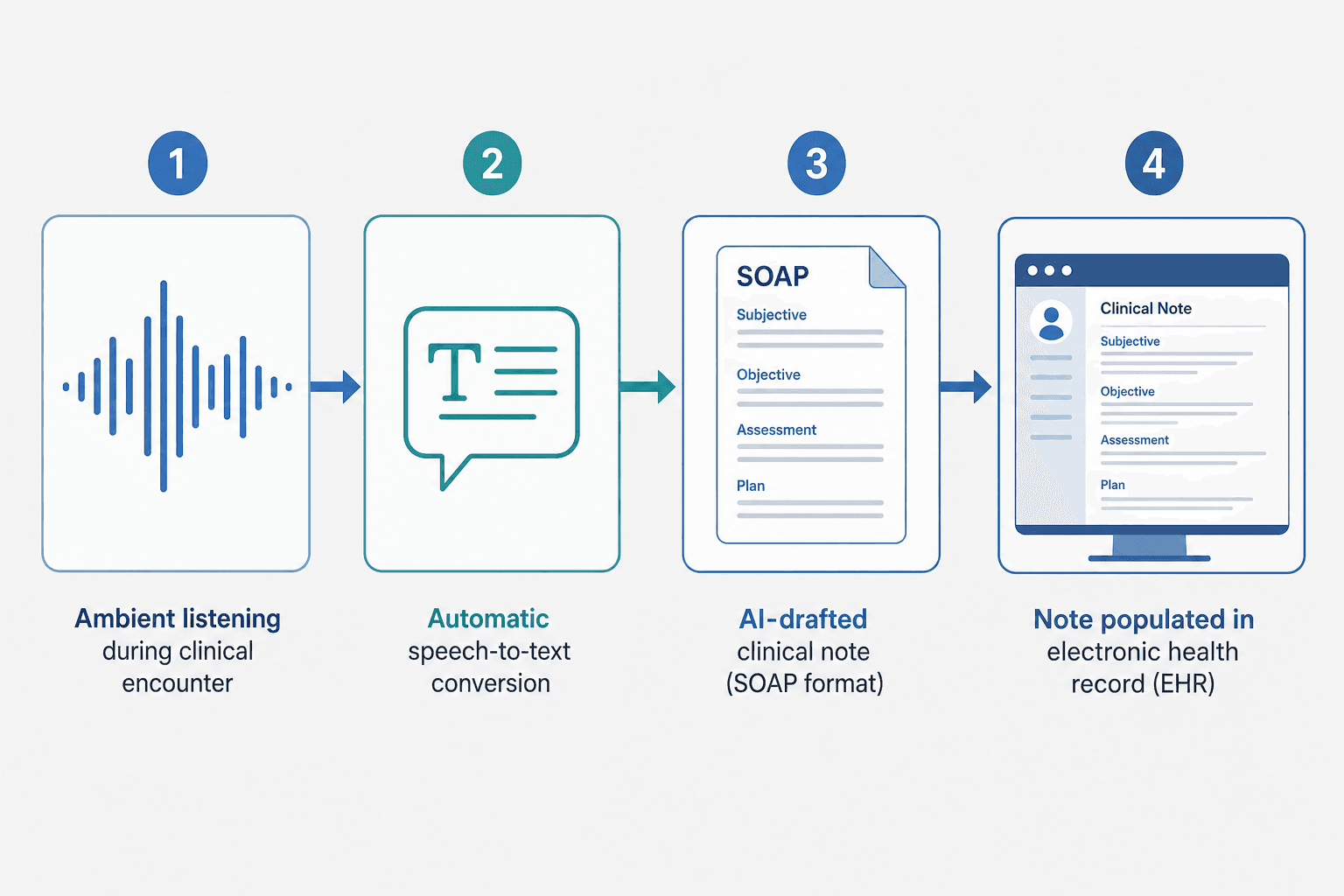
Within Epic EHR environments specifically, three integration models are currently operating:
- Native EHR embedding (Epic AI Charting, launched February 2026). Epic's own ambient documentation feature is embedded directly within the EHR workflow — no separate login, no third-party middleware, no audio transmitted to an external vendor's cloud. The tool draws on the patient's complete longitudinal record in real time while generating documentation and can also queue orders and diagnoses based on encounter content. Epic holds approximately 42% of the acute care hospital EHR market and covers around 55% of hospital beds in the United States, giving this native launch significant structural reach.
- App Orchard-integrated third-party tools. Tools such as Abridge operate as ambient listening layers within Epic via the App Orchard marketplace. At BJC HealthCare and WashU School of Medicine, for example, Abridge uses device microphones to differentiate voices, applies specialty-specific language models, and pushes structured draft notes directly into Epic note templates. The platform supports more than 50 specialties and 28 languages. More than 800,000 notes had been generated across BJC and WashU as of the most recent publicly available figures, with Abridge reporting 85% content retention from draft to final note.
- Overlay tools. Some ambient scribes operate as standalone applications running alongside the EHR rather than embedded within it, requiring manual transfer of generated notes into Epic. This integration model was used in the JMIR 2026 Singapore General Hospital study, and its limitations are discussed in the evidence section below.
Epic AI Charting's structural advantage — direct access to the patient's longitudinal record without third-party middleware — is architecturally significant. It also introduces a different set of trade-offs around vendor lock-in and specialty customization maturity that health systems should evaluate independently. No head-to-head peer-reviewed comparative study of Epic AI Charting versus third-party tools exists as of June 2026; integration model comparisons in this article are descriptive, not evaluative.
FDA and Regulatory Status: Administrative Tool Classification and Its Implications
This classification has practical consequences that clinicians and health IT leaders must understand before deployment. Because ambient scribes are categorized as administrative tools rather than clinical decision-support software, they do not undergo the premarket review process that FDA applies to SaMD. There is no FDA-cleared performance standard for note accuracy, no mandated post-market surveillance requirement, and no regulatory floor for hallucination rates or omission rates.
The practical implication is that the governance burden falls entirely on health systems and individual clinicians. When a clinician signs an AI-generated note, that signature constitutes attestation that the note is accurate and complete. An AI-drafted note containing an error, omission, or hallucination that goes uncorrected before signing creates the same medicolegal exposure as a clinician-authored error.
At the state level, a developing governance layer is emerging alongside the absence of federal SaMD oversight. Texas SB 1188 (Health & Safety Code Ch. 183) establishes EHR storage and access controls and addresses clinical AI in connection with EHR-driven diagnosis or treatment. Texas HB 149 (the Texas Responsible AI Governance Act, or TRAIGA) creates a broader AI governance framework requiring disclosure to patients when AI is used in diagnosis or treatment. These laws are illustrative of a trend toward state-level regulation, but should not be read as finalizing the regulatory picture nationally.
- No ambient AI scribe product holds specific FDA SaMD authorization as of June 2026.
- Administrative tool classification means no FDA-mandated accuracy standards apply to AI-generated note content.
- Clinician sign-off is the legal and clinical accountability mechanism — not a best practice but a requirement.
- HIPAA and Business Associate Agreement requirements apply to all ambient scribe processing of electronic protected health information (ePHI).
- State-level regulation is evolving; health systems operating in multiple states should assess applicable requirements independently.
Peer-Reviewed Deployment Evidence: What the Studies Show
The evidence base for ambient AI scribes has grown substantially in 2025–2026, with several peer-reviewed studies now providing deployment-scale data. The four most directly relevant sources for Epic EHR deployment contexts are summarized below.
JAMA 2026: Five Academic Medical Centers, 1,800 Clinicians
The largest real-world study to date examined ambient scribe use across five academic medical centers, involving approximately 1,800 clinicians using Ambience, DAX Copilot, and/or Abridge alongside Epic. Key findings, confirmed via STAT News reporting and the AHA summary (the full JAMA text, doi: 10.1001/jama.2847319, is paywalled and was not directly accessed for this article):
- 16 minutes of documentation time saved per 8-hour shift.
- 13.4 minutes of total EHR time reduction per shift.
- 0.49 additional patient visits per week among scribe adopters.
- Primary care clinicians and female clinicians showed larger benefits than other subgroups.
- No significant impact on after-hours EHR time was found.
The finding that after-hours EHR time did not decrease significantly is notable: it suggests that ambient scribes primarily reclaim time during the clinical day rather than eliminating the after-hours documentation burden that many clinicians identify as the most cognitively taxing component of their workload.
Vanderbilt JAMIA 2026: Enterprise-Wide Simultaneous Deployment
Wright et al. (JAMIA 2026, doi:10.1093/jamia/ocaf186) examined what happens when a health system deploys ambient scribing to all clinicians at once rather than through a staged rollout. Vanderbilt launched to more than 2,400 clinicians on January 15, 2025. By March 31, 2025 — approximately 10 weeks later:
- 20.1% of visit notes included ambient scribing.
- 1,223 clinicians had used the tool at least once.
- Among 209 survey respondents (22.1% response rate), 90.9% said they would be disappointed to lose access.
- 84.7% of survey respondents reported a positive training experience.
The Vanderbilt study demonstrates that simultaneous enterprise-wide deployment is operationally feasible at academic health system scale while keeping support demands manageable — a finding relevant to health systems weighing phased versus full-deployment strategies. The 22.1% survey response rate is a meaningful limitation for interpreting the satisfaction figures.
JMIR 2026: Time-Motion Study at Singapore General Hospital
Tan et al. (JMIR Medical Informatics 2026;14:e85580, doi:10.2196/85580) conducted a prospective within-clinician time-motion study across 169 consultations at Singapore General Hospital, involving 9 clinicians across 7 specialties between December 2024 and May 2025. Key findings:
- 15% reduction in documentation time per consultation (5.3 minutes to 4.5 minutes; P=.04).
- 10.6% increase in clinician eye contact time (69.6% to 77.1%; P=.009).
- No significant change in total consultation duration or total patient cycle time.
- 69.2% of 39 surveyed patients agreed their physician focused on them more during the encounter.
- No patients expressed discomfort with the ambient technology.
Real-World Health System Metrics
Beyond controlled studies, the AHA's April 2026 summary of health system deployments provides operational context for what ambient scribes are producing at scale. These figures are health system-reported and not from peer-reviewed trials, but they reflect deployment at institutions with the infrastructure and clinical governance to generate meaningful operational data.
- Emory Healthcare: 30.7% increase in documentation-related well-being prevalence.
- Mass General Brigham: 21.2% burnout reduction after 84 days of ambient scribe use.
- Cleveland Clinic: 14 minutes per day reduction in note writing and review time.
- Intermountain Health: 27% reduction in time spent in notes per appointment for clinicians with 10 or more encounters using the tool (April 2024–December 2025 period).
Performance Metrics Summary
| Study / Source | Population | Tool(s) | Primary Metric(s) | Key Limitation(s) |
|---|---|---|---|---|
| JAMA 2026 (doi: 10.1001/jama.2847319) — confirmed via STAT News and AHA summaries | ~1,800 clinicians, 5 academic medical centers, US | Ambience, DAX Copilot, Abridge + Epic | 16 min documentation savings/shift; 13.4 min total EHR time reduction/shift; 0.49 additional visits/week | Paywalled; key metrics confirmed via secondary sources. No significant after-hours EHR time reduction. Heterogeneous tool mix limits tool-specific conclusions. |
| Wright et al., JAMIA 2026 (doi: 10.1093/jamia/ocaf186) | 2,400+ clinicians, Vanderbilt University Medical Center, US | Not specified (enterprise ambient scribe platform) | 20.1% note penetration in 10 weeks; 90.9% of surveyed clinicians would be disappointed to lose access | 22.1% survey response rate limits generalizability of satisfaction data. No objective documentation time metric reported. |
| Tan et al., JMIR Med Inform 2026 (doi: 10.2196/85580) | 9 clinicians, 169 consultations, 7 specialties, Singapore General Hospital | In-house ambient tool (non-EHR-integrated) | 15% documentation time reduction; 10.6% increase in eye contact time; 69.2% of patients reported improved physician focus | Non-EHR-integrated tool with manual note transfer — likely underestimates gains for integrated systems. Small sample (9 clinicians). Single-site, non-US setting. |
| AHA Health System Summary, April 2026 | Multiple US health systems (Emory, MGB, Cleveland Clinic, Intermountain) | Various (Dragon Copilot, ambient platforms) | 14–30.7% improvement range across well-being, burnout, and time metrics depending on health system | Health system-reported operational data; not peer-reviewed. Metrics vary by tool, specialty, and measurement approach. |
Known Limitations: Accuracy Risks, the Burnout Paradox, and Deployment Variability
The evidence base supports cautious optimism about ambient AI documentation — but several failure modes are well-documented enough to constitute governance requirements rather than advisory concerns.
Note Accuracy: Hallucinations, Omissions, and Mandatory Review
Ambient AI scribes generate draft notes, not final notes. Hallucinations — plausible-sounding but inaccurate clinical content — omissions of clinically relevant information discussed during the encounter, and misattributions are documented failure modes across the evidence base. The peer-reviewed literature consistently frames clinician review and sign-off as a mandatory safeguard, not an optional best practice.
The Burnout Paradox: Time Savings Are Not Automatically Burnout Relief
The most consistent finding across studies is documentation time savings in the 15–30% range. The most frequently misread implication is that this translates directly into burnout reduction. It often does not.
Reclaimed documentation time is frequently absorbed by additional patient visits, inbox tasks, or other administrative demands rather than providing cognitive relief. The JAMA 2026 study found that scribe adopters saw approximately 0.49 additional visits per week — a workload expansion that partially offsets the documentation benefit. Organizations that deploy ambient scribes without explicitly protecting reclaimed time from reallocation are likely to see modest burnout impact despite meaningful time savings.
The health systems reporting stronger burnout improvements — such as Mass General Brigham's 21.2% reduction — tend to be those that have paired technology deployment with explicit workload governance decisions. Technology alone does not resolve the structural pressures that produce burnout.
Additional Limitations Health Systems Should Account For
- Individual-level heterogeneity is marked. The JMIR study found 7 of 9 clinicians benefited while 2 did not. Aggregate time savings figures mask substantial variation across clinicians, specialties, and documentation styles. Health systems should not assume uniform benefit.
- Specialty customization maturity varies. CIOs assessing Epic AI Charting ahead of its February 2026 launch noted that early native offerings may not match the specialty-specific language model depth and multi-speaker recognition capabilities of established dedicated vendors in complex specialties such as oncology. This is an empirical question that health systems should assess through piloting rather than assumption.
- The JMIR Singapore study's generalizability is constrained. Its non-EHR-integrated tool, manual note transfer workflow, single-site setting, and non-US clinical environment limit direct applicability to Epic-integrated deployments in US health systems.
- Infrastructure dependencies are non-trivial. Health IT leadership at BJC HealthCare and WashU has explicitly noted that ambient AI is unforgiving when wireless reliability, identity management, and device lifecycle management are not solid. Deployment readiness assessments should include infrastructure audits.
Patient Perspectives, Consent, and Data Governance
Patient acceptance of ambient AI documentation is generally favorable in the studies reviewed. The JMIR 2026 study found that 69.2% of surveyed patients agreed their physician focused on them more during the encounter, and no patients expressed discomfort with the ambient technology in that study's context. The patient experience benefit — clinicians making more eye contact, being more present — is one of the more consistently reported findings across deployment accounts.
However, patient experience in controlled study settings may not fully represent the range of patient responses in broader deployment. Research by Chandrasekaran and Moustakas (JAMIA 2026) documents divided patient attitudes in some contexts: a subset of patients report discomfort with audio recording, self-censorship around sensitive topics, and uncertainty about how their recorded conversations are stored and used. These concerns are not marginal — they reflect structurally unresolved questions about consent and data governance.
Consent practices vary across institutions and states. Some health systems obtain explicit written consent; others rely on posted notice or verbal disclosure. The absence of a federal standard for ambient AI recording consent means health systems are making these decisions independently, with variable patient communication and variable patient understanding of what is being recorded and how it is used.
Equity and Algorithmic Bias: An Underexamined Evidence Gap
The current ambient AI scribe evidence base has a significant gap: equity and algorithmic bias considerations are underexamined relative to their clinical importance.
Leung, Coristine, and Benis (JMIR Medical Informatics 2025;13:e80898) explicitly identify algorithmic bias as a concern requiring attention, alongside limited research on patient perspectives and non-physician clinician workflows. The Tan et al. JMIR 2026 authors similarly flag limited evidence on non-English-speaking populations and performance disparities across demographic subgroups as gaps their study does not address.
The absence of published equity data is not evidence of absence of equity concerns. It reflects a gap in the research agenda that health systems, vendors, and researchers should actively work to close. Deployment planning should include explicit consideration of how ambient scribe performance will be monitored across patient populations and clinical staff demographics.
Deployment and Governance Requirements for Health Systems
Health systems evaluating ambient AI scribe deployment in Epic environments face a set of operational and governance decisions that the evidence base can inform but not resolve. The following requirements reflect both published deployment experience and the structural constraints of the current regulatory environment.
Non-Negotiable Governance Requirements
- Mandatory clinician review before signing. Every AI-generated note must be reviewed and approved by the responsible clinician before entering the medical record. This is not a best practice recommendation — it is the foundational governance requirement given the absence of FDA accuracy standards and the medicolegal implications of signed documentation.
- HIPAA Business Associate Agreements. All ambient scribe vendors processing ePHI require BAAs. This applies to third-party tools integrated via App Orchard as well as any overlay tools. Native Epic AI Charting processes data within the Epic environment, which changes but does not eliminate the data governance analysis.
- Explicit patient consent and disclosure policy. Health systems must establish and communicate a clear policy for how patients are informed about ambient recording, how consent is obtained or documented, and what patients' options are.
- Workload governance alongside deployment. To realize burnout benefits rather than simply workload expansion, organizations must make explicit decisions about how reclaimed documentation time will be protected — whether through schedule adjustments, inbox management policies, or other mechanisms.
Integration Model Trade-Offs
Choosing between Epic AI Charting and a third-party tool integrated via App Orchard involves trade-offs that no peer-reviewed head-to-head study currently resolves. The relevant dimensions include:
- Vendor lock-in versus specialty depth. Native Epic AI Charting eliminates third-party middleware and audio transmission to external clouds, but ties the health system to Epic's development roadmap and update cadence. Third-party tools via App Orchard may offer more mature specialty customization in complex or subspecialty environments, but introduce additional vendor relationships and data flows.
- Security architecture. Epic AI Charting's native architecture means audio is not transmitted to a third-party cloud — a security advantage cited by health system leaders evaluating the tool. Third-party tools transmit audio to vendor infrastructure, requiring careful BAA and data security assessment.
- Cost consolidation. Epic AI Charting pricing has not been publicly disclosed as of June 2026. Health systems should contact Epic account representatives directly for current pricing. Third-party tool pricing varies by vendor and contract structure.
- Piloting before enterprise commitment. CIOs who assessed Epic's entry into the ambient scribe market recommended side-by-side pilots assessing accuracy, provider satisfaction, and data governance in the health system's specific specialty mix before committing to either model. This remains the appropriate approach given the absence of comparative evidence.
Infrastructure Prerequisites
Health IT leadership at institutions with documented deployments has been explicit: ambient AI documentation is unforgiving when underlying infrastructure is not solid. Before enterprise deployment, health systems should assess:
- Wireless network reliability across all clinical environments where the tool will be used.
- Identity and access management systems, particularly for tools requiring clinician-specific authentication.
- Device lifecycle management — the age and microphone quality of clinical workstations and mobile devices affects transcription accuracy.
- IT support capacity for the deployment and ongoing troubleshooting volume.
For readers interested in the broader vendor ecosystem context — including company profiles for Abridge, Nuance/Microsoft (DAX Copilot), and Ambience Healthcare — the site's structured overview of the healthcare AI company landscape provides that framing without the deployment evidence depth covered here.
Discussion
Clinical experience, implementation questions, and workflow observations from clinicians and administrators are welcome.
Comments
Join the discussion with an anonymous comment.