
Company Snapshot
Abridge was founded in March 2018 by Dr. Shivdev Rao (CEO), Sandeep Konam (CTO), and Florian Metze (CSO) at the Pittsburgh Health Data Alliance, a joint initiative of UPMC and Carnegie Mellon University. Rao, a practicing cardiologist, built the company around a specific clinical observation: that the burden of documentation was degrading the quality of patient encounters, and that AI capable of listening passively to clinical conversations could address that problem structurally rather than incrementally.
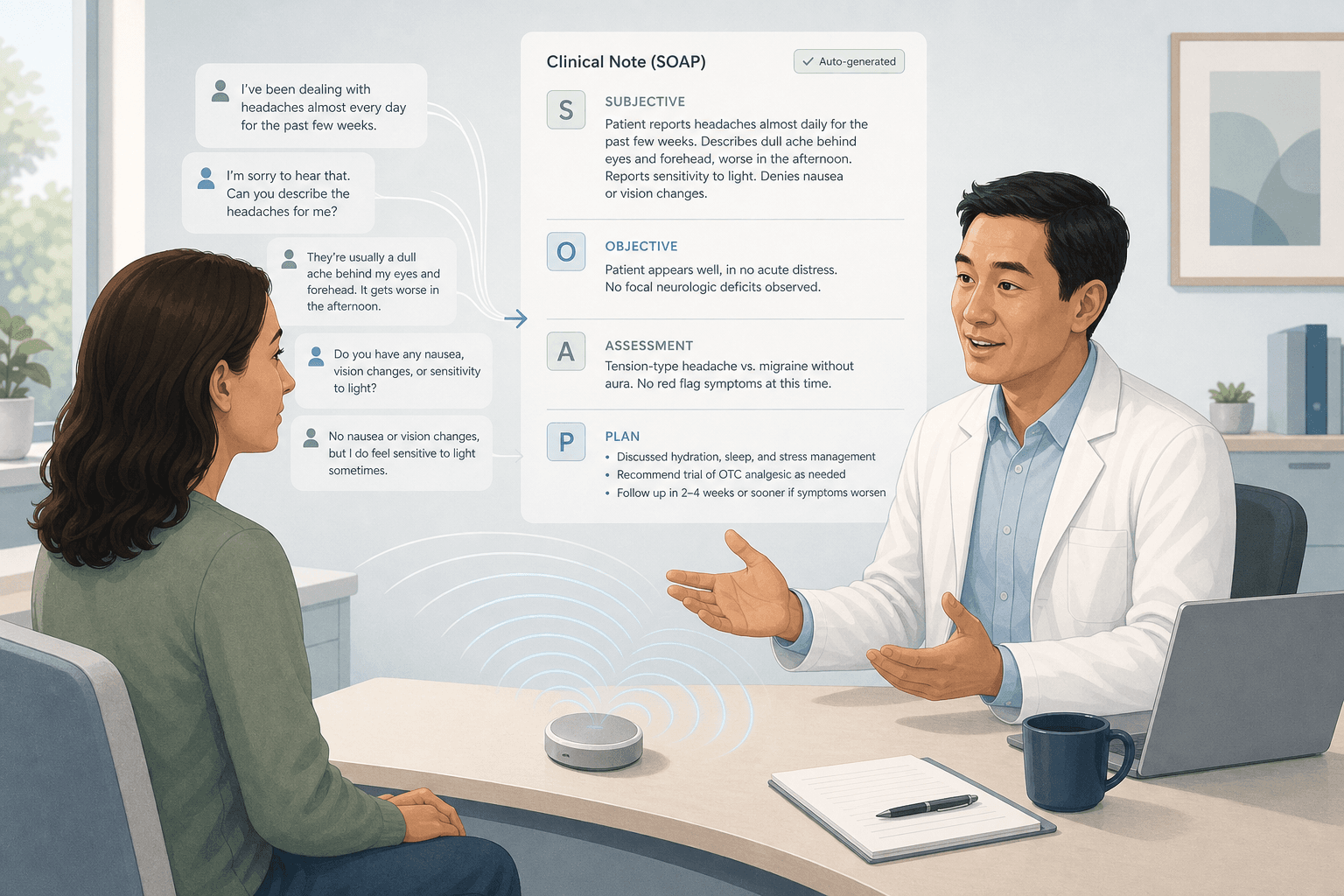
The company is headquartered in Pittsburgh, Pennsylvania, and had approximately 330 employees as of mid-2025. Its primary focus is ambient AI documentation — software that listens to clinician-patient conversations and automatically generates structured clinical notes — with an expanding footprint in revenue cycle management, prior authorization, and clinical decision support.
| Field | Detail |
|---|---|
| Founded | March 2018 |
| Founders | Dr. Shivdev Rao (CEO), Sandeep Konam (CTO), Florian Metze (CSO) |
| Origin | Pittsburgh Health Data Alliance (UPMC / Carnegie Mellon University) |
| Headquarters | Pittsburgh, Pennsylvania |
| Employees (approx.) | ~330 as of mid-2025 |
| Primary Focus | Ambient AI documentation; revenue cycle AI; clinical decision support (expanding) |
| Company Stage | Private |
Funding History and Valuation
Abridge has raised approximately $757 million in total disclosed funding across multiple rounds, with its valuation growing from $850 million after a $150 million Series C in 2024 to $5.3 billion following a $300 million Series E led by Andreessen Horowitz (a16z) in June 2025. A subsequent Series E extension of $316 million was reported by Sacra in April 2026, though this figure has not been confirmed by a primary Abridge press release as of this profile's publication date.
UPMC Enterprises was an original investor in 2018. Later-stage investors include Khosla Ventures, IVP, Bessemer Venture Partners, CapitalG (Alphabet's growth fund), NVentures (NVIDIA's venture arm), Lightspeed Venture Partners, and CVS Health Ventures. The investor roster reflects both financial and strategic interest: NVIDIA and Alphabet have AI infrastructure stakes, while CVS Health Ventures signals interest in payer-side workflow integration.
| Round | Amount | Valuation | Date | Lead Investor(s) |
|---|---|---|---|---|
| Series C | $150M | $850M post-money | 2024 | Not publicly disclosed |
| Series D | $250M | $2.75B post-money | February 2025 | Elad Gil, IVP |
| Series E | $300M | $5.3B post-money | June 2025 | Andreessen Horowitz (a16z), Khosla Ventures |
| Series E Extension | $316M | Not disclosed | April 2026 (Sacra) | Not publicly disclosed |
Sacra estimates Abridge reached $100 million in annual recurring revenue (ARR) in May 2025, up from approximately $60 million at end of 2024, with contracted ARR reaching $117 million in Q1 2025. These are third-party estimates from a private market research firm, not disclosed by Abridge directly. The company's revenue model centers on enterprise subscription licenses priced at approximately $2,500 per clinician per year, with health system pricing negotiated case-by-case.
Product Architecture
Abridge's platform has three primary components: an automatic speech recognition (ASR) layer the company calls "Ears," a note generation pipeline that converts transcribed conversation into structured clinical documentation, and a suite of downstream modules for revenue cycle and clinical decision support.
The Ears ASR system is trained on medical conversations and achieves a self-reported word error rate (WER) of 12.7% on internal medical conversation benchmarks, compared to 16.6% for Google Medical Conversations and 17.1% for AWS Transcribe Medical — a 16% relative reduction versus Google's model. Medical term recall is reported at 97.0%. On a challenge dataset of newly approved medication names, Abridge reports an 83% relative reduction in errors compared to Google Medical Conversations. Spanish WER is reported at 3.1%, lower than English (6.2% on the FLEURS benchmark).
The note generation pipeline produces SOAP-formatted notes and supports more than 50 medical specialties and 28 languages. A feature called Linked Evidence surfaces the specific portions of the recorded conversation that support each claim in the generated note, allowing clinicians to verify documentation accuracy against the source audio. This is intended to address the hallucination risk inherent in large language model-generated text.
Abridge also describes a confabulation elimination framework, detailed in an August 2025 company whitepaper, that uses a proprietary task-specific AI model trained on more than 50,000 examples to detect unsupported claims in generated notes. The company reports this system catches 97% of confabulated content on an internal benchmark of more than 10,000 clinical encounters, compared to 82% for GPT-4o. The whitepaper is not a peer-reviewed publication, and these figures have not been independently validated.
The Contextual Reasoning Engine extends the platform into revenue cycle management, supporting CMS-HCC Version 28 risk adjustment models and ICD-10 coding with MEAT criteria documentation at the point of care. EHR integration is delivered primarily through the Epic Pal program, discussed in detail in the partnership section below, as well as direct integrations with other EHR systems.
- "Ears" ASR system: 12.7% self-reported WER on medical conversations (internal benchmark, not independently validated)
- SOAP-format note generation with Linked Evidence for source verification
- Confabulation elimination framework: 97% self-reported detection rate on internal benchmarks (company whitepaper, not peer-reviewed)
- Contextual Reasoning Engine for CMS-HCC Version 28 and ICD-10 revenue cycle coding
- 28+ language support; 50+ medical specialties
- EHR integration via Epic Pal program and direct API pathways
Deployment Scale and Customer Base
As of February 2026, Abridge reported deployment across more than 250 health systems, with the platform projected to support more than 80 million clinician-patient conversations in 2026. The company's enterprise customer base includes some of the largest health systems in the United States.
| Health System | Scale / Notes |
|---|---|
| UPMC | 12,000+ clinicians across 40+ hospitals and 800+ outpatient sites by 2026; original investor (2018) |
| Kaiser Permanente | 24,600 physicians |
| Mayo Clinic | 2,000+ clinicians; also an Abridge research partner |
| Johns Hopkins Medicine | Enterprise-wide implementation announced early 2025 |
| Duke Health | Enterprise-wide implementation announced early 2025 |
| Sutter Health | Abridge customer; site of Stults et al. 2025 peer-reviewed study |
| Memorial Sloan Kettering Cancer Center | Announced February 2025 |
| Emory Healthcare | 3,450+ clinicians; first enterprise agreement under Epic Pal program (2023) |
| Akron Children's Hospital | Announced February 2025 |
| Oak Street Health | Announced February 2025 |
Abridge received the KLAS Best-in-KLAS designation for Ambient AI in Revenue Cycle Management in both 2025 and 2026, earning A+ ratings across Culture, Loyalty, Relationship, and Value categories. KLAS ratings are derived from structured customer satisfaction interviews with health system decision-makers. They reflect customer experience and perceived value, not clinical outcomes, independent safety review, or a clinical evidence standard. The recognition is relevant as a procurement signal, not as a substitute for clinical evidence evaluation.
Epic Partnership and EHR Integration
In August 2023, Abridge became the first company accepted into Epic's Partners and Pals (Pal) program, a designation that provides preferential technical integration into Epic's EHR workflows. Epic is used by approximately 42% of US hospitals, making this partnership a significant go-to-market advantage: health systems already on Epic can deploy Abridge within as few as two weeks of implementation, with full auditability inside existing clinical workflows.
According to Sacra, the arrangement involved Abridge granting Epic both an equity stake and an ongoing revenue share in exchange for this preferential access. The commercial terms have not been independently confirmed by Abridge or Epic in public disclosures. The strategic implication is two-sided: the partnership accelerates Abridge's penetration into the Epic-installed base, but it also constrains Abridge's ability to compete directly against Epic's own products or disrupt Epic's EHR ecosystem.
Clinical Evidence: What Peer-Reviewed Studies Show
The peer-reviewed evidence base for Abridge specifically — as distinct from vendor-reported outcomes — consists of a small number of published studies, all with material methodological limitations that must be understood before drawing conclusions about clinical effectiveness. Vendor-reported figures (such as "60–70% burnout reduction" cited in Abridge's Series E announcement) are aggregate case study claims, not peer-reviewed findings, and should not be treated as equivalent to published research.
Olson et al., JAMA Network Open (October 2025)
This multicenter quality improvement study examined 263 ambulatory clinicians across six US health systems using the Abridge platform from February through October 2024. The primary finding was a statistically significant reduction in burnout: from 51.9% to 38.8% after 30 days of use (adjusted odds ratio 0.26, 95% CI 0.13–0.54, p<0.001). Secondary outcomes included a 2.64-point improvement in note-related cognitive task load on a 10-point scale (p<0.001), a 0.90 hour per week reduction in after-hours documentation time (p<0.001), and a 2.05-point improvement in ability to give undivided attention to patients (p<0.001).
Stults et al., JAMA Network Open (2025)
This study examined 57 clinicians at Sutter Health using Abridge. Documentation time decreased from 6.2 to 5.3 minutes per encounter (p<0.001), and clinician full attentiveness during patient encounters increased from 57.9% to 93.0% (p<0.001). However, burnout reduction was not statistically significant: burnout rates moved from 42.1% to 35.1% (p=0.12). The study also documented note bloat — a significant increase in total note length — which the authors identified as an implementation concern alongside the time savings.
Razaghi et al., Mayo Clinic Narrative Review (February 2026)
A narrative review published in Cardiovascular Diagnosis and Therapy (PMC12973079) by authors from Mayo Clinic Cardiovascular Medicine synthesized 18 studies on ambient AI scribes, including the Stults et al. Abridge study. The review documents that 70% of AI-generated ambient scribe notes contained at least one error in simulated settings, predominantly omissions, based on Biro et al. Primary care clinicians reported the highest satisfaction with ambient AI tools (85%), compared to medical subspecialties (36.4%) and surgical subspecialties (50%). The review cautions that benefits are not uniform across specialties and that cautious interpretation of aggregate findings is warranted.
| Study | Design | N | Key Findings | Limitations |
|---|---|---|---|---|
| Olson et al., JAMA Network Open (Oct 2025) | Multicenter quality improvement study | 263 clinicians, 6 health systems | Burnout: 51.9%→38.8% (OR 0.26, p<0.001); after-hours documentation −0.90 hrs/week (p<0.001) | 2 Abridge employees as co-authors; Abridge facilitated data collection; no control group; voluntary participation bias |
| Stults et al., JAMA Network Open (2025) | Single-site observational | 57 clinicians, Sutter Health | Documentation time 6.2→5.3 min (p<0.001); attentiveness 57.9%→93.0% (p<0.001); burnout reduction non-significant (p=0.12); note bloat documented | Sutter Health is an Abridge customer; small sample; no control group |
| Razaghi et al., Mayo Clinic narrative review (Feb 2026) | Narrative review, 18 studies | Multiple studies synthesized | 70% of AI-generated notes contained ≥1 error (Biro et al., simulated, not Abridge-specific); primary care satisfaction 85% vs subspecialties 36.4% | All authors from Mayo Clinic (Abridge customer); 70% error figure is category-level, not Abridge-specific |

Regulatory and FDA Status
Abridge does not hold FDA clearance, de novo authorization, or premarket approval for any of its products. This is not unique to Abridge: as of early 2026, none of the approximately 126 ambient AI scribe products on the market had received FDA authorization. The FDA's list of more than 1,000 AI/ML-enabled medical devices includes no ambient documentation scribes.
The reason ambient scribes operate without FDA clearance is that they are currently classified as administrative documentation tools rather than medical devices under FDA's Software as a Medical Device (SaMD) framework. Administrative tools that do not make or inform clinical decisions about individual patients fall outside the scope of FDA premarket review. This classification means no independent agency has reviewed Abridge's safety, efficacy, or accuracy claims before deployment in clinical settings.
CEO Shiv Rao has publicly acknowledged that as Abridge moves into higher-stakes workflows, increased regulatory responsibility will follow. In a Business Insider interview (August 2025), Rao stated the company will need to be "really, really responsible" as it enters domains with greater patient outcome implications. This statement is notable because it implicitly acknowledges the current regulatory gap and the likelihood that future product expansions will require more rigorous oversight.
A class action lawsuit has been filed against Sutter Health and Sharp, alleging that patients were recorded without proper consent through the use of Abridge's platform. The lawsuit's allegations remain unproven as of this profile's publication date, and its current legal status should be verified before publication. The case is significant as a governance precedent: it highlights the consent and patient notification gaps that can arise when ambient audio capture tools are deployed without robust patient disclosure frameworks. Health systems deploying ambient AI tools should review their consent processes against applicable state and federal law.
Competitive Landscape
The ambient AI documentation market has grown rapidly since 2023, with more than 126 products reported on the market as of early 2026. Abridge holds a leading position by deployment scale and funding, but faces competition from both established health IT vendors with EHR integration advantages and well-funded independent ambient AI companies. For a broader view of the ambient AI documentation market and other healthcare AI company categories, the site's structured landscape overview of active healthcare AI developers provides multi-company context.
| Competitor | Key Differentiator | Strategic Position vs. Abridge |
|---|---|---|
| Epic Art for Clinicians | Native EHR integration; powered by Nuance Dragon Copilot and Epic Cosmos dataset; launched 2025 | Most significant structural threat: EHR-native product eliminates the integration advantage that defines Abridge's go-to-market; available to all Epic customers without a separate vendor relationship |
| Nuance Dragon Copilot (Microsoft) | Established ASR heritage; Microsoft cloud infrastructure; powers Epic Art for Clinicians | Competes directly in ambient documentation; also the engine behind Abridge's primary EHR-native competitor |
| Ambience Healthcare | $243M Series C (July 2025); multispecialty focus | Well-funded independent competitor; similar enterprise target market |
| Suki | $70M Series D; voice AI for clinical documentation | Smaller scale but established customer base; competing for the same enterprise health system buyers |
| DeepScribe | Specialty-focused ambient documentation | Competes in overlapping specialties; smaller deployment scale |
| Nabla | European-origin ambient AI; expanding US presence | Geographic and enterprise market overlap |
The most structurally significant competitive risk is EHR-native commoditization. Epic's Art for Clinicians, embedded directly in the EHR used by approximately 42% of US hospitals, eliminates the friction that a third-party integration like Abridge must overcome. Health systems already on Epic may find that an EHR-native ambient tool meets their documentation needs without a separate vendor contract, data governance framework, or integration project. This dynamic is distinct from competition between independent ambient AI vendors and represents a structural pressure on Abridge's market position.
Known Risks and Open Questions
The following risks and open questions are relevant to health systems evaluating Abridge for clinical deployment, procurement teams assessing governance requirements, and policy professionals tracking non-FDA-cleared AI tools in clinical settings. These are framed as evaluation considerations, not conclusions about Abridge specifically. For broader context on how ambient AI tools are deployed in practice and the governance considerations that accompany real-world implementation, see the site's coverage of how clinical AI deployments actually work.
- EHR-native commoditization: Epic Art for Clinicians, launched in 2025 and powered by Nuance Dragon Copilot and Cosmos data, offers ambient documentation natively inside Epic EHR. Health systems on Epic may find this eliminates the need for a third-party ambient AI vendor.
- Documentation error rates: Simulated studies of ambient AI scribes (Biro et al., as synthesized in the Mayo Clinic 2026 review) found that 70% of AI-generated notes contained at least one error, predominantly omissions. This is a category-level finding, not specific to Abridge, but it indicates that sustained clinician review of AI-generated notes is necessary regardless of platform.
- Note bloat paradox: The Stults et al. 2025 study documented significant increases in total note length alongside time savings. Longer notes may increase downstream review burden for billing teams, reduce clinical readability, and complicate audit processes.
- Absence of FDA clearance: No ambient AI scribe has undergone FDA premarket review. The administrative tool classification means no independent agency has validated accuracy, safety, or efficacy claims. This may change as the category expands into clinical decision support and prior authorization.
- Consent and patient notification governance: The alleged class action lawsuit against Sutter Health and Sharp highlights the governance gap in ambient audio capture consent practices. Health systems must establish clear patient notification and consent frameworks before deployment, accounting for state-specific recording consent laws.
- HIPAA compliance cost pressures: Proposed HHS Security Rule updates in 2025 would increase compliance costs for AI tools that process protected health information. Health systems should assess how these requirements affect ambient AI vendor contracts and data governance frameworks.
- Multilingual performance equity gaps: Abridge supports 28+ languages, but self-reported WER figures vary by language (Spanish 3.1%, English 6.2% on FLEURS). Performance disparities across languages and dialects have direct health equity implications for patient populations whose primary language is not English.
- Expansion into higher-stakes workflows: Abridge's stated expansion into revenue cycle coding, prior authorization, and clinical decision support moves the product closer to functions that influence clinical decisions. These expansions may trigger FDA scrutiny and will require health systems to revisit their governance frameworks for the tool.
Expansion Trajectory
Abridge has publicly described a strategic expansion beyond core ambient documentation into four adjacent domains: revenue cycle management, real-time prior authorization, clinical decision support, and inpatient and nursing workflows.
The Contextual Reasoning Engine, already deployed for revenue cycle management, supports CMS-HCC Version 28 risk adjustment and ICD-10 coding at the point of care. Abridge received Best-in-KLAS recognition specifically in the Ambient AI in Revenue Cycle Management category for 2025 and 2026, indicating that health system customers view this capability as differentiated from documentation-only tools.
A real-time prior authorization capability was developed in partnership with Highmark, a major regional health plan. Partnerships with the New England Journal of Medicine and JAMA, announced in April 2026, signal an expansion into clinical decision support — integrating clinical evidence resources into the documentation workflow at the point of care.
CEO Shiv Rao has stated that approximately 20% of the company's capital is earmarked for acquisitions, focused primarily on talent and data rather than product acquisition. Abridge had approximately 330 employees as of mid-2025 and was competing with OpenAI and Anthropic for AI research talent, according to Business Insider.
- Revenue cycle management: Contextual Reasoning Engine for CMS-HCC Version 28 and ICD-10 coding; KLAS Best-in-KLAS recognition 2025 and 2026
- Real-time prior authorization: Partnership with Highmark for point-of-care prior authorization support
- Clinical decision support: NEJM and JAMA partnerships announced April 2026 to integrate clinical evidence at the point of care
- Inpatient and nursing workflows: Platform expanding beyond ambulatory settings into hospital inpatient and nursing documentation
- Acquisitions: ~20% of capital earmarked for acquisitions focused on talent and data (CEO statement, August 2025)
Feedback & Corrections
Corrections, deployment experience notes, and questions from clinicians and procurement professionals are welcome. For formal corrections, use the contact page.
Comments
Join the discussion with an anonymous comment.