
 Cohere Unify (Cohere Health); AltitudeAI / Auth Accelerate (Waystar)
Regulatory and Market Context
Prior authorization remains one of the most resource-intensive administrative processes in U.S. healthcare. The American Medical Association has documented that more than 90% of physicians report PA delays patient care, and the average physician practice spends approximately 13 hours per week managing prior authorization requests. That burden is distributed across clinical staff, administrative teams, and the technology systems that connect them.
The regulatory environment shifted materially in January 2024 when CMS published the CMS-0057-F Interoperability and Prior Authorization Final Rule. The rule applies to Medicare Advantage organizations, state Medicaid and CHIP fee-for-service programs, Medicaid managed care plans, CHIP managed care entities, and qualified health plan issuers on federally facilitated exchanges. Its compliance timeline runs in two phases: operational provisions — including specific denial reasons, 72-hour urgent and 7-day standard PA decision timeframes, and public PA metrics reporting — became effective January 1, 2026. Full FHIR Prior Authorization API implementation is required by January 1, 2027.
This compliance pressure has accelerated vendor adoption in a market that commercial analysts estimate at approximately $1.74 billion in 2026, projected to reach $4.21 billion by 2031 at a 19.38% compound annual growth rate. These figures come from Mordor Intelligence's AI-based prior authorization market report (updated June 2026) and should be treated as analyst estimates with proprietary methodology, not independently verified figures. Healthcare payers held approximately 49.64% of revenue in 2025; providers are projected as the fastest-growing segment at a 20.36% CAGR through 2031. CMS-0057-F is identified in that report as the strongest near-term market driver.
The academic literature has begun to examine the governance dimensions of this growth. A peer-reviewed policy analysis by Mello, Trotsyuk, Djiberou Mahamadou, and Char (Stanford University), published in Health Affairs Vol. 45, No. 1 (January 2026), frames the deployment of AI in utilization review as a potential 'arms race' between payer-side and provider-side systems. The authors formally classify Cohere Health's clinical intelligence product as an insurer-facing predictive AI tool and Waystar's Authorization Manager and Altitude Create as provider-facing tools, placing both companies within their taxonomy of AI UR platforms. Their analysis notes that the National Association of Insurance Commissioners' 2024 survey found 37% of insurers using AI for prior authorization and 56% for utilization management broadly.
Cohere Health: Company Profile
Cohere Health was co-founded around 2019–2020 by Siva Namasivayam and is headquartered in Boston. The company's commercial focus is exclusively on the payer side of the prior authorization transaction: it sells its Cohere Unify clinical intelligence platform to health plans and managed care organizations seeking to transform their utilization management operations.
Funding and Corporate Milestones
Cohere has raised approximately $200 million in total disclosed funding across multiple rounds. Key milestones include a $36 million Series B in April 2021 led by Polaris Partners, a $50 million equity raise in February 2024 from Deerfield Management, and a $90 million Series C in May 2025 led by Temasek. The company remains privately held.
- October 2020: Humana MSK partnership — an early pilot deployment that established Cohere's clinical evidence base in musculoskeletal utilization management.
- July 2022: Geisinger Health Plan deployment reported, subsequently cited in vendor case study materials as yielding a 15% reduction in medical expenses and a 63% reduction in denial rates. These are vendor-reported figures from case study materials, not independently peer-reviewed outcomes.
- May 2022: KLAS Points of Light Award for the Humana MSK program.
- January 2025: Cohere Connect launched, reporting 15 million+ PA submissions via FHIR APIs.
- March 2025: Cohere Align launched, with vendor-reported metrics of 80% of submissions streamlined for high-trust providers and 98% provider satisfaction.
- September 2025: ZignaAI acquisition, extending Cohere into payment integrity.
- January 2026: Company reported record 2025 growth including 10 new health plan deals closed, Deloitte Fast 500 ranking at #218, TIME World's Top HealthTech recognition, and HLTH 2025 Best in Class AI award.
- May 2025: $90 million Series C closed, led by Temasek.
Cohere Unify Platform: Architecture and Stated Performance
The Cohere Unify platform is organized around three deployment models — in-house utilization management, delegated UM, and API-based compliance — each targeting a different operational relationship between Cohere and the health plan client. Across all deployment models, the company reports 85% of prior authorizations approved in real time, 70% faster care access, 47% administrative cost reduction, and 94% provider satisfaction across a network of 660,000+ clinicians. All of these figures are vendor-reported from press release and case study materials and have not been independently validated in peer-reviewed clinical research.
Cohere Health Product Suite: Cohere Unify Platform Components
The Cohere Unify platform comprises seven named product components, each targeting a distinct stage of the utilization management and payment integrity workflow. The following table summarizes each component's stated function and vendor-reported metrics.
| Product | Primary Function | Vendor-Reported Metrics |
|---|---|---|
| Cohere Connect | FHIR-based API layer for PA submission and compliance (CRD, DTR, PAS APIs) | 9M+ FHIR-based authorizations; 15M+ total PA submissions; 4,000+ policies supported |
| Cohere Align | High-trust provider pathway streamlining PA submissions for qualified clinicians | 80% of submissions streamlined; 98% provider satisfaction |
| Cohere Review Assist | AI-assisted acute inpatient utilization management and authorization completion | 50% faster inpatient UM completion (vendor-reported) |
| Cohere Policy Studio | Clinical policy configuration and management for health plan UM teams | Not separately quantified in available public materials |
| Cohere Validate | Payment integrity module targeting overpayment prevention via authorization matching | Up to $96 PMPY savings in year one; 14% hit rate improvement; 8–9x ROI (vendor-reported) |
| Cohere Complete | End-to-end authorization workflow management | Not separately quantified in available public materials |
| Cohere Match | 8-point authorization matching criteria for overpayment prevention | Positioned as a payment integrity tool post-ZignaAI acquisition |
The ZignaAI acquisition in September 2025 extended Cohere's platform into payment integrity, adding capabilities that complement the core UM workflow. Cohere Validate and Cohere Match represent the post-acquisition payment integrity layer, targeting overpayment detection and authorization-to-claim matching.
On the clinical oversight question, Cohere has stated publicly that no claim is denied exclusively by AI — every decision is overseen by a specialist. This design choice is relevant to the governance concerns documented in the Health Affairs analysis, discussed in the evidence quality section below.
Waystar: Company Profile
Waystar (Nasdaq: WAY) is a publicly traded revenue cycle management software company. Unlike Cohere Health, which sells exclusively to health plans, Waystar sells to providers and health systems — hospitals, physician groups, and outpatient networks that need to navigate the payer-side authorization and claims environment. The company's scale distinguishes it as one of the largest RCM platforms in the U.S. market.
Scale and Market Position
As of early 2026, per Waystar's investor and press materials, the platform serves more than 30,000 clients representing over 1 million distinct providers. It processes more than 7.5 billion healthcare payment transactions annually, representing approximately $2.4 trillion in gross claim charges. The network covers roughly 60% of U.S. patients and processes data from one in three U.S. hospital discharges. These figures reflect the January 2026 and Q1 2026 reporting period; earlier press materials from February 2025 cited 6 billion transactions and $1.8 trillion in gross claims, indicating material growth over the intervening period.
AltitudeAI Platform and Authorization Automation Timeline
- January 2025: Waystar launched AltitudeAI, described as the industry's first generative AI platform for denial prevention and recovery in the RCM context.
- February 2025: Auth Accelerate launched, targeting end-to-end automation of the authorization submission process. Vendor-reported metrics at launch: 70% reduction in submission time, 75% reduction in payer approval wait time, 85% auto-approval rate. Prisma Health (South Carolina's largest healthcare organization, serving 1.6M+ patients annually) was among the first implementations.
- January 2026: Waystar introduced agentic AI capabilities at the J.P. Morgan Healthcare Conference, framing the milestone as an initial step toward the 'autonomous revenue cycle.' AltitudeAI was reported to have prevented $15.5 billion in claim denials in under one year since launch.
- March 2026: Expanded Google Cloud Gemini partnership announced, targeting hyperscale deployment of agentic AI across complex revenue cycle workflows and a 'self-learning revenue cycle' flywheel.
- Q1 2026 Earnings: Revenue of $313.9 million, up 22% year-over-year; adjusted EBITDA of $135.4 million; non-GAAP EPS of $0.42, beating analyst estimates of $0.39. AI-powered solutions represent approximately 50% of offerings and approximately 40% of new bookings.
Iodine Software Acquisition
Waystar acquired Iodine Software for a reported $1.25 billion, extending the platform into clinical mid-cycle AI — the point in the revenue cycle where clinical documentation integrity, coding accuracy, and denial prevention intersect. Per Q1 2026 earnings reporting, the Iodine integration is described as 'running ahead of plan.' Iodine's clinical intelligence capabilities are positioned to prevent denials upstream by improving documentation quality before claims are submitted. Readers should verify the acquisition price against Waystar's SEC filings for precise accuracy; the $1.25 billion figure is sourced from Fierce Healthcare reporting.
Waystar Product Suite: AltitudeAI and Authorization Automation
| Product / Capability | Primary Function | Vendor-Reported Metrics |
|---|---|---|
| Authorization Manager (AltitudeAI-powered) | Rules-engine-based authorization requirement determination and submission across 35+ service lines | 44M+ authorization transactions annually; real-time EHR/HIS/PM order analysis; clinical documentation attachment |
| Auth Accelerate | End-to-end automation of PA submission process for providers | 70% submission time reduction; 75% payer wait time reduction; 85% auto-approval rate (vendor-reported) |
| AltitudeAI — Denial Prevention and Recovery | Generative AI for identifying denial risk upstream and automating appeal workflows | $15.5B in prevented denials in under one year (vendor-reported); 95% time savings on denial appeal and recovery |
| Agentic AI (January 2026 milestone) | Autonomous multi-step task execution across revenue cycle workflows with minimal human intervention | ~40% reduction in manual correction workload for clinical documentation integrity (vendor-reported, early results) |
| Iodine Software (acquired) | Clinical mid-cycle AI for documentation integrity, coding accuracy, and denial prevention | Integration ahead of plan per Q1 2026 earnings; specific combined metrics not yet publicly reported |
| Atlantic Health System case study (2024) | Deployment outcome metrics from a documented health system implementation | 50%+ reduction in authorization initiation time; <2% cancellation rate due to denied/delayed auths; 8-day increase in average lead time; 97% DAR clearance rate; provider NPS 74+ |
Waystar's stated strategic direction centers on what CEO Matt Hawkins has described as 'software that can manage the full life cycle of a medical claim — from prior authorization through appeals — with minimal human involvement.' The agentic AI roadmap targets the approximately $100 billion in annual RCM labor services performed across the U.S. healthcare industry. The Google Cloud Gemini partnership expansion is framed as enabling hyperscale deployment of this agentic architecture across Waystar's existing provider network.
Structured Comparison: Cohere Health vs. Waystar
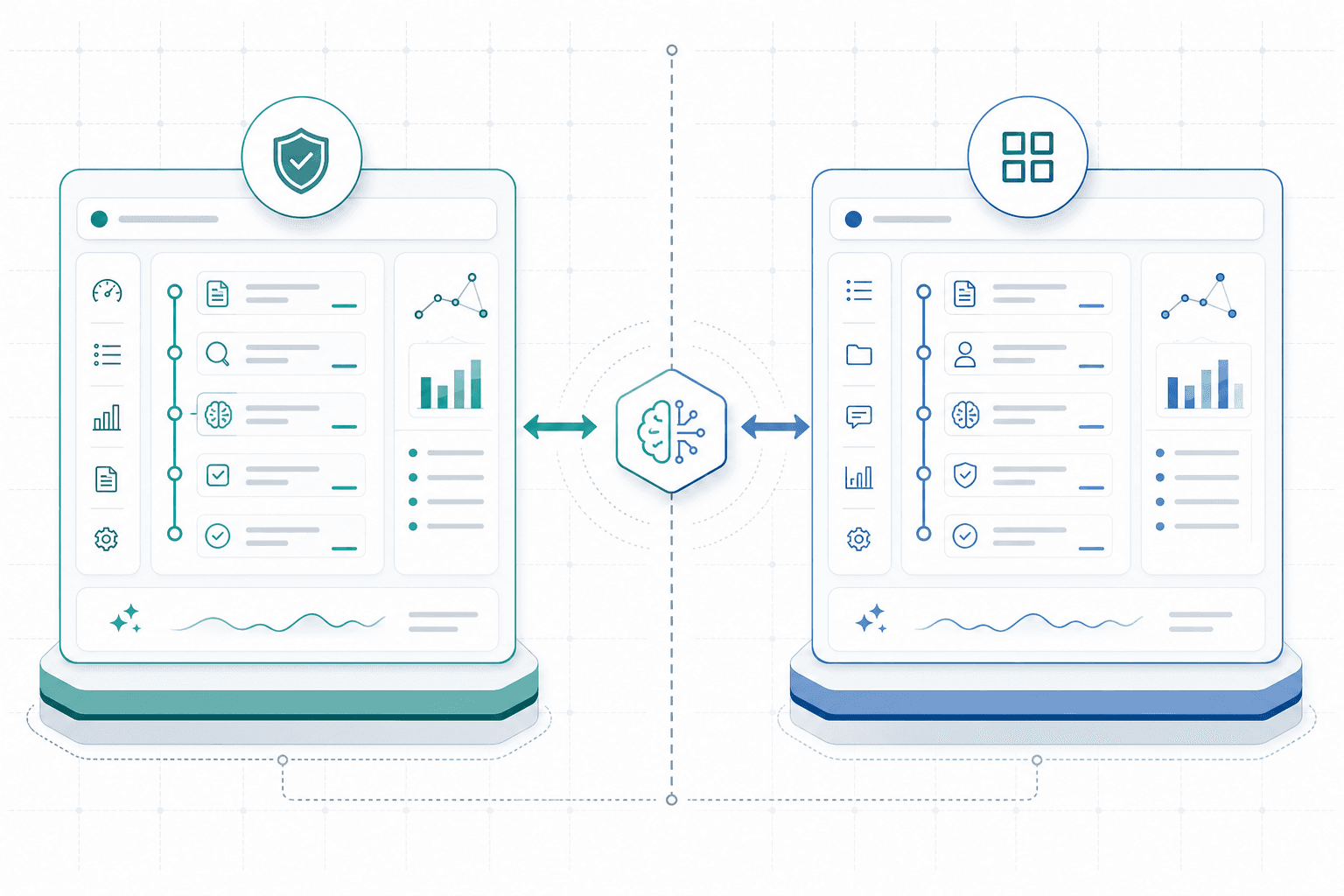
Cohere Health and Waystar are frequently mentioned in the same context — both operate in prior authorization automation, both claim CMS-0057-F compliance readiness, and both use AI to reduce administrative burden. However, they serve structurally different buyers and operate at different points in the same transaction. A procurement team evaluating one is unlikely to be choosing between them; they are more often deployed simultaneously on opposite sides of the same PA event.
| Dimension | Cohere Health | Waystar |
|---|---|---|
| Primary Buyer | Health plans, payers, managed care organizations | Providers, hospitals, health systems, physician groups |
| Platform Role in PA Transaction | Payer-side: manages incoming authorization requests, applies clinical criteria, routes decisions | Provider-side: submits authorization requests, tracks status, automates appeals |
| Primary AI Approach | Clinical intelligence, NLP-based criteria application, predictive approval routing, FHIR API compliance | Generative AI (AltitudeAI), rules engine, agentic task automation, mid-cycle clinical documentation AI (Iodine) |
| Platform Scope | Utilization management transformation, payment integrity (post-ZignaAI) | End-to-end revenue cycle management — financial clearance through denial recovery |
| Scale Metrics | 660,000+ clinicians in network; 15M+ PA submissions; 9M+ FHIR-based authorizations | 30,000+ clients; 1M+ providers; 7.5B+ annual transactions; $2.4T gross claims; ~60% U.S. patients |
| Company Stage | Private; ~$200M total raised; Series C (May 2025, Temasek) | Public (Nasdaq: WAY); Q1 2026 revenue $313.9M (+22% YoY) |
| CMS-0057-F Compliance Posture | Core commercial differentiator; FHIR CRD/DTR/PAS APIs central to Connect product | Core commercial differentiator; FHIR integration embedded in Auth Accelerate and Authorization Manager |
| EHR Integration Approach | API-based integration with health plan and provider EHR systems for clinical data exchange | Deep EHR/HIS/PM integration for real-time order analysis and documentation attachment |
| FDA Regulatory Status | Not FDA-cleared; administrative/operational software subject to CMS rules | Not FDA-cleared; administrative/operational software subject to CMS rules |
| Evidence Tier | Vendor case studies and press releases; no independent peer-reviewed RCTs on PA automation outcomes | Vendor press releases, earnings reports, and one documented health system case study (Atlantic Health); no independent peer-reviewed RCTs |
Evidence Quality, Limitations, and Governance Concerns
The performance metrics cited throughout both company profiles above share a common provenance: they originate from vendor press releases, investor materials, earnings calls, and case studies produced or commissioned by the companies themselves. No independent randomized controlled trials evaluating PA automation outcomes for either Cohere Health or Waystar are publicly available as of Q2 2026.
This is not a minor caveat. The peer-reviewed policy analysis by Mello and colleagues, published in Health Affairs Vol. 45, No. 1 (January 2026, DOI: 10.1377/hlthaff.2025.00897), addresses this directly. The authors examined the deployment of AI in utilization review across the U.S. market and documented the absence of rigorous independent evidence for the claims being made.
Notwithstanding the effusive marketing claims, rigorous evidence that AI tools improve efficiency, accuracy, staff experience, or other metrics has yet to surface. — Mello et al., Health Affairs Vol. 45:1, January 2026
The same analysis documents four specific governance concerns applicable to AI utilization review tools broadly, including platforms in the categories occupied by both Cohere Health and Waystar:
- Toothless humans-in-the-loop: AI systems that assemble authorization files or flag cases may trigger anchoring bias in human reviewers, who may defer to the AI's framing even when nominally reviewing the decision independently.
- Automation bias and low AI literacy: Clinical and administrative staff using AI-assisted tools may over-rely on AI outputs without adequately understanding the model's limitations, error rates, or training data characteristics.
- Opacity of AI predictions: The analysis found that fewer than one-quarter of insurers disclose to providers when AI was used in a prior authorization decision. This opacity limits providers' ability to challenge AI-influenced denials with appropriate specificity.
- Uneven governance accountability: More than 40% of large insurers have not adopted documented accountability practices for the impact of AI tools on PA decisions, per the NAIC 2024 survey data cited in the Health Affairs analysis.
These concerns apply at the system level and are not allegations specific to Cohere Health or Waystar. However, they are directly relevant to procurement decisions and deployment governance for any organization implementing AI in the PA workflow.
FDA Regulatory Status
Neither Cohere Health's Cohere Unify platform nor Waystar's AltitudeAI and Auth Accelerate products are FDA-cleared medical devices. Both are administrative and operational software subject to CMS interoperability mandates under CMS-0057-F. They do not fall under the FDA's Software as a Medical Device (SaMD) regulatory pathway. Procurement teams should not interpret vendor claims about compliance with CMS-0057-F as equivalent to FDA clearance or as evidence of clinical efficacy validation.
Summary: Structural Complementarity and Procurement Considerations
The central structural insight from this dual profile is that Cohere Health and Waystar are not direct competitors in any meaningful procurement sense. Cohere Health operates inside health plan and managed care organization workflows, applying clinical intelligence to incoming authorization requests and transforming how payers manage utilization decisions. Waystar operates inside provider and health system workflows, automating the submission, tracking, and appeal of those same authorization requests. In many real-world deployments, the two platforms are active on opposite ends of the same transaction simultaneously.
For health plan administrators and payer executives evaluating AI UM transformation, Cohere Health's Cohere Unify platform represents the dominant purpose-built option in that market segment as of Q2 2026, with documented health plan client deployments and a product suite that spans FHIR compliance, clinical review automation, and payment integrity. The ZignaAI acquisition in September 2025 extended its scope beyond UM into post-payment integrity.
For health system CIOs, CFOs, revenue cycle directors, and health IT teams evaluating provider-side PA automation, Waystar's scale, public company financial transparency, and the breadth of its AltitudeAI platform — spanning authorization, denial prevention, appeals automation, and now mid-cycle clinical intelligence through Iodine Software — position it as a comprehensive RCM platform rather than a point solution. The January 2026 agentic AI announcement and the Q1 2026 financial performance indicate active investment in expanding that scope.
The CMS-0057-F compliance timeline is directly relevant to both buyer types. Payer organizations subject to the rule face an operational January 2026 compliance date that has already passed and a FHIR PA API implementation deadline of January 1, 2027. Provider organizations benefit from the payer-side compliance requirements because they create the API infrastructure through which tools like Auth Accelerate operate. Both companies have positioned FHIR compliance readiness as a core commercial differentiator.
Comments
Join the discussion with an anonymous comment.