
 Pharma.AI (Insilico Medicine); Benevolent Platform (BenevolentAI); AtomNet / COSMOS (Atomwise, now Numerion Labs)
Why These Three Companies Are Routinely Grouped — and Why the Grouping Obscures More Than It Reveals
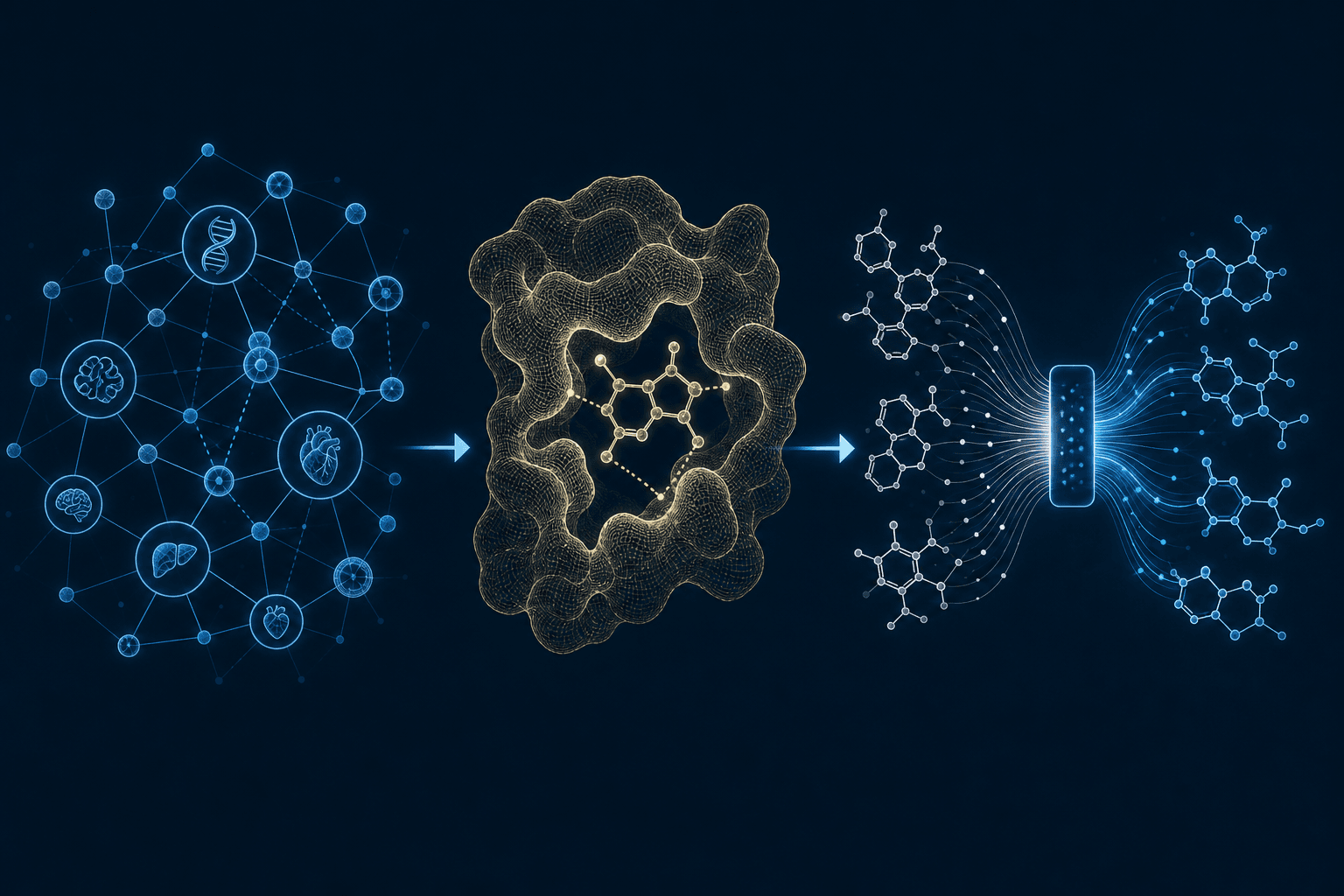
AI drug discovery is not a single category. It spans target identification, indication expansion, virtual hit screening, generative molecular design, ADMET prediction, and clinical trial optimization — each of which involves different data types, different model architectures, and different validation standards. When Insilico Medicine, BenevolentAI, and Atomwise (now Numerion Labs) appear together in scientific reviews and market analyses, it is typically because all three apply machine learning to early-stage pharmaceutical research. That shared label conceals more than it reveals.
Insilico Medicine operates an end-to-end generative AI platform that moves from biological target identification through molecular design to clinical candidate nomination — and now has a Phase IIa randomized controlled trial published in a peer-reviewed journal. BenevolentAI built its platform around a biomedical knowledge graph for target and indication hypothesis generation, accumulated partnership milestones with AstraZeneca and Merck KGaA, then underwent a significant organizational restructuring before delisting from public markets in March 2025. Atomwise, which rebranded as Numerion Labs in October 2025, has focused specifically on structure-based virtual screening using a graph convolutional neural network, and published the largest prospective screening study of its kind in 2024.
These are not interchangeable platforms at different stages of maturity. They address different scientific problems, have produced evidence of different types, and are in materially different organizational states as of mid-2026. ClinicalMind's existing coverage of the broader AI healthcare company landscape provides category-level context across multiple domains — including drug discovery as one segment — but does not profile these three companies individually or in depth. The profiles below are structured for healthcare professionals, translational researchers, and clinical scientists who need accurate, source-grounded intelligence on what each platform has actually validated, what is currently in clinical development, and what organizational changes affect the reliability or accessibility of platform data.
For broader context on AI company categories across healthcare, see ClinicalMind's AI Companies in Healthcare: A Structured Landscape Overview and Healthcare AI Companies: A Structured Landscape Overview. This article goes substantially deeper on the three named companies, with specific data points, trial figures, named platform modules, and organizational event dates.
Insilico Medicine: Pharma.AI Platform, Rentosertib Phase IIa Data, and HKEX IPO
Insilico Medicine is the most clinically advanced of the three companies in terms of published randomized trial evidence for an AI-designed compound. Its primary platform, Pharma.AI, is structured as an integrated pipeline covering four functional layers: target and disease biology analysis (PandaOmics, also called Biology42), generative molecular design (Chemistry42), scientific intelligence and literature synthesis (Science42), and closed-loop laboratory automation (the Life Star robotics lab). The company describes this as an end-to-end system capable of moving from biological hypothesis to clinical candidate nomination within a single computational and experimental infrastructure.
Rentosertib (ISM001-055): The Primary Clinical Evidence Anchor
Rentosertib is a first-in-class small-molecule inhibitor of TNIK (Traf2- and Nck-interacting kinase) designed by Chemistry42 for idiopathic pulmonary fibrosis (IPF). The Phase IIa GENESIS-IPF trial was a multicenter, double-blind, randomized, placebo-controlled study. Of 128 patients screened, 71 were randomized across four arms: 30mg once daily (n=18), 30mg twice daily (n=18), 60mg once daily (n=18), and placebo (n=17), with treatment over 12 weeks.
At the highest dose tested (60mg QD), the mean change in forced vital capacity (FVC) was +98.4mL (95% CI: 10.9 to 185.9) compared with −20.3mL (95% CI: −116.1 to 75.6) in the placebo group. Treatment-related serious adverse event rates were described as low. The authors concluded that targeting TNIK with rentosertib is safe and well tolerated and warrants investigation in larger-scale trials. Results were published in Nature Medicine in 2025, with the trial registered at ClinicalTrials.gov as NCT05938920. This represents the most clinically advanced AI-designed drug with published randomized trial data as of mid-2026.
HKEX IPO and 2025 Financial Results
Insilico Medicine listed on the Main Board of the Hong Kong Stock Exchange (HKEX: 3696) on December 30, 2025, in what the company described as Hong Kong's largest biotech fundraising for that year. As of December 31, 2025, cash and bank balances were $393.3 million.
The company's 2025 annual results, published in early 2026, reported total revenue of $56.24 million. Software revenue increased 23.8% year-over-year, and the subscription customer base grew 18.3% year-over-year. The Pharma.AI platform serves 13 of the top 20 global pharmaceutical companies. Newly signed collaboration agreements in 2025 totaled $1.3 billion, bringing cumulative collaboration value to $4.6 billion.
Pipeline Breadth and Active Clinical Programs
As of the latest practicable date in the 2025 annual results, Insilico reported 40+ total pipeline programs, with 30 preclinical candidates nominated since 2021 and 13 pipelines having received IND approval. Ten programs were in clinical trials.
- Rentosertib (ISM001-055) — TNIK inhibitor, IPF; Phase IIa data published in Nature Medicine (2025); Phase IIb status to be verified independently.
- ISM5411 (Garutadustat) — PHD inhibitor, inflammatory bowel disease (IBD); Phase IIa BETHESDA study launched with first patient dosing completed in 2025.
- ISM6331 — pan-TEAD inhibitor, mesothelioma and solid tumors; Phase I initiated.
- Additional named programs in clinical or advanced preclinical stages include a QPCTL inhibitor (cancer immunotherapy), USP1 inhibitor (BRCA-mutant cancer), MAT2A inhibitor (MTAP-deficient cancer), and FGFR2/3 dual inhibitor (solid tumors).
BenevolentAI: Knowledge Graph Platform, AstraZeneca Collaboration, and the Transition to Private Status
BenevolentAI built its platform around a fundamentally different approach than generative molecular design. The Benevolent Platform centers on a biomedical knowledge graph that connects genes, proteins, diseases, compounds, and their relationships across more than 85 curated data types — integrating public, proprietary, and inferred knowledge. The primary scientific task this architecture addresses is target and indication hypothesis generation: reasoning across heterogeneous biological data to identify which gene or protein to pursue for a given disease, and why.
Platform Validation: Baricitinib and the AstraZeneca Collaboration
The most widely cited early validation of the Benevolent Platform was the identification of baricitinib as a candidate for COVID-19 treatment in 2020, using the knowledge graph to reason from known drug-target interactions to a novel indication. This was a hypothesis-generation demonstration rather than a de novo drug design, but it established the platform's capacity to surface non-obvious biological connections.
The more sustained evidence base came from the AstraZeneca collaboration, which began in 2019 focused on chronic kidney disease (CKD) and IPF. The collaboration expanded in January 2022 to include heart failure and systemic lupus erythematosus (SLE), bringing the total to five target areas. Between 2021 and 2024, the collaboration yielded seven portfolio-entry milestones. A heart failure target was added in 2024, and an SLE target was confirmed in June 2024 as the second target selected that year. Across the full collaboration timeline, approximately £32 million was generated. Each target was discovered using the Benevolent Platform and experimentally validated by AstraZeneca.
Internal Pipeline: BEN-8744, BEN-28010, and BEN-2293
BenevolentAI also maintained an internal proprietary pipeline alongside its partnership programs. As of 2024 public disclosures:
- BEN-8744 — a PDE10 inhibitor for ulcerative colitis (UC); positive topline Phase Ia data were announced in March 2024, with Phase II-enabling studies described as underway.
- BEN-28010 — a CHK1 inhibitor for glioblastoma; IND-enabling work was described as complete and the asset was available for partnering.
- BEN-2293 — an atopic dermatitis program; discontinued after Phase 2a. This program should not be listed as an active pipeline asset.
- Merck KGaA collaboration — a separate partnership with potential value up to $594 million was active as of the April 2024 restructuring announcement.
April 2024 Restructuring and March 2025 Delisting
In April 2024, BenevolentAI announced a significant restructuring: approximately 30% headcount reduction (targeting approximately 180 staff by year end), closure of the US office, and cessation of work on its Knowledge Exploration Tools. The stated rationale was to reduce cash burn by approximately 20% and extend cash runway to late Q3 2025, while focusing on AI-driven drug discovery collaboration and proprietary pipeline revenue.
In December 2024, BenevolentAI announced a pivot back to its stated 'TechBio' roots and an intention to delist from public markets. On March 12, 2025, all EGM resolutions passed. On March 13, 2025, BenevolentAI's shares were delisted from Euronext Amsterdam via merger into Osaka Holdings S.à r.l. The original listed BenevolentAI entity ceased to exist; Osaka Holdings adopted the BenevolentAI name. The company is now a private entity.
Atomwise (Now Numerion Labs): AtomNet Architecture, the AIMS 318-Target Study, and the October 2025 Rebrand
Atomwise — which rebranded as Numerion Labs in October 2025 — built its platform around a specific, well-defined task: structure-based virtual screening of small molecules against protein targets to identify hit compounds. The company should be referenced as Atomwise (now Numerion Labs) or Numerion Labs, formerly Atomwise, to serve readers searching under either name.
AtomNet: Architecture and Scope
AtomNet is a graph convolutional neural network (GCN) trained globally on millions of bioactivities and protein binding sites. The model takes a three-dimensional protein structure — from X-ray crystallography, cryo-EM, or homology modeling — and scores candidate small molecules for predicted binding affinity. The scientific claim is that this computational approach can replace or substantially reduce the role of physical high-throughput screening (HTS) as the first step of small-molecule drug discovery.
The AIMS 318-Target Prospective Study: Primary Empirical Evidence
The primary evidence base for AtomNet's performance is a prospective study published in Scientific Reports in April 2024 (Sci Rep 14, 7526). The study evaluated AtomNet across 318 projects through the Atomwise Informatics and Machine learning Screening (AIMS) program: 22 internal targets and 296 academic targets submitted by 482 laboratories from 257 institutions across 30 countries.
Key results from the AIMS study:
- Project-level success: 73% of the 296 AIMS academic targets (215 projects) yielded at least one confirmed bioactive hit.
- Average hit rate: 7.6% for academic targets; 6.7% for internal targets.
- Hit rates were consistent across protein structure types: X-ray crystal structures (5.6%), cryo-EM structures (5.5%), and homology models (5.1%) — indicating no substantial performance degradation when experimental structures are unavailable.
- For the 70% of targets with no active molecules in the training data, success rate was 75% and hit rate 5.3% — suggesting the model generalizes beyond memorized training examples.
- Protein-protein interaction (PPI) sites: 74% project-level success (53 of 72 projects).
- Allosteric sites: 79% project-level success (46 of 58 projects).
- No human cherry-picking of results — the study was designed prospectively with academic labs submitting targets independently.
Our empirical results suggest that machine learning approaches have reached a computational accuracy that can replace HTS as the first step of small-molecule drug discovery.
The AIMS study measures virtual screening hit identification performance — not clinical outcomes. A confirmed bioactive hit in a biochemical assay is an early-stage finding that requires extensive downstream validation before it can be considered a drug candidate, let alone a clinical compound.
Key Partnerships and October 2025 Rebrand to Numerion Labs
Atomwise's partnership portfolio included agreements with Sanofi (approximately $1.2 billion in potential milestones), Eli Lilly, and Bayer, positioning the company as a virtual screening infrastructure provider for major pharmaceutical organizations.
In October 2025, Atomwise rebranded as Numerion Labs, describing itself as an AI-native company pioneering the application of AI/ML to drug discovery. Concurrent with the rebrand, the company published the APEX (Approximate-but-Exhaustive Search) protocol on arXiv, co-authored with NVIDIA subject matter experts. APEX uses COSMOS — described as Numerion's structure-based, generative pre-trained foundation model — to screen combinatorial synthesis libraries of 10 billion compounds in under 30 seconds. The company notes that traditional virtual screening techniques typically assess less than 0.1% of available compounds. CEO Steve Worland was quoted in the announcement.
Cross-Profile Comparison: Pipeline Position, AI Approach, Evidence Type, Corporate Status, and Key Partnerships
| Dimension | Insilico Medicine | BenevolentAI | Atomwise (now Numerion Labs) |
|---|---|---|---|
| Pipeline stage addressed | End-to-end: target identification through generative molecular design and clinical candidate nomination | Upstream: target and indication hypothesis generation via knowledge graph reasoning | Hit identification: structure-based small-molecule virtual screening |
| Core AI architecture | PandaOmics/Biology42 (target discovery); Chemistry42 (generative molecular design); Science42 (scientific intelligence); Life Star robotics lab (closed-loop automation) | Biomedical knowledge graph connecting genes, proteins, diseases, and compounds across 85+ curated data types | AtomNet: graph convolutional neural network trained on millions of bioactivities and protein binding sites; COSMOS generative foundation model (post-rebrand) |
| Primary evidence type and maturity | Phase IIa randomized, double-blind, placebo-controlled trial (rentosertib, Nature Medicine 2025); 71 patients, 12 weeks, FVC +98.4mL at 60mg QD vs. −20.3mL placebo | Seven AstraZeneca portfolio-entry milestones (2021–2024) across CKD, IPF, heart failure, SLE; BEN-8744 Phase Ia positive topline data (UC, March 2024); all pre-delisting disclosures | Prospective virtual screening study: 318 targets, 73% project-level success, 7.6% average hit rate, consistent across crystal structures, cryo-EM, and homology models (Sci Rep 2024) |
| Corporate status — Q2 2026 | Public company listed on HKEX (ticker: 3696) since December 2025; $393.3M cash as of December 31, 2025 | Private entity since March 13, 2025; delisted from Euronext Amsterdam via merger into Osaka Holdings S.à r.l.; post-delisting pipeline visibility substantially reduced | Private company operating as Numerion Labs (formerly Atomwise) since October 2025 |
| Key partnership anchors | 13 of top 20 global pharma as customers; $4.6B cumulative collaboration value; $1.3B in new agreements signed in 2025 | AstraZeneca (2019–2024, seven milestones, ~£32M generated); Merck KGaA (up to $594M potential); both pre-dating March 2025 delisting | Sanofi (~$1.2B potential milestones); Eli Lilly; Bayer |
| FDA SaMD authorization | None for drug discovery applications | None for drug discovery applications | None for drug discovery applications |
Evidence Limitations, Regulatory Context, and What These Profiles Do Not Establish
These profiles present the strongest available evidence for each platform. That evidence has significant boundaries that professionals evaluating these companies need to hold clearly.
Shared Limitations Across All Three Profiles
- No FDA SaMD authorization: None of the three platforms hold FDA authorization as software as a medical device for drug discovery applications. AI-generated targets, hits, and molecular candidates are research outputs that must progress through conventional IND filing, preclinical safety studies, and phased clinical trials before any regulatory approval pathway is engaged.
- AI generation does not substitute for clinical validation: The fact that a compound was designed by an AI platform does not alter the regulatory and scientific requirements for demonstrating safety and efficacy. Rentosertib's Phase IIa data are notable precisely because they represent the output of a conventional randomized clinical trial, not a shortcut around one.
- BenevolentAI visibility gap: Post-March 2025 delisting, BenevolentAI is not subject to public disclosure obligations. The pipeline information in this profile reflects 2024 investor communications and press releases. The status of BEN-8744, BEN-28010, the Merck KGaA collaboration, and the Benevolent Platform itself cannot be independently verified from public sources as of mid-2026.
- Rentosertib Phase IIb status requires independent verification: Insilico's 2025 annual results confirm Phase IIa completion and IBD Phase IIa launch but do not explicitly confirm Phase IIb initiation for rentosertib. Readers should verify current Phase IIb status via ClinicalTrials.gov or Insilico's 2026 interim disclosures.
- AIMS study scope: The Atomwise AIMS 318-target study measures virtual screening hit identification in biochemical assays — not in vivo efficacy, ADMET performance, or clinical outcomes. A 73% project-level success rate means 73% of targets yielded at least one compound with measurable bioactivity in a primary assay. This is a meaningful early-stage metric, but it is a long distance from clinical proof of concept.
- APEX/COSMOS preprint status: The October 2025 APEX protocol published by Numerion Labs was posted to arXiv. Peer-reviewed publication status should be verified before treating its performance claims as equivalent to published evidence.
What a Peer-Reviewed Landscape Analysis Classifies as Distinct
A 2025 review in Pharmacological Reviews comparing leading AI drug discovery platforms classified these companies under distinct categories: Insilico Medicine under 'integrated target-to-design pipelines,' BenevolentAI under 'knowledge-graph repurposing,' and confirmed citation of both the rentosertib Phase IIa Nature Medicine publication and the Atomwise AIMS 318-target Scientific Reports study. This classification is consistent with the distinctions drawn in this article. The full text of that review is behind an institutional paywall; the abstract and reference list were the accessible sources used here.
Comments
Join the discussion with an anonymous comment.