
Device Identity and Authorization Summary
IDx-DR received a De Novo authorization from FDA on April 11, 2018, under submission number DEN180001. It was the first autonomous AI diagnostic system authorized by FDA in any field of medicine. The authorization was granted under 21 CFR 886.1100, creating new product code PIB and a new device classification — diabetic retinopathy detection device, Class II. No Predetermined Change Control Plan was authorized at the time of the De Novo grant.
| Field | Value |
|---|---|
| De Novo Number | DEN180001 |
| Device Name | IDx-DR |
| Requester | IDx LLC, 458 Hwy 1 W, Iowa City, IA 52246 |
| Contact | Michael D. Abramoff |
| Regulation Number | 21 CFR 886.1100 |
| Product Code | PIB |
| Date Received | January 12, 2018 |
| Decision Date | April 11, 2018 |
| Decision | Granted (DENG) |
| Classification Advisory Committee | Ophthalmic |
| Device Classification Name | Diabetic retinopathy detection device |
| Device Class | Class II |
| Predetermined Change Control Plan Authorized | No |
Intended Use and Indicated Population
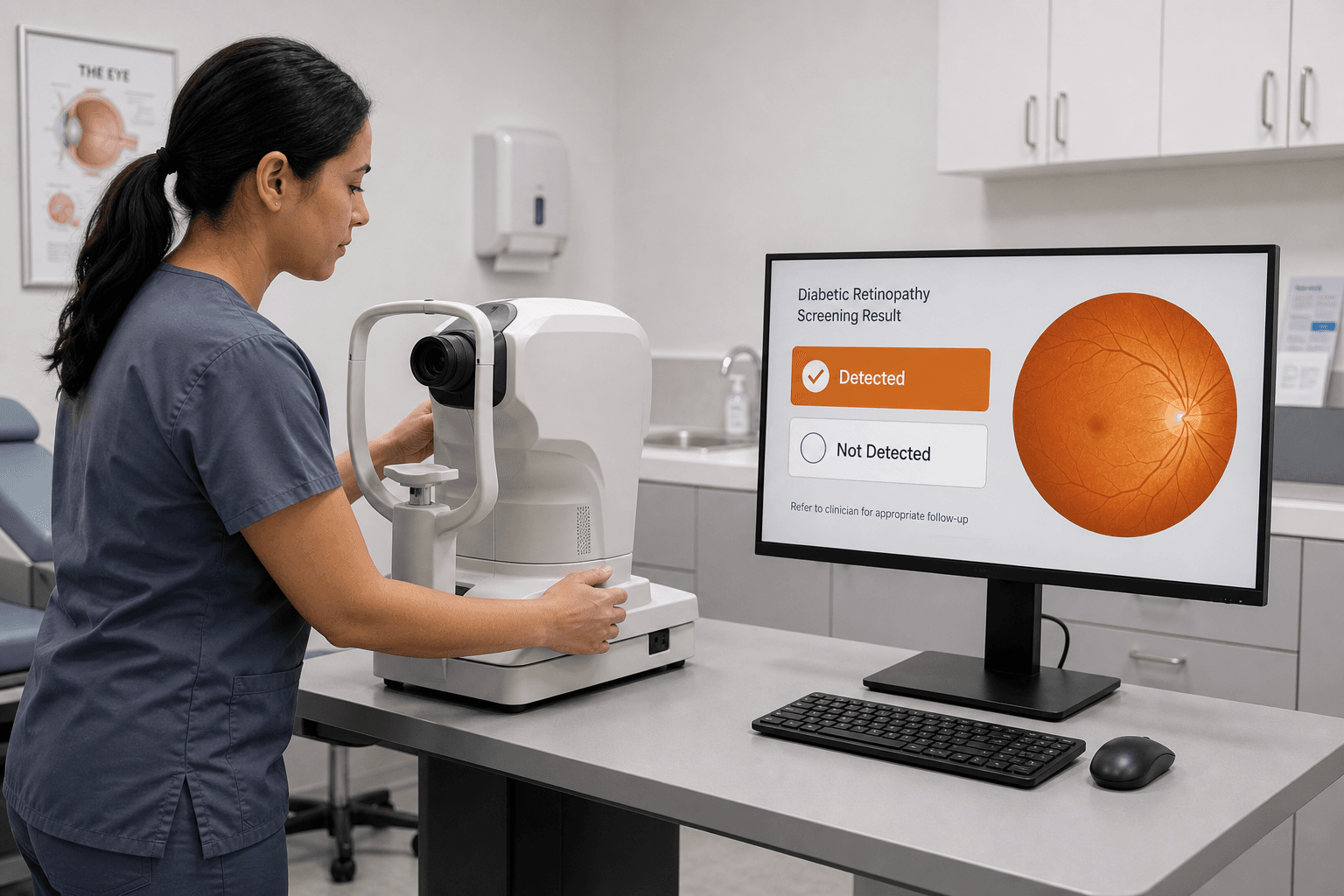
IDx-DR is intended for use by health care providers to automatically detect more than mild diabetic retinopathy (mtmDR) in adults (22 years of age or older) diagnosed with diabetes who have not been previously diagnosed with diabetic retinopathy. IDx-DR is indicated for use with the Topcon NW400.
The authorization carries three explicit population constraints that define its scope. All three must be met for the device to be used within its cleared indication.
- Age: Adults 22 years of age or older only. No authorization exists for pediatric populations under this De Novo.
- Diagnosis: Patient must have an existing diagnosis of diabetes.
- Prior DR status: Patient must have no prior diagnosis of diabetic retinopathy. The device is not indicated for monitoring of known DR.
The device produces a binary output — no grading scale, no severity staging, no secondary findings. The two possible results and their associated clinical actions are:
- mtmDR detected: Refer to an eye care professional.
- mtmDR not detected: Retest in 12 months.
Why De Novo Was Required: No Predicate, New Classification
At the time IDx LLC submitted its De Novo request in January 2018, no FDA-cleared predicate device existed for an autonomous AI diagnostic system — one that produces a diagnostic result without requiring a clinician to also interpret the image or confirm the output. Because 510(k) clearance requires demonstrating substantial equivalence to a legally marketed predicate, that pathway was not available.
No existing device classification or product code covered this device type. De Novo was the appropriate pathway for a novel, low-to-moderate risk device without a predicate. The grant created an entirely new regulatory infrastructure for this device type: product code PIB under 21 CFR 886.1100, Class II classification, with special controls established in the Classification Order.
The practical consequence of this pathway choice is that IDx-DR's De Novo authorization itself became the predicate for subsequent autonomous DR AI devices seeking 510(k) clearance — a regulatory role documented in Section 7 of this record. For a broader explanation of how FDA classifies AI medical devices across pathways, see AI in Medicine: How FDA-Cleared Devices Are Authorized and What They Actually Do.
Pivotal Clinical Trial Evidence (NCT02963441)
The De Novo authorization was supported by a prospective, multi-site pivotal trial (NCT02963441) conducted January through July 2017 at 10 US primary care sites. Results were published in npj Digital Medicine in August 2018 (Abramoff et al.). The trial was designed to evaluate performance under real primary care conditions, with non-specialist operators rather than trained ophthalmic technicians.
| Trial Parameter | Detail |
|---|---|
| Trial ID | NCT02963441 |
| Enrollment period | January–July 2017 |
| Sites | 10 US primary care sites |
| Enrolled | 900 participants |
| Intent-to-screen population | 892 |
| Fully analyzable | 819 |
| Operators | Existing primary care staff, 4-hour standardized training, no prior ocular imaging experience |
| Reference standard | Wisconsin FPRC widefield stereoscopic photography (4W-D protocol) + OCT for DME, ETDRS severity grading |
| mtmDR definition | ETDRS level ≥35 and/or DME in at least one eye |
| Primary sensitivity | 87.2% (95% CI 81.8–91.2%) |
| Primary specificity | 90.7% (95% CI 88.3–92.7%) |
| Imageability | 96.1% (95% CI 94.6–97.3%) |
| Sensitivity for vtDR (ETDRS ≥53) | 97.4% |
| Algorithm lock | Before study start, by Algorithm Integrity Provider CCR Inc. |
All pre-specified superiority endpoints were met. A post-hoc logistic regression subgroup analysis found no statistically significant effects of age, sex, race, ethnicity, HbA1c, lens status, or site on sensitivity — a finding relevant to the equity considerations discussed in Section 11.
Algorithm Architecture
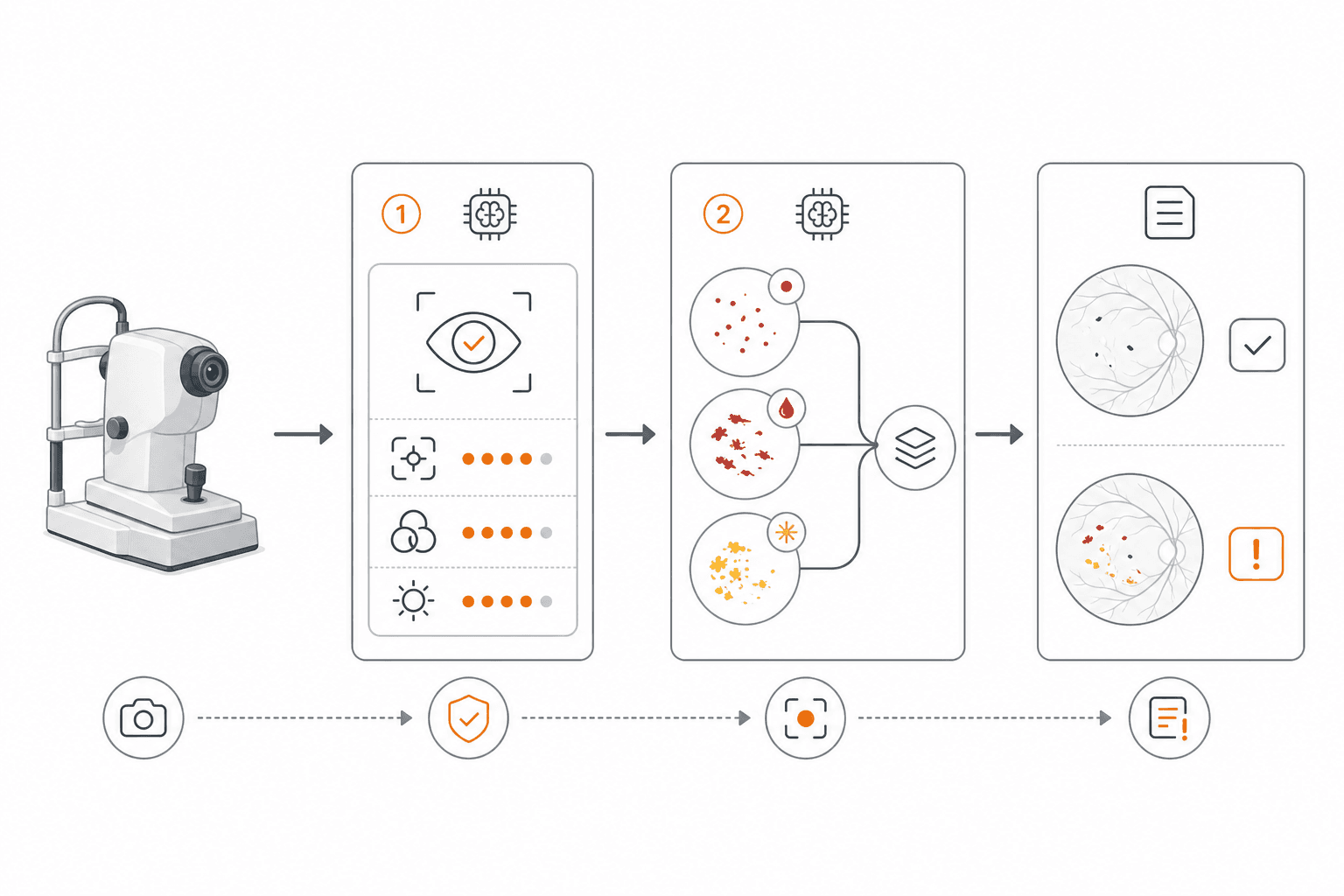
The IDx-DR algorithm operates as two distinct sequential components. Understanding this two-stage design clarifies both the device's performance characteristics and its failure modes. For readers who need foundational context on how AI medical devices process clinical inputs, see AI in the Medical Field: How FDA-Cleared Devices Actually Work.
- Image Quality Algorithm: Runs in real time during image acquisition. Uses multiple independent detectors evaluating retinal area coverage, focus quality, color balance, and exposure level. Provides immediate feedback to the operator so that image quality problems can be corrected before submission to the diagnostic algorithm. This component is what enables non-specialist operators to acquire acceptable images with limited training.
- Diagnostic Algorithm: Applies lesion-specific convolutional neural network (CNN) detectors for microaneurysms, hemorrhages, and lipoprotein exudates — the three primary morphological features of diabetic retinopathy. The outputs of these individual detectors are fused by a separately trained machine learning algorithm to produce a single binary disease-level result. The design was described by the authors as 'physiologically plausible' because the intermediate representations correspond to recognized DR pathological features rather than opaque image features. The result is delivered within 30 seconds of image submission.
Special Controls and Device Limitations
As a Class II device authorized via De Novo, IDx-DR is subject to special controls specified in the Classification Order (DEN180001). The full text of those controls is contained in the Classification Order PDF at FDA's accessdata server and should be consulted directly for authoritative regulatory language — the controls text was not reproduced in full in publicly accessible web sources at the time this record was prepared. For context on what Class II special controls mean in the broader regulatory framework, see AI for Medical Use: How FDA-Cleared Devices Are Authorized and What That Actually Means.
The following device limitations are documented in the manufacturer labeling and in the peer-reviewed trial record:
- Does not replace a comprehensive eye examination. A positive or negative result from IDx-DR is not equivalent to an ophthalmologic evaluation.
- Binary output only. The device does not produce a severity grade, a staging score, or any sub-classification of DR level. The output is either mtmDR detected or mtmDR not detected.
- Population restriction. The authorization applies only to adults aged 22 or older, with a diabetes diagnosis, and no prior DR diagnosis. Use outside these parameters is outside the cleared indication.
- Incidental finding gap. IDx-DR does not detect glaucoma, age-related macular degeneration, or other retinal pathology. Patients with incidental findings visible on the fundus image will not receive an alert from this device.
- No PCCP. Because no Predetermined Change Control Plan was authorized, any modification to the algorithm — including retraining, threshold adjustment, or architecture change — requires a new FDA submission before deployment.
Regulatory Significance: IDx-DR as Class-Creating Predicate
The De Novo grant for IDx-DR did more than authorize a single device. By creating product code PIB under 21 CFR 886.1100, it established the regulatory classification that subsequent autonomous DR AI devices would use as a predicate for 510(k) clearance. Two additional autonomous DR AI systems have been cleared using IDx-DR v2.0 as the predicate device.
| Device | Pathway | Submission Number | Clearance Date | Predicate Relationship |
|---|---|---|---|---|
| IDx-DR v2.0 | De Novo | DEN180001 | April 11, 2018 | Class-creating device — no predicate |
| EyeArt | 510(k) | K203629 | May 2020 | Demonstrated equivalence to IDx-DR v2.0 |
| AEYE-DS | 510(k) | Not confirmed in this record | October 2022 (per Ophthalmology Science 2025) | Demonstrated equivalence to IDx-DR v2.0 |
Post-Market Evolution: Version Updates and Rebranding
Following the original De Novo authorization, IDx-DR underwent two 510(k)-cleared version updates. The manufacturer also underwent a corporate and product rebranding between approximately 2022 and 2023. The current commercial product is named LumineticsCore, marketed by Digital Diagnostics (formerly IDx LLC).
| Version | Pathway / Number | Date | Key Changes |
|---|---|---|---|
| IDx-DR v2.0 | De Novo DEN180001 | April 11, 2018 | Original authorized version — class-creating authorization |
| LumineticsCore (v2.x) | 510(k) K203629 | May 2021 | Added DICOM submission capability, guided workflow, local image retention, and a training mode. No algorithm classification change. |
| LumineticsCore v2.3 | 510(k) K213037 | June 2022 | Improved handling of ungradable images and increased processing speed. No change to the DR classification algorithm. |
The version 2.3 update (K213037) explicitly did not alter the algorithm that classifies diabetic retinopathy — the core diagnostic logic authorized under DEN180001 remains the reference standard for the product code PIB device class. The v2.3 improvements addressed operational limitations (ungradable image handling and throughput) without triggering a reclassification review.
Reimbursement and Billing Context
The reimbursement pathway for IDx-DR involves a CPT code with a specific creation and implementation timeline that is frequently mischaracterized in secondary sources. The sequence of events is as follows:
- September 2020: The American Medical Association CPT Editorial Panel created CPT code 92229 as part of the 2021 CPT code set. This was the first CPT code created for autonomous AI in any medical specialty.
- January 1, 2021: CPT 92229 became effective for billing.
- CY 2022 Physician Fee Schedule: CMS established the first national Medicare payment rate for CPT 92229.
| Year | Medicare National Payment Rate (CPT 92229) | Source |
|---|---|---|
| 2022 | $47.06 | Teng et al., Ophthalmology Science 2025 |
| 2023 | $45.74 | Teng et al., Ophthalmology Science 2025; Rajesh et al., Diabetes Care 2023 |
| 2024 | $40.28 | Teng et al., Ophthalmology Science 2025; Retina Specialist 2025 |
Analysis of a large commercial claims database (IQVIA PharMetrics+) found a median privately negotiated rate of $127.81 for CPT 92229 as of November 2022 (Anthem, CA/NY markets). This figure is drawn from a specific payer and geography and should not be treated as a nationally representative private rate.
Adoption Evidence and Deployment Context
The manufacturer (Digital Diagnostics) states that LumineticsCore is deployed in more than 1,000 US clinical sites. This figure appears on the manufacturer's product page and has been repeated in peer-reviewed literature. However, the Retina Specialist 2025 review explicitly noted that this claim could not be independently verified. It is attributed here as a manufacturer claim, not a confirmed figure.
Confirmed academic health system adopters, with documented deployment dates, include:
- University of Iowa — April 2018 (coinciding with the De Novo authorization)
- Mayo Clinic — September 2019
- Johns Hopkins Health System — August 2020
- Stanford Medicine — February 2021
- University of Pennsylvania — January 2024
Non-academic adopters documented in the literature include Cahaba Medical Care, OSF Healthcare, Tarzana Treatment Centers, and LabCorp. These represent a mix of federally qualified health center, integrated health system, and commercial laboratory deployment contexts.
Claims data from the IQVIA PharMetrics+ database, covering approximately 40% of US insurance claims and skewing toward commercially insured patients under 65, identified 15,097 total CPT 92229 claims between January 2021 and June 2023. The three cities with the highest claim volumes were Philadelphia, Dayton (Ohio), and New Orleans. ZIP codes containing an academic medical center were 17 times more likely to have medical AI billing than those without; metropolitan ZIP codes were 5.25 times more likely than non-metropolitan areas.
Equity Considerations, Known Limitations, and Evidence Gaps
The pivotal trial reported imageability of 96.1% and found no statistically significant sensitivity differences by race, ethnicity, sex, age, HbA1c, lens status, or site in logistic regression analysis. These results, however, were obtained under protocol conditions that included reflexive dilation when initial image quality was insufficient — a meaningful departure from standard nonmydriatic primary care deployment.
Across five academic implementation studies reviewed in the literature, real-world nonmydriatic gradability rates ranged from 49% to 75%. This is not a contradiction of the trial result — it reflects the difference between controlled trial conditions and routine clinical deployment without dilation protocols. Facilities relying on nonmydriatic imaging without a dilation fallback should expect a meaningful proportion of ungradable images, which the device flags as uninterpretable rather than producing a false result.
- Real-world gradability gap: Trial imageability 96.1% vs. real-world nonmydriatic gradability 49–75% across five academic implementation studies. The difference is attributable to protocol conditions, not algorithm failure.
- Geographic concentration: Claims data shows adoption concentrated in metropolitan academic centers. Rural and underserved settings — where undiagnosed DR burden is often highest — are underrepresented in current deployment.
- Pediatric authorization absent: DEN180001 is restricted to adults aged 22 or older. Feasibility studies in pediatric populations (including the SEE study and the ACCESS RCT at Johns Hopkins) represent investigational use outside the scope of this De Novo authorization. Any clinical use in patients under 22 is off-label.
- No head-to-head comparisons: No peer-reviewed head-to-head performance comparison between IDx-DR/LumineticsCore, EyeArt, and AEYE-DS has been published as of this record's preparation. Procurement decisions based on comparative performance cannot be supported by current published evidence.
- Incidental finding gap: The device does not detect glaucoma, age-related macular degeneration, or other retinal pathology. Patients with co-existing conditions visible on fundus imaging will not receive an alert.
Editorial Notes, Source Traceability, and Update Cadence
This record is sourced from the following primary and peer-reviewed sources, each confirmed during preparation:
- FDA CDRH De Novo database record (DEN180001): Confirmed device name, requester, regulation, product code, dates, decision, and advisory committee. Full special controls text requires direct consultation of the Classification Order PDF.
- Abramoff et al. 2018, npj Digital Medicine (NCT02963441): Primary source for all trial design, enrollment, performance metrics, algorithm architecture, and algorithm lock confirmation.
- Teng et al., Ophthalmology Science 2025: Source for academic adopter list with dates, CPT 92229 Medicare rate history, real-world gradability range, and 510(k) version update details.
- Rajesh et al., Diabetes Care 2023 (PMC10516248): Source for predicate device relationships, version 2.3 510(k) characterization, and 2023 Medicare rate.
- Wu et al., NEJM AI 2023: Source for CPT 92229 claims data (15,097 claims, January 2021–June 2023), geographic concentration analysis, and privately negotiated rate ($127.81 median, Anthem CA/NY, November 2022).
- Rajesh and Lee, Retina Specialist 2025: Source for 2024 Medicare rate, geographic claims concentration by city, and the explicit note that the manufacturer's '>1,000 clinics' claim could not be independently verified.
Specific caveats for readers using this record:
- The Classification Order PDF (DEN180001.pdf) was not directly crawlable due to PDF format restrictions. Special controls language must be verified from the original FDA document before citing in regulatory submissions or procurement evaluations.
- The AEYE-DS 510(k) submission number was not confirmed in any source consulted during preparation. The clearance date (October 2022 per Ophthalmology Science 2025; November 2022 per Diabetes Care 2023) should be verified in the FDA 510(k) database before citing.
- The version-to-510(k) correspondence (K203629 → May 2021 update; K213037 → June 2022 v2.3) should be cross-verified against the FDA 510(k) database entries before citing in regulatory documents.
- The '>1,000 US clinical sites' figure is a manufacturer claim (Digital Diagnostics product page) that could not be independently verified per Retina Specialist 2025.
- The NEJM AI 2023 claims figure (15,097) covers approximately 40% of US claims and underrepresents Medicare and Medicaid populations; it is a lower-bound indicator of national utilization.
This record will be updated when any of the following occur: a new 510(k) clearance is issued for LumineticsCore or a successor product; annual Medicare Physician Fee Schedule rates are finalized for CPT 92229; a peer-reviewed post-market performance study with external validation is published; or a material regulatory action (e.g., recall, safety communication, or Special Controls update) is issued for product code PIB devices.
Feedback & Corrections
Corrections, deployment experience notes, and questions from clinicians and procurement professionals are welcome. For formal corrections, use the contact page.
Comments
Join the discussion with an anonymous comment.