
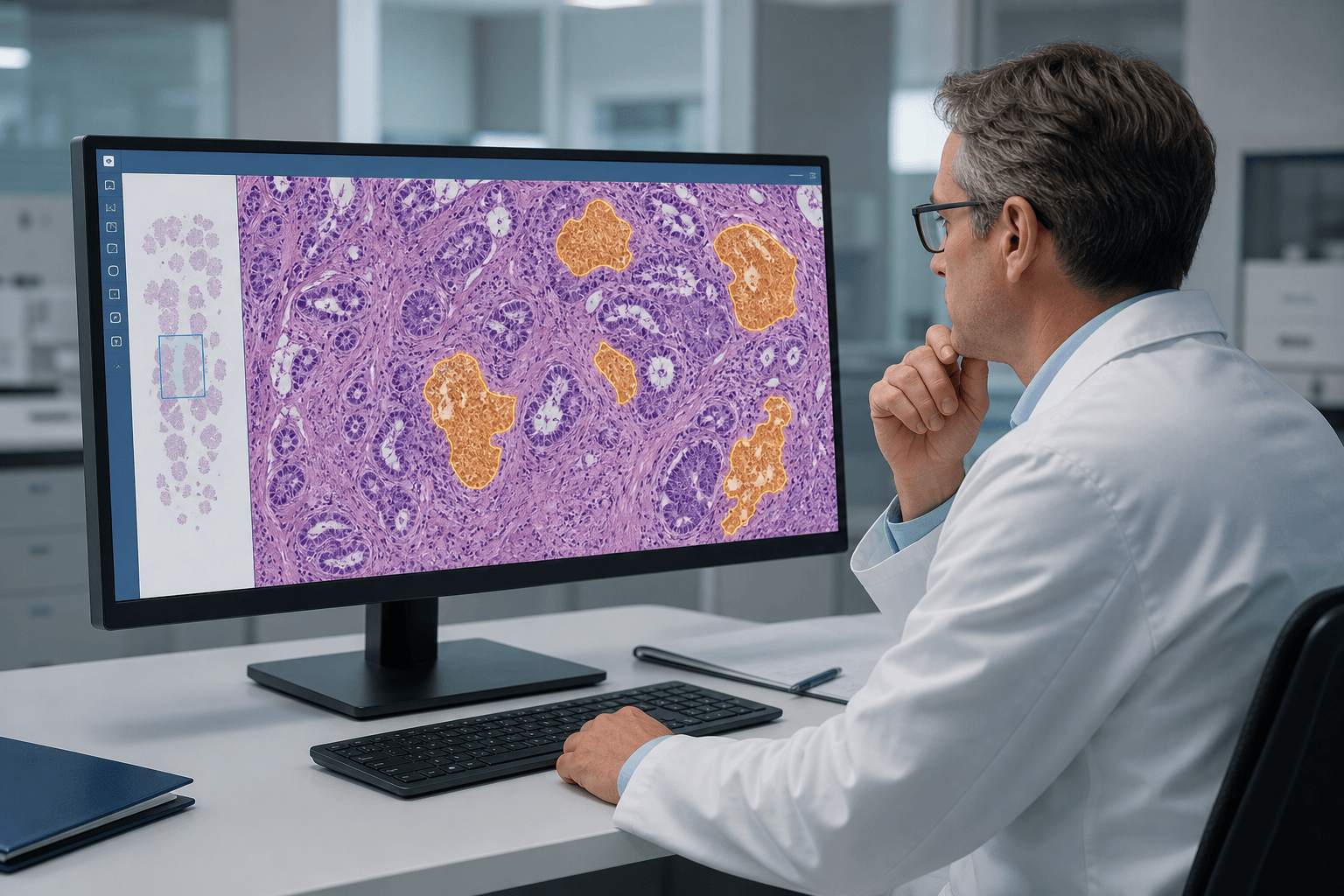
Device Identity and Authorization Summary
Paige Prostate received FDA marketing authorization on September 21, 2021, becoming the first AI-based device authorized by the FDA for use in computational pathology. The authorization was granted under the De Novo pathway — not a Premarket Approval (PMA) — a distinction that carries significant regulatory consequences for how subsequent AI pathology devices are classified and cleared. The record below is derived from the official FDA De Novo database entry.
| Field | Value |
|---|---|
| De Novo Number | DEN200080 |
| Device Name | Paige Prostate |
| Requester | Paige.AI, 11 Times Sq., 37th Floor, New York, NY 10036 |
| Decision Date | September 21, 2021 |
| Decision | Granted (DENG) |
| Regulatory Pathway | De Novo (21 CFR Part 860.260) |
| Regulation Number | 21 CFR 864.3750 |
| Product Code | QPN |
| Classification Advisory Committee | Pathology |
| Device Class | II |
| PCCP Authorized | No |
| Type | Direct De Novo |
Regulatory Pathway: De Novo, Not PMA
The most common factual error in coverage of this device is labeling the FDA action a PMA (Premarket Approval). The correct pathway is De Novo. These are meaningfully different regulatory routes with different evidentiary standards, device class outcomes, and downstream consequences for the industry.
| Pathway | Device Class | Risk Level | Evidentiary Standard | Predicate Required? | Outcome |
|---|---|---|---|---|---|
| 510(k) | I or II | Low to moderate | Substantial equivalence to a predicate device | Yes | Clearance |
| De Novo | I or II | Low to moderate (novel) | Valid scientific evidence demonstrating safety and effectiveness | No — creates a new classification | Marketing authorization; new classification becomes predicate for future 510(k)s |
| PMA | III | High | Reasonable assurance of safety and effectiveness (typically RCT-level) | No | Approval |
The De Novo pathway exists for novel devices that are low-to-moderate risk but lack a legally marketed predicate device. Because no prior FDA-authorized AI pathology tool existed in 2021, Paige.AI could not file a 510(k). The De Novo grant did two things simultaneously: it authorized Paige Prostate for marketing, and it created a new device classification — 21 CFR 864.3750 under product code QPN — that did not exist before.
The practical consequence is significant: any subsequent AI device with the same intended use as Paige Prostate may now seek 510(k) clearance using Paige Prostate as its predicate. The De Novo authorization effectively opened a 510(k) pathway for the entire category of AI-assisted prostate biopsy analysis tools. This is structurally parallel to how IDx-DR (DEN180001), the first autonomous AI diagnostic system authorized by the FDA, created a new classification for autonomous AI diagnostic devices in ophthalmology. Both De Novo authorizations established regulatory precedents that reshaped the clearance landscape for their respective specialties.
Intended Use and Clinical Indication
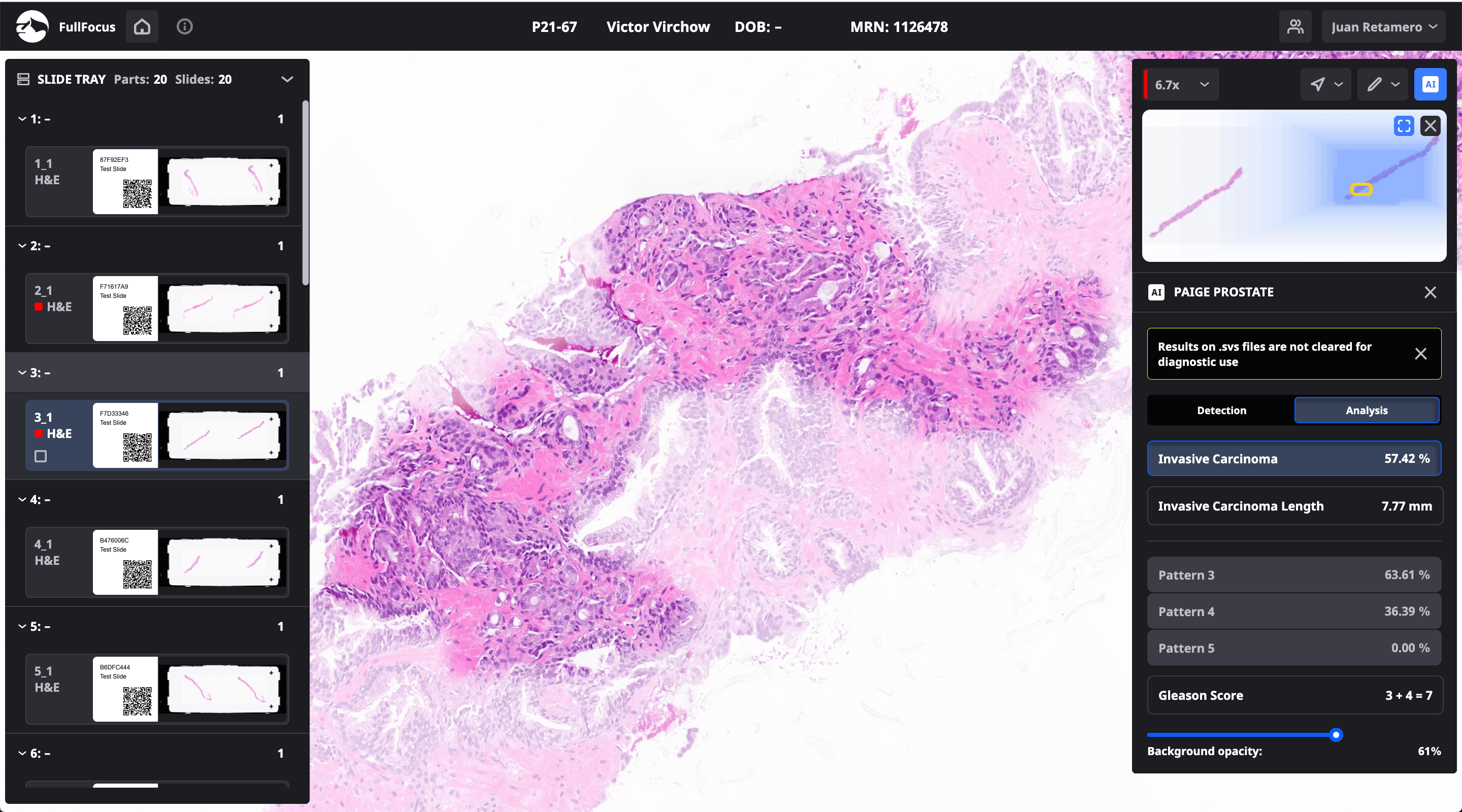
Paige Prostate is authorized as an adjunct tool for use by qualified pathologists reviewing digitized whole slide images (WSIs) of prostate needle core biopsies. The device analyzes a WSI and flags the area of highest suspicion for cancer, which the pathologist then reviews as part of their standard diagnostic workflow.
The authorized use is precisely bounded. Paige Prostate does not render a diagnosis. It does not generate a Gleason grade. It does not replace pathologist review. A qualified pathologist must make all final diagnostic determinations. The device's role is to direct attention to regions a pathologist should examine — functioning as a second-read signal, not a diagnostic conclusion.
- Authorized input: Digitized whole slide images of prostate needle core biopsy specimens.
- Authorized output: A flagged region indicating the area of highest suspicion for cancer on each slide.
- Authorized user: Qualified pathologists — the device is not authorized for use by non-pathologist clinicians acting independently.
- Scanner restriction at authorization: At the time of the original De Novo grant, the device was authorized for use with WSIs produced by the Philips Ultrafast Scanner only. Subsequent 510(k) submissions have expanded scanner compatibility.
- Not authorized: Autonomous diagnosis, Gleason grading at authorization, or use as a standalone diagnostic system without pathologist oversight.
Algorithm Development and Training Data
Paige Prostate's underlying algorithm uses a weakly supervised multiple-instance learning (MIL) approach, a methodology described in the Campanella et al. 2019 paper published in Nature Medicine. MIL is a form of weakly supervised learning particularly suited to computational pathology because it does not require expert annotation of tumor regions at the pixel level — a labor-intensive process that would be impractical at scale.
Instead of pixel-level tumor annotation, each WSI in the training set was labeled only as 'positive' (cancer present) or 'negative' (cancer absent) at the slide level. The model learned to identify histological features associated with cancer from this slide-level signal alone, without being told precisely where on the slide the cancer was located.
- Training dataset size: 12,727 prostate biopsy WSIs.
- Geographic scope of training data: Specimens from laboratories across 45 countries, drawn from over 150 institutions — a deliberate design choice to improve generalizability across different staining protocols, tissue preparation methods, and scanner characteristics.
- Labeling methodology: Slide-level positive/negative labels (weakly supervised), not pixel-level tumor annotation.
- Validation dataset: Approximately 12,000 additional slides used for model validation.
- Post-authorization retraining: The authorized version of the software is not continually retrained on clinical cases encountered in practice. No Predetermined Change Control Plan (PCCP) was authorized, meaning any significant algorithm modification requires a new premarket submission to the FDA.
Clinical Evidence Basis for Authorization
The FDA's authorization was supported by a pivotal clinical study evaluated by the agency as part of the De Novo review. The study enrolled 16 pathologists who examined 527 prostate biopsy WSIs — 171 slides containing cancer and 356 benign slides. Each pathologist completed two sequential reads: an unassisted read followed by an AI-assisted read using Paige Prostate.
The study design measured per-slide cancer detection performance — specifically whether pathologists identified cancer on individual slide images more accurately when using the AI tool. It was not a prospective patient outcome trial.
The primary peer-reviewed publication supporting the authorization is Raciti et al. 2023, published in Archives of Pathology and Laboratory Medicine (PMID 36538386). That study enrolled 18 pathologists evaluating 610 prostate needle core biopsy WSIs prepared at 218 institutions, with and without AI assistance. It found that pathologists improved sensitivity and specificity across all histologic grades and tumor sizes when using the AI tool, and that the AI correctly classified 100% of WSIs in which pathologists corrected their initial diagnoses during the AI-assisted phase.
Performance Metrics
The following figures are sourced to the FDA-evaluated pivotal study (as reported in the FDA press release and De Novo decision) and to Raciti et al. 2023 (PMID 36538386). Figures from these two sources are distinguished in the table below.
| Metric | Value | Source |
|---|---|---|
| Mean sensitivity improvement (assisted vs. unassisted) | +7.3 percentage points (89.5% → 96.8%) | FDA-evaluated pivotal study |
| Reduction in false-negative diagnoses | 70% | FDA-evaluated pivotal study |
| Reduction in false-positive diagnoses | 24% | FDA-evaluated pivotal study |
| Non-specialist pathologist accuracy with AI vs. prostate specialist without AI | Equivalent | FDA-evaluated pivotal study |
| Standalone sensitivity range across studies | 96% – 99.2% | Raciti et al. 2023 / CADTH horizon scan |
| Standalone specificity range across studies | 93% – 98% | Raciti et al. 2023 / CADTH horizon scan |
| AI correctly classified WSIs with corrected diagnoses in AI-assisted phase | 100% | Raciti et al. 2023 (PMID 36538386) |
| Pathologists who improved sensitivity and specificity with AI | All histologic grades and tumor sizes | Raciti et al. 2023 (PMID 36538386) |
The finding that non-specialist pathologists using Paige Prostate reached accuracy levels comparable to prostate subspecialty pathologists working without AI is among the most clinically relevant results. It suggests the device may help reduce diagnostic variability across pathologist experience levels — though this has not been evaluated in a prospective trial measuring patient outcomes.
Known Limitations and Risk Controls
The following limitations are structural features of the authorization — not editorial assessments. They reflect constraints the FDA built into the De Novo grant and characteristics of the pivotal evidence base.
- Adjunct use only: Paige Prostate is not authorized for autonomous use. A qualified pathologist must review all AI-flagged regions and render final diagnoses.
- One flag per slide: The FDA noted that the device flags one area of highest suspicion per slide. It does not mark all suspicious regions on a given WSI simultaneously.
- Original scanner restriction: At time of the De Novo grant, authorized use was limited to WSIs produced by the Philips Ultrafast Scanner. Subsequent 510(k) submissions have expanded scanner compatibility, but labs must confirm their scanner is covered by a current clearance.
- No PCCP authorized: No Predetermined Change Control Plan was authorized as part of the De Novo grant. Any significant modification to the algorithm — including retraining on new data — requires a new premarket submission to the FDA before deployment.
- No patient outcome data at authorization: The pivotal study measured per-slide cancer detection, not final patient diagnosis outcomes. The device was not evaluated in a prospective trial measuring downstream clinical decisions, treatment initiation, or survival.
- Not continually retrained: The authorized version does not update itself based on clinical cases encountered in practice. Model drift over time — as laboratory equipment, staining protocols, or scanner characteristics change — is a consideration for post-market surveillance.
Equity and Training Data Diversity
The FDA Decision Summary for DEN200080 reports that 82.2% of the training dataset comprised biopsy slides from patients who were white. This figure is documented in the CADTH horizon scan (NBK608438), which directly cites the FDA Decision Summary PDF. The training data's demographic composition is a material consideration given that Black patients face a higher incidence of prostate cancer and are diagnosed at younger ages compared to white patients.
Raciti et al. 2023 (PMID 36538386) reported no statistically significant difference in Paige Prostate's diagnostic performance by race or ethnicity. However, that finding must be interpreted in context: only 7% of WSIs in the study were from patients who identified as Black, and the study used a simulated rather than prospective real-world setting. A study with 7% Black-patient representation is statistically underpowered to detect performance differences in that subgroup.
Post-Market Developments
Tempus AI Acquisition (August 2025)
Tempus AI (NASDAQ: TEM) announced the acquisition of Paige on August 22, 2025, for $81.25 million paid predominantly in Tempus common stock. Paige's digital pathology products — including Paige Prostate — now sit within the Tempus portfolio.
CONFIDENT-P Prospective Trial (2025)
The most significant post-authorization clinical evidence comes from the CONFIDENT-P trial, published in JCO Clinical Cancer Informatics (2025 Mar; 9:e2400193; PMID 40036728). This prospective clinical trial evaluated whether an AI-assisted workflow using Paige Prostate Detect reduces immunohistochemistry (IHC) use while maintaining diagnostic safety.
- IHC reduction at patient level: Rate ratio (RR) 0.55 (95% CI 0.39–0.72) — a 45% reduction in IHC use per detected prostate cancer case at the patient level.
- IHC reduction at slide level: RR 0.41 (95% CI 0.29–0.52) — a 59% reduction at the slide level.
- Diagnostic safety: The study concluded that AI assistance maintained diagnostic safety standards. No increase in missed diagnoses was reported.
- Pathologist confidence: Pathologists reported higher diagnostic confidence with AI assistance (80% vs. 56% without AI).
IHC is a supplementary staining technique used to confirm ambiguous diagnoses; it adds cost and time to the diagnostic workflow. The CONFIDENT-P results suggest that AI-assisted triage of suspicious slides may reduce the number of cases requiring IHC confirmation — a clinically and operationally meaningful outcome that was not measured in the original pivotal study. These results are based on the published abstract; the full text is available in JCO Clinical Cancer Informatics.
Regulatory Cross-References and Predicate Status
The De Novo authorization for Paige Prostate established 21 CFR 864.3750 and product code QPN as the new regulatory classification for AI-assisted prostate biopsy analysis devices. Any subsequent device with the same intended use may now file a 510(k) clearance application citing Paige Prostate as its predicate, rather than needing to pursue a De Novo or PMA pathway.
A 2024 review published in npj Digital Medicine (Matthews et al.) surveyed 26 regulatory-approved AI digital pathology products on the EEA and GB markets and found that only one — Paige Prostate — had received FDA authorization as of the study's scope period (through approximately September 2023). The same review noted that only 42% of AI digital pathology products had peer-reviewed external validation studies, and only 17% of those publications were independent of vendors.
| Regulatory Jurisdiction | Status | Scanner Compatibility at Time of Grant |
|---|---|---|
| US (FDA) | De Novo marketing authorization — DEN200080 (Class II, 21 CFR 864.3750) | Philips Ultrafast Scanner (subsequent 510(k)s expanded compatibility) |
| EU | CE-IVD mark | Leica Aperio AT2 and Philips Ultrafast Scanner (per CADTH horizon scan) |
| UK | UKCA mark | Leica Aperio AT2 and Philips Ultrafast Scanner (per CADTH horizon scan) |
Paige Prostate's De Novo authorization is structurally comparable to that of IDx-DR (DEN180001) in ophthalmology — both are the first AI devices in their respective specialties to receive FDA marketing authorization via the De Novo pathway, and both created new device classifications that enabled subsequent 510(k) filers. The key distinction is that IDx-DR was authorized for autonomous use (no pathologist review required for a result), while Paige Prostate is strictly an adjunct tool requiring pathologist oversight. Readers tracking the broader landscape of FDA De Novo AI device authorizations can reference the IDx-DR (DEN180001) authorization record for a parallel case in a different specialty.
Feedback & Corrections
Corrections, deployment experience notes, and questions from clinicians and procurement professionals are welcome. For formal corrections, use the contact page.
Comments
Join the discussion with an anonymous comment.