
Why No Single Metric Is Enough: The Five-Domain Framework
A clinical AI model that reports an AUROC of 0.91 sounds impressive. But that number tells you only one thing: how well the model ranks patients with the outcome above those without it. It says nothing about whether the predicted probabilities are accurate, whether using the model actually improves clinical decisions, or whether the model performs equally across demographic groups. A model can achieve an excellent AUROC while systematically overestimating risk for every patient — and a clinician relying on that model would never know from the AUROC alone.
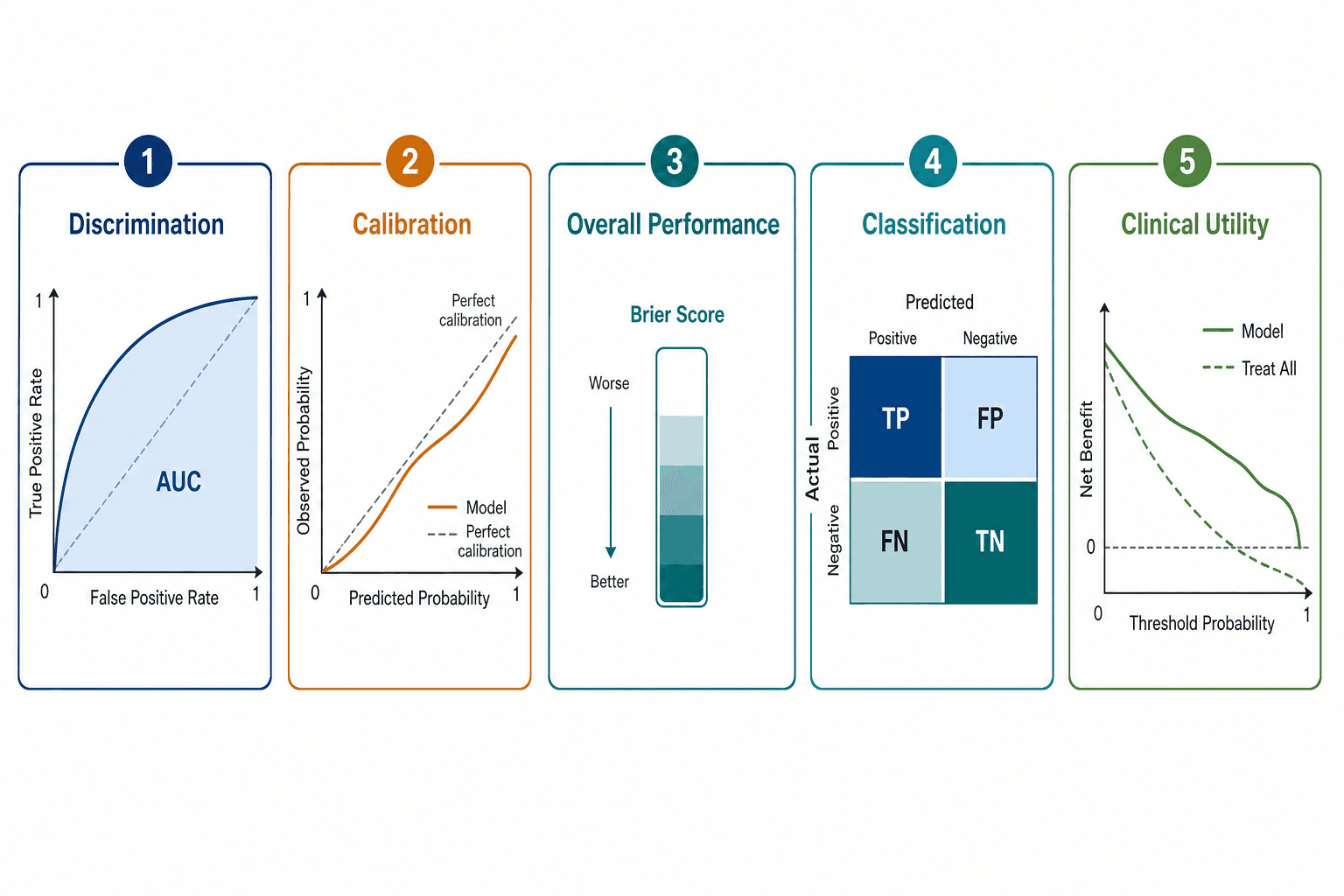
A 2025 landmark review in The Lancet Digital Health by Van Calster and colleagues evaluated 32 performance measures used in clinical AI research and organized them into five distinct performance domains: discrimination, calibration, overall performance, classification, and clinical utility. Each domain measures something fundamentally different. Each is necessary. None is sufficient on its own.
- Discrimination: Can the model correctly rank higher-risk patients above lower-risk ones?
- Calibration: Do the model's predicted probabilities match observed event rates?
- Overall performance: How large is the combined error in the model's probability estimates?
- Classification: At a given decision threshold, how accurately does the model separate positive from negative cases?
- Clinical utility: Does using the model lead to better clinical decisions than available alternatives?
The review also found that 13 of those 32 measures are improper — meaning their expected value can be higher for an incorrect model than for a correct one. Three additional measures lack a clear focus on either statistical or decision-analytical performance. F1 score is the only measure that fails on both counts simultaneously.
This entry covers all five domains and provides a practical framework for interpreting the metrics you will encounter in validation studies, vendor presentations, and procurement decisions. Readers who need foundational AI terminology before engaging with this taxonomy should first consult AI and Health: Core Concepts Every Evaluator Needs to Understand. The discrimination domain — specifically AUROC — is introduced concisely here, with full treatment available in the dedicated AUROC Explained entry.
Discrimination: What AUROC Measures — and What It Cannot
Discrimination is the model's ability to assign higher predicted probabilities to patients who actually experience the outcome than to those who do not. The primary measure of discrimination is the Area Under the Receiver Operating Characteristic Curve (AUROC), also called the C-statistic. An AUROC of 1.0 indicates perfect ranking; 0.5 is no better than chance. The C-statistic answers a specific question: if you randomly select one patient who experienced the outcome and one who did not, what is the probability the model assigned the higher score to the correct patient?
Discrimination is a necessary property of a useful model, but it is not sufficient. A model with excellent discrimination can still assign systematically wrong probabilities — for instance, predicting 60% risk for patients whose true risk is 20%. In that case, the model ranks patients correctly but provides inaccurate probability estimates. Clinical decisions based on those probabilities will be miscalibrated, potentially leading to overtreatment. Discrimination alone cannot detect this problem.
Calibration: Are the Predicted Probabilities Accurate?
The FDA defines model calibration as the process of ensuring that predicted probabilities accurately reflect the observed frequencies of events in the real world. If a well-calibrated model assigns a 20% probability of an event to a group of patients, approximately 20 out of 100 of those patients should actually experience that event. When calibration fails, the model's probability outputs become unreliable as the basis for clinical decisions — even if its discrimination remains strong.
Calibration is assessed through several complementary tools:
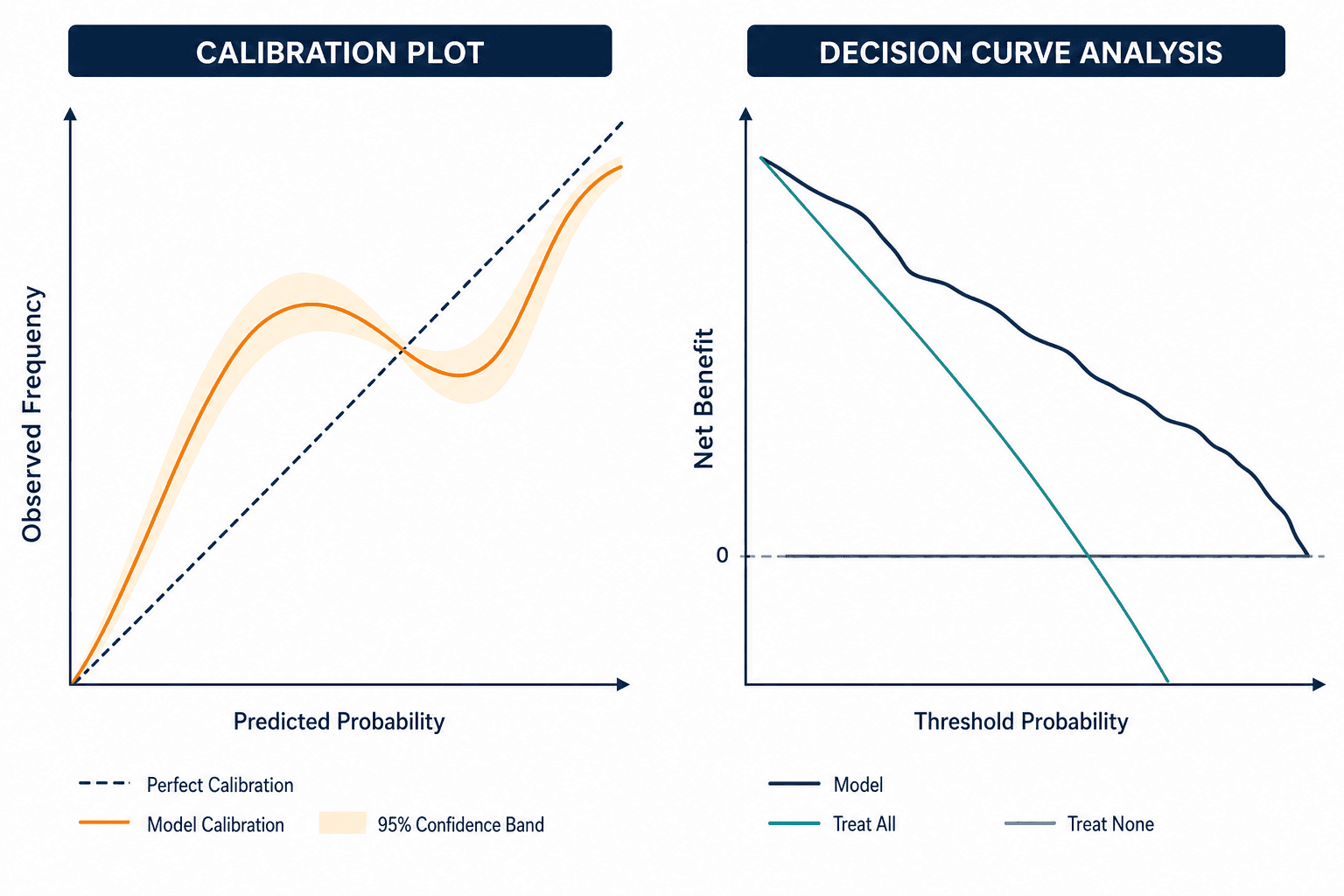
- Calibration plot (reliability diagram): Plots predicted probabilities on the x-axis against observed event rates on the y-axis. A perfectly calibrated model produces points along the 45-degree diagonal. Systematic deviation above the line indicates underestimation of risk; deviation below indicates overestimation.
- Observed-to-Expected (O:E) ratio: The ratio of the total number of observed events to the total number predicted. An O:E ratio of 1.0 indicates perfect mean calibration. Ratios above 1.0 mean the model underestimates event rates; below 1.0 means it overestimates.
- Calibration slope: A regression coefficient from regressing observed outcomes on the model's log-odds predictions. A slope of 1.0 is ideal. Slopes below 1.0 indicate that the model is overconfident — it spreads predicted probabilities too wide relative to what is observed.
- Brier score: The mean squared error between predicted probabilities and observed binary outcomes. Lower scores are better; 0 is perfect. The Brier score captures both discrimination and calibration, making it an overall performance measure as well.
The clinical consequences of miscalibration are direct. An overconfident model — one that predicts high probabilities for patients who are actually low-risk — will cause systematic overtreatment. An underconfident model will cause undertreatment. Neither failure mode is visible in the AUROC.
A 2024 study published in npj Digital Medicine examined a deployed malnutrition prediction model (MUST-Plus) within a large healthcare system. The model had a C-index of 0.81 — indicating strong discrimination — yet was significantly miscalibrated according to both weak and moderate calibration metrics, with a Brier score of 0.26. More critically, the degree of miscalibration differed significantly between White and Black patients and between male and female patients. Logistic recalibration substantially improved calibration across these subgroups in the hold-out sample.
Calibration is also time-sensitive. A model that is well calibrated at the time of internal validation may become miscalibrated after deployment as patient populations, care practices, or data collection processes shift. This is a specific form of performance drift. For post-deployment calibration monitoring, see Model Drift in Deployed Clinical AI. Despite its clinical importance, calibration remains underreported in published validation studies and vendor performance claims.
Classification Metrics: Sensitivity, Specificity, PPV, and NPV
Classification metrics are derived from the confusion matrix — a 2×2 table that counts how a model's binary predictions (positive or negative) relate to actual outcomes (event or no event) at a specific decision threshold. The four cells are true positives (TP), false positives (FP), false negatives (FN), and true negatives (TN).
| Metric | Definition | Conditions on | Key dependency |
|---|---|---|---|
| Sensitivity (Recall) | TP / (TP + FN) — proportion of actual positives correctly identified | True outcome (positive) | Decision threshold |
| Specificity | TN / (TN + FP) — proportion of actual negatives correctly identified | True outcome (negative) | Decision threshold |
| Positive Predictive Value (PPV) | TP / (TP + FP) — proportion of positive predictions that are correct | Predicted classification (positive) | Prevalence + threshold |
| Negative Predictive Value (NPV) | TN / (TN + FN) — proportion of negative predictions that are correct | Predicted classification (negative) | Prevalence + threshold |
Two dependency relationships are essential to understand when interpreting these metrics:
Sensitivity and specificity are threshold-dependent. They describe model performance at a single, specific decision threshold. Lowering the threshold increases sensitivity (more positives are flagged) while decreasing specificity (more false positives are generated). Raising it does the reverse. A study or vendor that reports sensitivity of 92% and specificity of 85% without stating the threshold at which those values were measured is providing incomplete information. The same model at a different threshold will produce entirely different values.
PPV and NPV are prevalence-dependent. Even at a fixed threshold, PPV and NPV change when the model is applied to a population with a different baseline event rate. A model with a PPV of 80% in a high-prevalence ICU setting may have a PPV of 30% when deployed in a general outpatient population with the same condition occurring far less frequently. This is why PPV and NPV from a validation study cannot be assumed to transfer to a new deployment setting without adjustment.
The Lancet Digital Health 2025 review makes a further point that is often overlooked: all classification measures are improper at clinically relevant decision thresholds other than 0.5 or the true prevalence. This means that at the thresholds actually used in clinical practice — which are rarely exactly 0.5 or the population prevalence — these metrics can favor incorrect models over correct ones.
Clinical Utility: Net Benefit and Decision Curve Analysis
Clinical utility is the only performance domain that directly addresses the question a clinician actually cares about: does using this model lead to better decisions than I would make without it? Discrimination, calibration, and classification metrics describe statistical properties of the model. Clinical utility measures whether those properties translate into actionable benefit for patients.
The primary method for assessing clinical utility is decision curve analysis (DCA), which calculates net benefit across a range of decision thresholds. Net benefit is defined as:
Net Benefit = (TP / n) − (FP / n) × (pt / (1 − pt))
where n is the total number of patients and pt is the decision threshold probability — the probability at which the clinician or patient considers the expected benefit of treatment equal to the expected benefit of avoiding treatment. This threshold is not a statistical parameter; it reflects the relative valuation of false positives versus false negatives in a specific clinical context.
A decision curve analysis plot displays net benefit on the y-axis against threshold probability on the x-axis. The model curve is compared to two reference strategies that require no model at all: treat all (assume every patient has the outcome and act accordingly) and treat none (assume no patient has the outcome). A model is only clinically useful at thresholds where its net benefit curve lies above both reference lines. A model that fails to outperform treat-all or treat-none at the thresholds relevant to a clinical decision provides no incremental value — regardless of its AUROC.
Overall Performance: Brier Score and Log-Loss in Context
Overall performance measures combine discrimination and calibration into a single summary score. They are useful for comparing models but cannot replace domain-specific assessment because they do not reveal which component is driving the result.
- Brier score: The mean squared error between predicted probabilities and observed binary outcomes (0 or 1). Ranges from 0 (perfect) to 1. A Brier score of 0.25 represents the performance of a model that assigns 0.5 probability to every patient — i.e., no better than uninformed guessing. The Brier score can be mathematically decomposed into calibration and discrimination components, making it a useful diagnostic tool when interpreted alongside those domain-specific measures.
- Log-loss (binary cross-entropy): Penalizes confident wrong predictions more heavily than uncertain ones. Like the Brier score, it is minimized by a well-calibrated model with good discrimination. Log-loss is more sensitive to extreme probability predictions and is commonly reported in machine learning contexts, though less intuitive for clinical audiences.
Both measures are proper scoring rules — meaning a model that produces accurate probabilities will always achieve a better expected score than one that does not. This is a key property that many classification metrics lack. However, a single overall performance score cannot tell you whether a model's shortcomings are in its ranking ability, its probability accuracy, or both. Use these measures as supporting summaries alongside domain-specific assessment, not as primary evidence.
Proper vs. Improper Measures: Why F1 and Accuracy Mislead in Clinical AI
A proper scoring rule is one whose expected value is maximized only when a model produces the true underlying probabilities. An improper measure can produce a better score for an incorrect model than for a correct one — which means optimizing on an improper measure can steer model development and selection in the wrong direction.
The Lancet Digital Health 2025 review found that 13 of 32 commonly used clinical AI performance measures are improper. Among classification metrics, all are improper at clinically relevant thresholds other than 0.5 or the true prevalence. The following measures deserve specific attention:
| Measure | Problem | Clinical implication |
|---|---|---|
| F1 score | Improper AND lacks clear focus; ignores true negatives; value changes if outcome labels are switched | Should not be used for clinical AI evaluation under any circumstances |
| Classification accuracy | Improper at clinical thresholds; dominated by the majority class in imbalanced datasets | A model predicting 'no event' for every patient can achieve 95% accuracy when event prevalence is 5% |
| AUPRC (Area Under Precision-Recall Curve) | Ignores true negatives; violates decision-analytical principles | True negatives matter in clinical decisions — correctly ruling out a diagnosis has direct value |
| Partial AUROC (pAUROC) | No decision-analytical basis; arbitrary restriction of the ROC curve region | Does not correspond to any clinically meaningful decision scenario |
| Youden index (as threshold selector) | Treats FP and FN as equally costly; inconsistent with decision theory | Clinical costs of false positives and false negatives are almost never equal |
A persistent misconception is that class imbalance — a dataset where the outcome is rare — makes AUROC misleading and justifies switching to AUPRC or F1. The Lancet Digital Health 2025 review explicitly addresses this: class imbalance is an epidemiological property of the data, not a property of the model. AUROC is not affected by class imbalance in the way AUPRC is. Misclassification costs — the relative harm of false positives versus false negatives — are clinical judgments about decision-making, not statistical properties of prevalence. Conflating the two leads to incorrect metric substitution.
The Recommended Core Reporting Set: What to Require in Validation Studies and Vendor Claims
The Lancet Digital Health 2025 review and TRIPOD+AI — the current reporting standard for prediction model studies, replacing TRIPOD-2015 — converge on a minimum core set of four elements that should be present in any credible clinical AI validation report:
- AUROC on an independent external validation set: Provides the discrimination signal. Must be from a dataset not used in model training or internal validation, and ideally from a population that reflects the intended deployment setting.
- Smoothed calibration plot: Provides the calibration signal. A smoothed (loess-fitted) curve is preferred over grouped decile plots, which can obscure miscalibration patterns. The O:E ratio and calibration slope should accompany the plot.
- Net benefit with decision curve analysis at clinically relevant thresholds: Provides the clinical utility signal. Thresholds should be specified based on the clinical context — the relative harm of false positives versus false negatives — not selected to maximize model performance.
- Probability distribution plots by outcome category: Shows the distribution of predicted probabilities separately for patients who experienced the outcome and those who did not. Reveals whether the model adequately separates the two groups and whether predicted probabilities cluster in clinically meaningful ranges.
TRIPOD+AI is a 27-item checklist governing the reporting of studies that develop, validate, or update prediction models — whether using regression or machine learning methods. It applies to diagnostic, prognostic, monitoring, and screening models across all medical domains. Note that TRIPOD+AI governs prediction model reporting; CONSORT-AI is the complementary standard for randomized trial reporting of AI interventions. The two are distinct and address different study designs.
Red-Flag Checklist: Evaluating Vendor Reports and Validation Studies
When reviewing a vendor performance claim or a published validation study, the following patterns should prompt skepticism:
- Only F1 score or classification accuracy is reported, with no discrimination or calibration metrics.
- Sensitivity and specificity are reported without specifying the decision threshold at which they were measured.
- No calibration assessment is included — no calibration plot, O:E ratio, or calibration slope.
- Validation was performed only on the training dataset or a held-out internal split, with no independent external validation.
- Claims of "98% accuracy" without specifying the population, event prevalence, or decision threshold.
- No discussion of clinical utility — no net benefit analysis, no comparison to treat-all or treat-none strategies.
- Demographic subgroup performance is absent — no reporting of calibration or discrimination stratified by race, sex, age, or other clinically relevant characteristics.
- AUPRC or pAUROC is presented as the primary performance measure, particularly in imbalanced datasets, without acknowledgment of their decision-analytical limitations.
- The Youden index is used to justify the chosen decision threshold without clinical rationale.
A model that satisfies the core reporting set — AUROC on external validation, smoothed calibration plot, net benefit with DCA, and probability distribution plots — provides the minimum evidence base for a meaningful evaluation conversation. A model that lacks any of these elements is incompletely characterized, regardless of how its headline metric reads.
Comments
Join the discussion with an anonymous comment.