
Term Definitions: Substantial Equivalence and Predicate Device
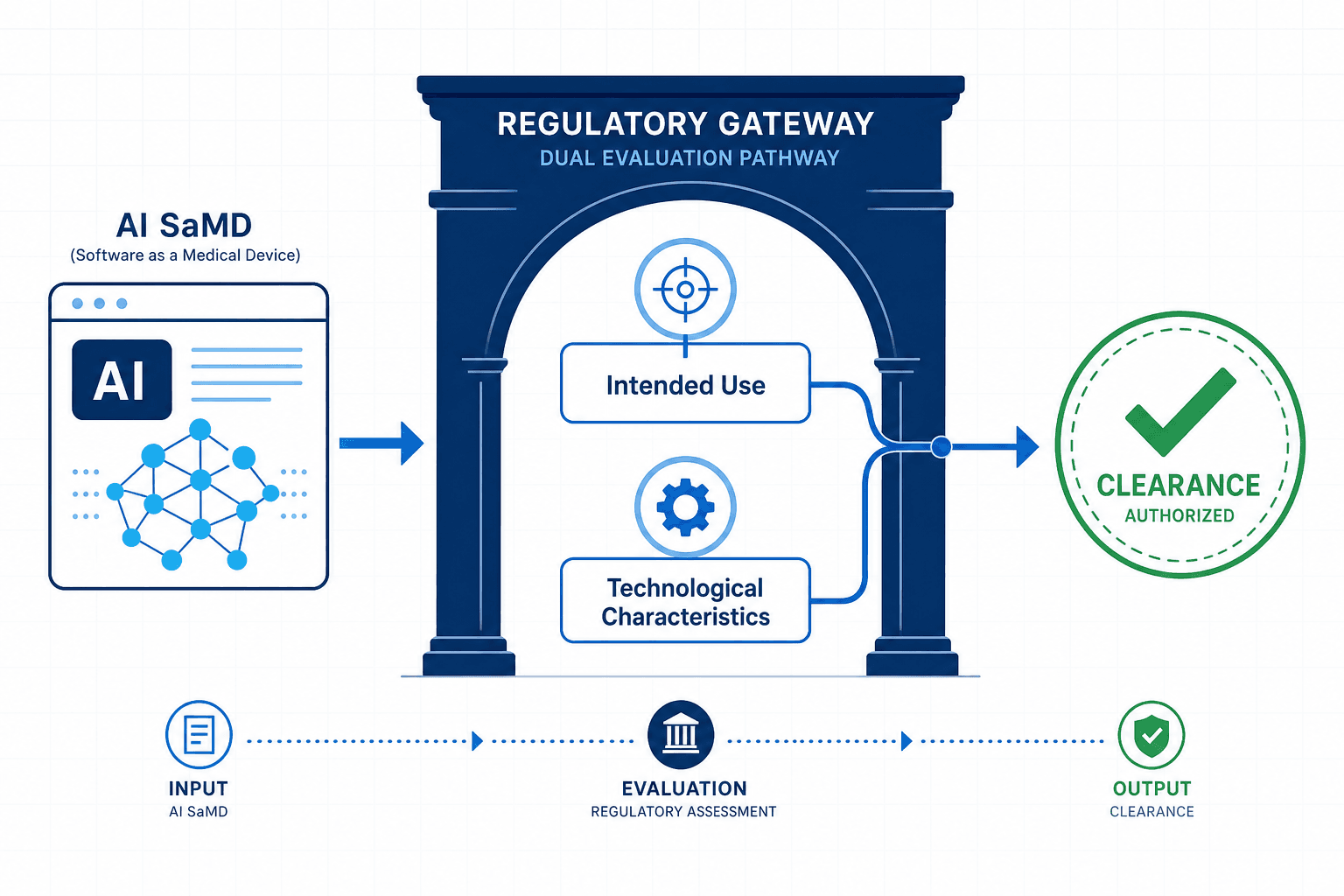
Substantial equivalence (SE) is the legal standard under Section 513(i) of the Federal Food, Drug, and Cosmetic Act (FD&C Act) by which the FDA determines whether a new medical device may be marketed without undergoing premarket approval. A device is substantially equivalent to a predicate if it has the same intended use as the predicate and either (a) the same technological characteristics, or (b) different technological characteristics that do not raise new questions of safety or effectiveness and demonstrate that the device is at least as safe and effective as the predicate.
Predicate device refers to a legally marketed U.S. medical device to which a new device is compared in a 510(k) submission. A predicate does not need to be identical to the new device — it serves as the regulatory benchmark against which intended use and technological characteristics are evaluated. The predicate must itself have a documented legal marketing status; it cannot be a device that was recalled, withdrawn from the market at FDA's request, or removed from the 510(k) database.
These two concepts are inseparable in practice. Substantial equivalence is the outcome; the predicate device is the reference point that makes the determination possible. A 510(k) submission without a valid predicate cannot demonstrate SE, and SE cannot be established without a defined comparison standard.
Legal and Regulatory Basis
The SE standard is established in Section 513(i) of the FD&C Act, which was introduced by the Medical Device Amendments of 1976 and has been amended by subsequent legislation including the Safe Medical Devices Act of 1990 and the FDA Modernization Act of 1997. The implementing regulations appear primarily in 21 CFR Part 807, Subpart E.
The FDA's July 2014 guidance document, "The 510(k) Program: Evaluating Substantial Equivalence in Premarket Notifications," remains the foundational interpretive document for SE determinations. It codifies the two-step decision framework, defines the types of legally marketed predicates, and establishes the evidentiary standards for technological characteristics comparison.
For AI-enabled Software as a Medical Device (SaMD), additional regulatory authority has accumulated through subsequent FDA guidance documents, including the 2019 discussion paper on AI/ML-based SaMD, the 2021 AI/ML Action Plan, and most materially, the January 2025 draft guidance and August 2025 final guidance on AI-Enabled Device Software Functions — each of which modifies or supplements how SE is demonstrated for AI SaMD.
- FD&C Act §513(i): Statutory definition of substantial equivalence and the conditions under which NSE is determined
- 21 CFR Part 807, Subpart E: Regulatory requirements for premarket notification submissions, including 510(k) content and format
- FDA July 2014 SE Guidance: Foundational interpretive document for the two-step SE determination process
- FDA January 2025 Draft Guidance on AI-Enabled Device Software Functions: Introduces AI-specific SE evidence requirements including demographic performance data and total product lifecycle risk management
- FDA August 2025 Final Guidance on AI-Enabled Device Software Functions: Adds the PCCP predicate nuance — SE comparison must be made to a predicate before its PCCP-implemented changes
The SE Determination Process: Two-Step Decision Framework
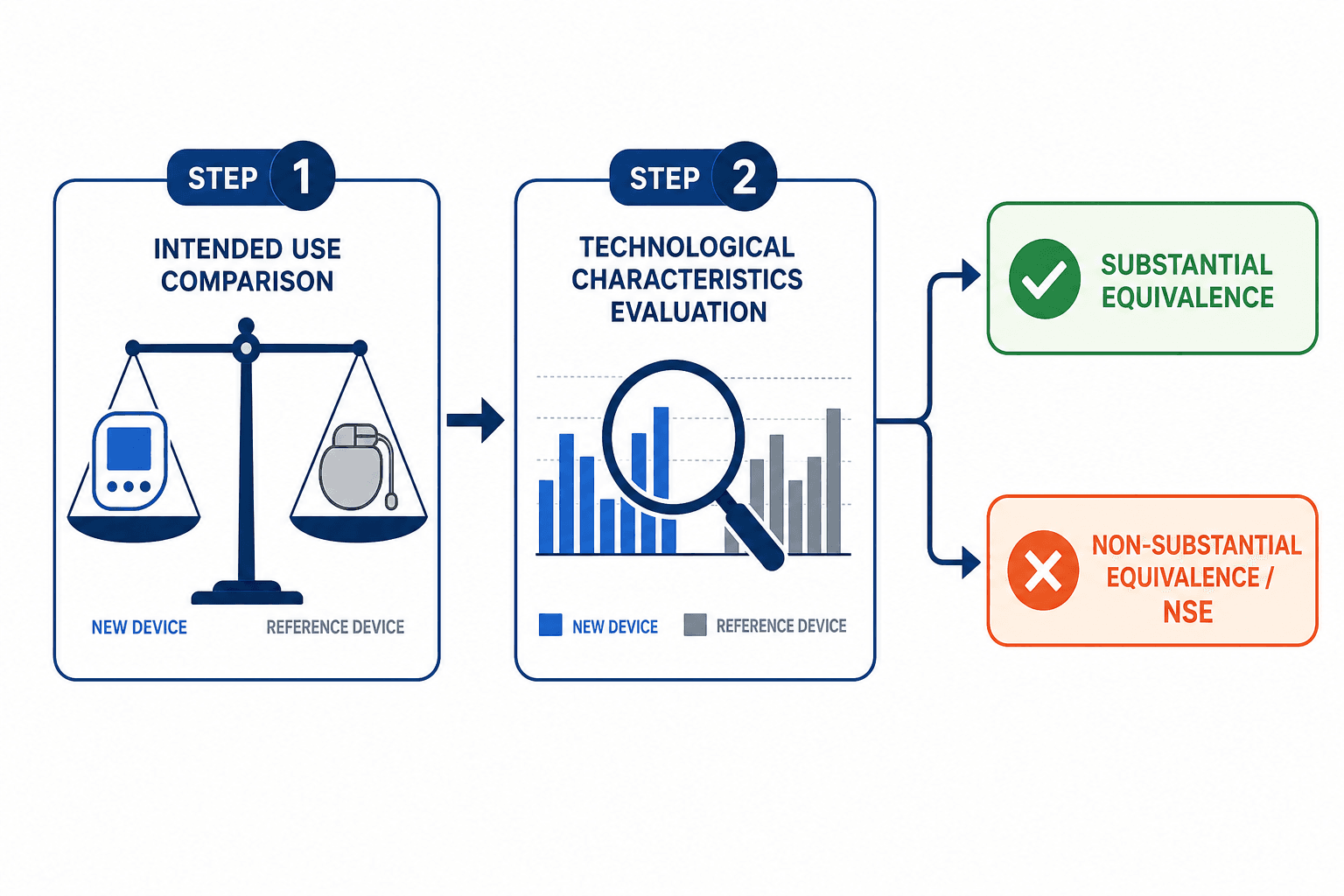
The FDA applies a sequential two-step process when evaluating whether a new device is substantially equivalent to a predicate. The steps are not parallel — they are strictly ordered, and the outcome of Step 1 determines whether Step 2 is reached at all.
Step 1 evaluates intended use. The FDA compares the indications for use and intended patient population of the new device against the predicate. If the intended use differs in any material respect — a different clinical indication, a different patient population, or a different point in the care pathway — the FDA issues a Not Substantially Equivalent (NSE) determination without proceeding to Step 2. There is no remediation path within the 510(k) framework for an intended-use mismatch.
Step 2 evaluates technological characteristics. Only if intended use matches does the FDA assess whether the new device's technological characteristics are the same as or different from the predicate's. If they are the same, SE is found. If they differ, the FDA evaluates whether those differences raise new questions of safety or effectiveness. If they do not raise new questions and performance data support equivalent or superior safety and effectiveness, SE may still be found.
| Step | Evaluation Question | Match Outcome | Mismatch Outcome |
|---|---|---|---|
| Step 1 | Does the new device have the same intended use as the predicate? | Proceed to Step 2 | Automatic NSE — 510(k) pathway closes |
| Step 2A | Are the technological characteristics the same as the predicate? | SE found | Proceed to Step 2B |
| Step 2B | Do different technological characteristics raise new safety or effectiveness questions? | SE may be found with performance data | NSE — may pursue De Novo or PMA |
An NSE determination does not mean the device is unsafe or ineffective. It means the device cannot be cleared through the 510(k) pathway and must either pursue De Novo authorization (if it presents low-to-moderate risk and no valid predicate exists) or premarket approval (PMA) for high-risk devices.
Predicate Device: Types, Selection, and Constraints
Not every marketed medical device qualifies as a predicate. The FD&C Act and FDA guidance specify four categories of legally marketed devices that may serve as predicates in a 510(k) submission:
- 510(k)-cleared devices: Devices previously cleared by the FDA through the 510(k) pathway, which constitute the large majority of available predicates
- De Novo-authorized devices: Devices that received a De Novo authorization, which creates a new device classification and product code — De Novo-authorized devices explicitly serve as predicates for subsequent 510(k) submissions in that classification
- Preamendments devices: Devices that were legally marketed in the U.S. before the Medical Device Amendments of 1976 and have not been required to submit a 510(k) or PMA, provided they have been continuously marketed since that date
- Downclassified PMA devices: Devices originally approved through PMA that were subsequently reclassified to Class II, making them available as predicates
Sponsors may rely on a single primary predicate or combine a primary predicate with one or more secondary predicates. A split predicate approach — using one predicate to establish intended-use equivalence and a separate predicate to establish technological characteristics equivalence — is permitted under the 2014 SE guidance, but the FDA has signaled increasing scrutiny of this approach when the two predicates are not closely related. Using a split predicate does not eliminate the requirement that the new device's combination of intended use and technological characteristics be coherent and not raise new safety or effectiveness questions.
A critical distinction for AI SaMD developers: De Novo authorization is not a faster 510(k). De Novo is a separate regulatory pathway for novel, low-to-moderate risk devices with no valid predicate. It requires the FDA to create a new product code and establish special controls — a process that takes considerably longer than 510(k) review. However, once a De Novo authorization is granted, that device becomes an original predicate for subsequent 510(k) submissions, creating a new branch of the predicate tree.
The 510(k) Pathway and AI SaMD: Prevalence and Context
The 510(k) SE pathway is not merely one option among several for AI medical device developers — it is the dominant route by a substantial margin. More than 95% of FDA-cleared AI-enabled medical devices have reached market through 510(k) clearance, with De Novo authorizations accounting for a small but growing fraction of AI device authorizations, and PMA approvals remaining rare for AI SaMD.
The practical appeal of the 510(k) pathway for AI SaMD developers reflects its timeline advantage. Median clearance time for AI devices cleared via 510(k) is approximately 142 days, compared to approximately 338 days for De Novo authorization. For commercially competitive AI products — particularly in radiology, cardiology, and pathology — this timeline differential is material to market entry strategy.
Real-world examples of AI SaMD cleared via 510(k) SE span multiple clinical specialties. Arterys received 510(k) clearance for AI-assisted cardiac MRI analysis. Viz.ai's LVO detection software for stroke triage was cleared via 510(k). The accumulation of cleared AI devices — exceeding 700 as of recent FDA counts — has itself created a growing pool of AI-specific predicates, partially reducing the earlier dependence on non-AI predicates.
| Pathway | Typical Use Case | Median Review Time | Creates New Predicate? |
|---|---|---|---|
| 510(k) | New device with valid predicate; most AI SaMD | ~142 days | No — relies on existing predicate |
| De Novo | Novel device, no valid predicate, low-to-moderate risk | ~338 days | Yes — establishes new product code and controls |
| PMA | High-risk device, no valid predicate or insufficient SE | 12–24+ months | No — PMA approval does not create a 510(k) predicate |
AI-Specific Challenges: Predicate Creep and Non-AI to AI Transitions
The static predicate-based SE framework was designed for conventional hardware devices with fixed performance characteristics. AI-enabled SaMD introduces structural tensions that the 510(k) framework was not originally designed to accommodate.
Predicate creep refers to the gradual drift of a device's intended use or technological characteristics away from the original preamendments or early-generation predicate through successive 510(k) clearances, each of which is found SE to the immediately prior device. Over multiple generations, the cleared device may bear little functional resemblance to the original predicate that anchored the chain.
A 2023 systematic analysis published in The Lancet Digital Health examined predicate networks for 285 AI-enabled medical devices cleared by the FDA between 2019 and 2021. The study found that more than a third of cleared AI devices cited non-AI predicate devices in the first generation of their predicate chain. For radiology AI devices specifically, the AI/ML task changed approximately every second predicate link — meaning that within two clearance generations, the clinical function being performed by the algorithm had materially shifted from what the predicate device performed.
The non-AI to AI predicate transition is a related but distinct challenge. When a sponsor uses a conventional (non-AI) software device as a predicate for an AI-enabled device, the technological characteristics comparison must address the AI/ML components explicitly. A rule-based clinical decision support tool, for example, has fundamentally different performance characteristics than a deep learning model trained on imaging data — different failure modes, different sensitivity to distribution shift, different behavior under edge cases. The SE framework requires the sponsor to demonstrate that these differences do not raise new safety or effectiveness questions, but the evidentiary standards for that demonstration were not fully specified until recent FDA guidance.
Adaptive and continuously learning algorithms present a further structural tension. A 510(k) clearance is granted based on the device's performance at a specific point in time — the state of the algorithm at submission. If the algorithm continues to learn or is retrained post-clearance, its performance characteristics may diverge from those of the predicate state used in the SE determination. Prior to the introduction of Predetermined Change Control Plans (PCCPs), there was no regulatory mechanism within the 510(k) framework to authorize planned post-market algorithm modifications, creating a gap between regulatory status and operational reality for continuously learning AI systems.
Regulatory Evolution: FDA 2025 Guidance on AI-Enabled Device Software Functions
The SE framework for AI SaMD is not static. The FDA has materially updated its SE evidence expectations for AI-enabled devices through two significant guidance actions in 2025.
The January 2025 draft guidance on AI-Enabled Device Software Functions introduced several AI-specific requirements for marketing submissions, including 510(k)s. Sponsors are now expected to explicitly state that the device uses AI, provide demographic-stratified performance data demonstrating that the device performs adequately across relevant patient subpopulations, and address total product lifecycle (TPLC) risk management — including how the device will be monitored for performance degradation post-market. These requirements reshape the evidentiary standard for the technological characteristics comparison in Step 2 of the SE determination.
The August 2025 final guidance on AI-Enabled Device Software Functions introduced a consequential nuance specific to PCCP-enabled predicates. When a sponsor selects a predicate device that itself had an authorized Predetermined Change Control Plan, the SE comparison must be made to that predicate before any modifications implemented under that PCCP were made — not to the predicate's current post-modification state. This requirement prevents a form of predicate inflation in which a sponsor compares their new device to an already-modified version of the predicate, potentially obscuring how far the new device has drifted from the original cleared baseline.
- January 2025 draft guidance: Requires explicit AI disclosure, demographic performance data by subpopulation, and TPLC risk management in 510(k) submissions for AI-enabled devices
- August 2025 final guidance: Establishes that when a predicate had an authorized PCCP, SE comparison is made to the predicate's pre-PCCP-modification state
- Implication for predicate selection: Sponsors must now document not only the identity of their predicate but its modification history under any authorized PCCP
- Implication for SE evidence: Performance data must address demographic subgroup performance, not only aggregate metrics — a higher evidentiary bar than prior practice
Taken together, these guidance actions represent a shift from treating AI SaMD as functionally equivalent to conventional software devices for SE purposes, toward a framework that acknowledges the distinct technical characteristics of AI systems and requires evidence tailored to those characteristics. The SE standard itself has not changed — the statutory language of §513(i) remains the same — but the FDA's interpretation of what constitutes adequate evidence of SE for AI-enabled devices has evolved substantially.
Related Terms
The following terms appear frequently in connection with substantial equivalence and predicate device determinations for AI SaMD. Each is defined briefly in its relationship to SE concepts.
| Term | Brief Definition | Relationship to SE / Predicate Device |
|---|---|---|
| De Novo Authorization | An FDA premarket pathway for novel, low-to-moderate risk devices with no valid predicate, resulting in a new device classification and product code | NSE under 510(k) may lead to De Novo; De Novo-authorized devices become original predicates for future 510(k)s |
| PMA (Premarket Approval) | The FDA's most stringent premarket pathway, required for Class III high-risk devices that cannot demonstrate SE | Devices requiring PMA cannot use the 510(k) SE pathway; PMA approval does not create a 510(k) predicate |
| PCCP (Predetermined Change Control Plan) | An FDA-authorized plan submitted with a device marketing application specifying the types of device modifications the manufacturer may make post-clearance without a new submission | August 2025 guidance requires SE comparison to a predicate's pre-PCCP state when the predicate had an authorized PCCP |
| SaMD (Software as a Medical Device) | Software intended to be used for one or more medical purposes that performs those purposes without being part of a hardware medical device, as defined by the IMDRF | Most AI-enabled medical devices are classified as SaMD; SE determination applies to SaMD under the same §513(i) standard |
| GMLP (Good Machine Learning Practice) | A set of FDA-recognized practices for the development, testing, and deployment of AI/ML-based SaMD, analogous to Good Manufacturing Practice for hardware devices | GMLP compliance is increasingly referenced in SE evidence submissions as part of total product lifecycle risk management |
| eSTAR (Electronic Submission Template and Resource) | The FDA's standardized electronic format for 510(k) and De Novo submissions, which now includes AI-specific modules following 2025 guidance updates | AI SaMD 510(k) submissions using eSTAR must complete AI-specific sections addressing algorithm description, training data, and performance across subpopulations |
| QMSR (Quality Management System Regulation) | The FDA's updated quality system regulation for medical devices, aligned with ISO 13485, effective February 2026 | QMSR requirements apply to AI SaMD manufacturers and interact with TPLC risk management expectations in the 2025 SE guidance for AI devices |
Comments
Join the discussion with an anonymous comment.