
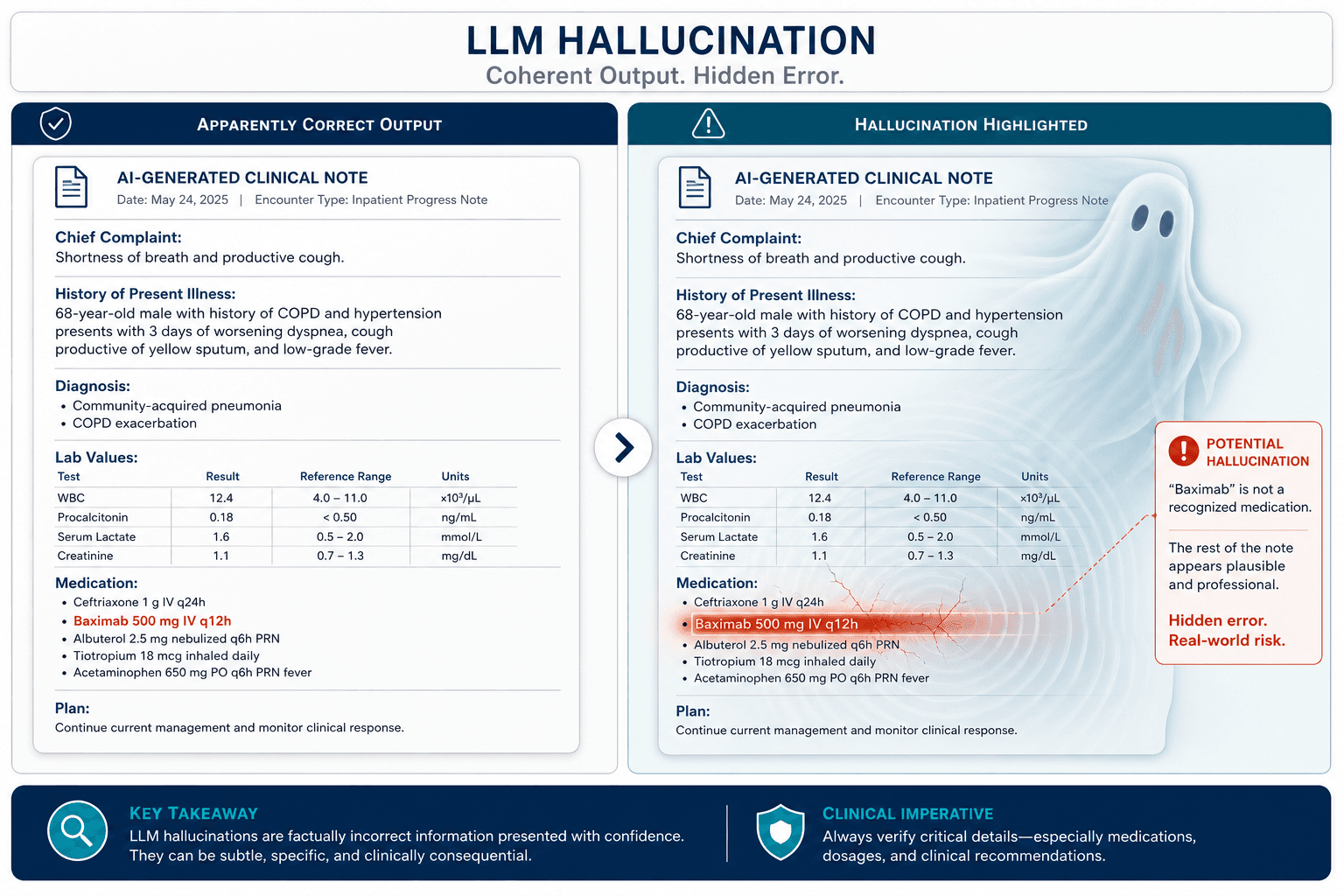
Definition and Clinical Framing
In the clinical AI context, hallucination refers to any model-generated output that is factually incorrect, logically inconsistent, or unsupported by authoritative clinical evidence in ways that could alter clinical decisions. This definition, grounded in the medical hallucination literature, distinguishes clinical hallucination from the broader AI usage of the term by anchoring it to patient-care consequences rather than general accuracy.
A related but distinct failure mode is confabulation: the model draws on real information but misrepresents, distorts, or misapplies it. An AI tool that invents a medical condition or cites a study that was never published is hallucinating. An AI tool that cites a legitimate guideline but misquotes its recommendation or applies it to the wrong patient population is confabulating. The practical distinction matters for governance: hallucination is primarily a training and grounding problem, while confabulation is primarily a reasoning and context problem — and each calls for somewhat different mitigation strategies.
The term "hallucination" has been criticized for anthropomorphizing AI systems, and alternatives such as "fabrication" or "confabulation" appear in parts of the literature. For clinical and regulatory purposes, the operational definition above — focused on potential to alter clinical decisions — is more useful than any etymological debate about terminology.
Why Clinical Hallucination Differs from General LLM Hallucination
General LLM hallucination — an AI assistant confidently naming a fictional book, inventing a historical date, or fabricating a software API — is a usability and trust problem. Clinical LLM hallucination is a patient safety problem. Three structural differences account for this gap.
- Clinical plausibility and expert-only detectability. Medical language is highly specialized. An LLM can generate a fabricated drug interaction, a non-existent syndrome, or an invented lab reference range using correct terminology, appropriate formatting, and plausible clinical reasoning — making the error undetectable to non-specialists and easily missed even by experienced clinicians under time pressure.
- High-precision task context. Clinical LLMs are increasingly applied to diagnostic reasoning, therapeutic planning, medication reconciliation, and laboratory interpretation — tasks where small inaccuracies cascade. A misattributed contraindication, a fabricated sensitivity result, or an incorrect dosing threshold is not a minor error; it is a potential harm event.
- Direct patient harm potential. A hallucination in a consumer chatbot degrades user experience. A hallucination in a clinical decision support tool can contribute to misdiagnosis, inappropriate treatment, or medication error. The consequence severity places clinical hallucination in a different risk category entirely.
The clinical stakes are not theoretical. In a global clinician survey of 70 practitioners, 91.8% reported having encountered medical hallucinations in AI-generated clinical content, and 84.7% considered them capable of causing patient harm. These figures, from the Kim et al. 2025 study, reflect not a hypothetical risk but a failure mode that clinicians are already encountering in practice.
Taxonomy of Hallucination Types
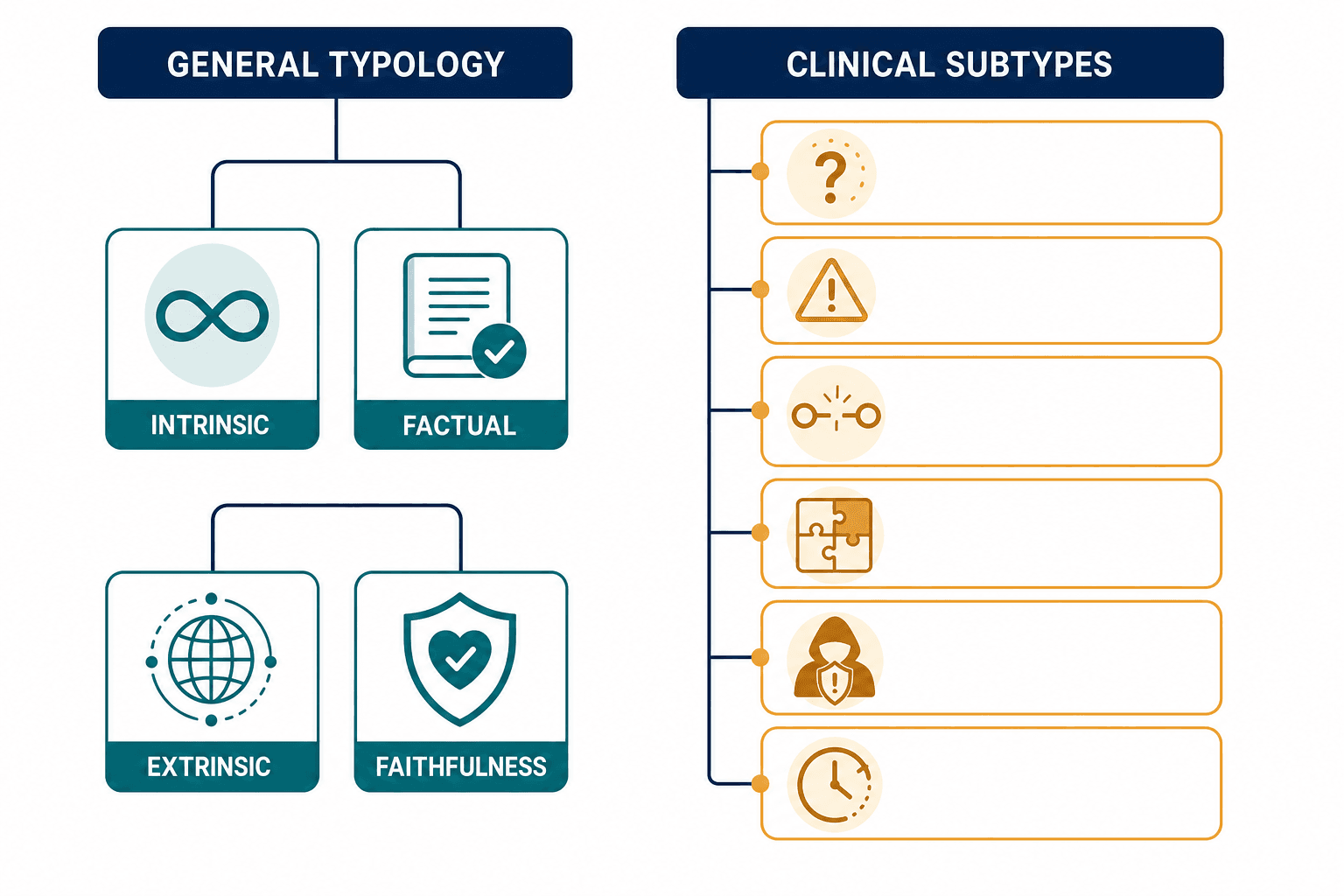
Understanding the specific forms hallucination takes in clinical outputs is a prerequisite for designing detection and mitigation workflows. The taxonomy operates at two levels: a general typology applicable across LLM domains, and a clinical-specific subtype classification derived from empirical analysis of medical AI outputs.
General Typology
The foundational typology distinguishes hallucinations along two axes. The first axis separates intrinsic hallucinations (output contradicts information present in the source or prompt) from extrinsic hallucinations (output adds content that cannot be verified or contradicted from the source — it simply wasn't there). The second axis separates factual hallucinations (errors in world-knowledge claims) from faithfulness hallucinations (errors in summarization or paraphrase fidelity, where the model's output diverges from a provided source document).
Clinical-Specific Subtypes
Empirical analysis of LLM outputs in clinical note generation and medical reasoning tasks has identified a more granular subtype structure. The Asgari et al. study in npj Digital Medicine, which analyzed 12,999 clinician-annotated sentences across 18 experimental configurations, identified four primary subtypes by frequency:
| Subtype | Frequency (Asgari et al.) | Clinical Example | Risk Level |
|---|---|---|---|
| Fabrication | 43% | AI generates a lab value (e.g., serum creatinine 1.2 mg/dL) that was never measured or documented in the patient record. | High — introduces false data into clinical reasoning |
| Negation | 30% | AI states a symptom was absent when the source note recorded it as present, or vice versa. | High — reverses clinical findings |
| Causality | 17% | AI incorrectly attributes a symptom to a condition (e.g., linking peripheral edema to a cardiac cause when the documented cause was hepatic). | High — distorts diagnostic reasoning |
| Contextual | 10% | AI applies a finding from one clinical encounter to the wrong patient, date, or clinical context. | Moderate to high — misplaces accurate information |
The Kim et al. / medrXiv taxonomy adds four additional clusters that extend beyond note summarization to the broader clinical AI deployment context:
- Outdated references. The model draws on guidelines or drug approvals that have since been superseded — for example, citing a dosing recommendation that was revised after the model's training cutoff.
- Spurious correlations. The model associates clinical features based on statistical co-occurrence in training data rather than established pathophysiology — for example, linking a demographic feature to a diagnosis in a way that reflects dataset bias rather than clinical reality.
- Fabricated sources or guidelines. The model invents citations — a non-existent clinical trial, a fictional guideline reference, or a fabricated expert consensus statement — presented with sufficient specificity to appear credible.
- Incomplete reasoning chains. The model reaches a diagnostic or therapeutic conclusion that is plausible at the surface level but omits critical intermediate reasoning steps — for example, recommending a treatment without accounting for a documented contraindication present elsewhere in the record.
Adversarial Hallucination: A Distinct High-Risk Subtype
Adversarial hallucination deserves specific attention because it represents a failure mode that most clinical AI evaluations do not routinely test for. In adversarial conditions — where a clinical prompt contains a single fabricated detail, such as a fictitious laboratory test, a non-existent physical finding, or an invented syndrome — LLMs do not reject the false premise. They accept it, reason from it, and generate clinically coherent outputs built on the fabricated foundation.
The Omar et al. study in Communications Medicine tested six leading LLMs against 300 physician-validated clinical vignettes, each containing one fabricated detail. Hallucination rates under default settings ranged from 50% to 83% across models. Even the best-performing model (GPT-4o) hallucinated in approximately half of adversarial cases. A targeted mitigation prompt reduced the overall mean rate from 65.9% to 44.2% — a statistically significant improvement that still left nearly half of adversarial inputs generating hallucinated outputs.
Root Causes
Clinical hallucination does not have a single cause. It emerges from the intersection of training data limitations, architectural properties of current LLMs, and domain-specific characteristics of medical knowledge. Understanding the causal structure helps evaluate which mitigation strategies address which failure modes.
Data-Related Causes
- EHR noise and documentation inconsistency. Clinical training data drawn from electronic health records contains abbreviations, free-text ambiguity, transcription errors, and inconsistent terminology across institutions and specialties. Models trained on this data inherit its inconsistencies.
- Outdated clinical guidelines. Medical knowledge evolves continuously. A model trained on literature with a fixed cutoff date will generate outputs reflecting superseded guidelines, withdrawn medications, or deprecated diagnostic criteria — without any indication that the information is no longer current.
- Underrepresented populations. Training datasets that underrepresent certain demographic groups, rare conditions, or non-Western clinical contexts produce models that hallucinate more frequently — and less detectably — when applied to those populations.
- Rapidly evolving medical knowledge. Clinical AI operates in a domain where evidence evolves faster than training cycles. The gap between a model's knowledge state and current best practice widens over time after deployment.
Model-Related Causes
- Autoregressive optimization over epistemic accuracy. Current transformer-based LLMs are trained to predict the next token based on likelihood — they are optimized to produce fluent, plausible text, not to distinguish between what they know and what they don't. This architectural property means models will generate confident-sounding outputs even when the underlying information is absent or uncertain.
- Overconfidence and poor calibration. Clinical LLMs frequently fail to express appropriate uncertainty. They generate definitive-sounding statements in contexts where a well-calibrated model should hedge, defer, or decline to answer.
- Limited causal reasoning. A critical finding from the Kim et al. analysis: 64–72% of residual hallucinations that persisted after chain-of-thought mitigation stemmed from causal and temporal reasoning failures — not from knowledge gaps. The model knew the relevant facts but failed to reason correctly about their causal relationships or temporal sequence.
Domain-Specific Causes
- Medical terminology ambiguity. The same term can carry different meanings across specialties, clinical contexts, or regional conventions. Ambiguous inputs generate ambiguous — and sometimes incorrect — outputs.
- High-precision requirement. Clinical tasks tolerate far less error than most general-purpose applications. A 3% error rate that would be acceptable in a consumer recommendation system is clinically significant in a medication dosing or diagnostic support context.
- Interconnected concept cascades. Clinical reasoning is deeply interconnected. An error in one step — a misidentified pathophysiology, a wrong causal link — propagates through subsequent reasoning, producing outputs that are internally consistent but clinically wrong.
Detection Methods
No single detection method is sufficient for clinical contexts. The characteristics that make clinical hallucination dangerous — domain-specific plausibility, coherent structure, confident tone — also make it resistant to automated detection. The current evidence supports a layered, hybrid approach combining automated methods with human expert review.
| Detection Method | How It Works | Clinical Strengths | Limitations |
|---|---|---|---|
| Factual verification (FACTSCORE-style) | Decomposes model output into atomic facts; retrieves supporting evidence for each from a reference corpus; scores each fact as supported or unsupported. | Systematic; can be applied at scale; identifies unsupported claims in structured outputs. | Requires a reliable reference corpus; may miss errors in reasoning chains rather than factual claims; computationally intensive at scale. |
| NLI-based consistency checks | Uses a natural language inference model to assess whether each claim in the output is entailed by, neutral to, or contradicts a reference document or prior context. | Detects intrinsic hallucinations (output contradicts source); automatable. | Depends on NLI model quality; less effective for extrinsic hallucinations where no reference document exists. |
| QA-based consistency | Generates questions from the output, retrieves answers from a reference source, and checks whether the output answers are consistent with retrieved answers. | Effective for summarization tasks; catches misattribution and negation errors. | Question generation quality affects reliability; does not address fabricated sources with no reference. |
| Uncertainty quantification (semantic entropy, sequence log-probability) | Measures model confidence via token probability distributions or semantic consistency across multiple output samples. | Provides a continuous hallucination risk signal; does not require external reference. | High uncertainty does not always correlate with hallucination; low uncertainty does not guarantee accuracy; calibration varies by model. |
| Human expert annotation | Domain-expert clinicians review model outputs for factual accuracy, clinical coherence, and potential harm. | Current gold standard; captures subtle clinical errors automated methods miss; provides harm severity classification. | Expensive; slow; moderate inter-rater agreement even among experts; not scalable for real-time deployment. |
The Asgari et al. study used clinician annotation across 12,999 sentences to establish ground truth — underscoring that even at research scale, human expert review remains the reference standard against which automated detection is benchmarked. In deployed systems, the cost and latency of expert annotation make it unsuitable as a primary real-time detection mechanism, but it remains essential for periodic auditing, model validation, and calibration of automated detection thresholds.
Mitigation Strategies
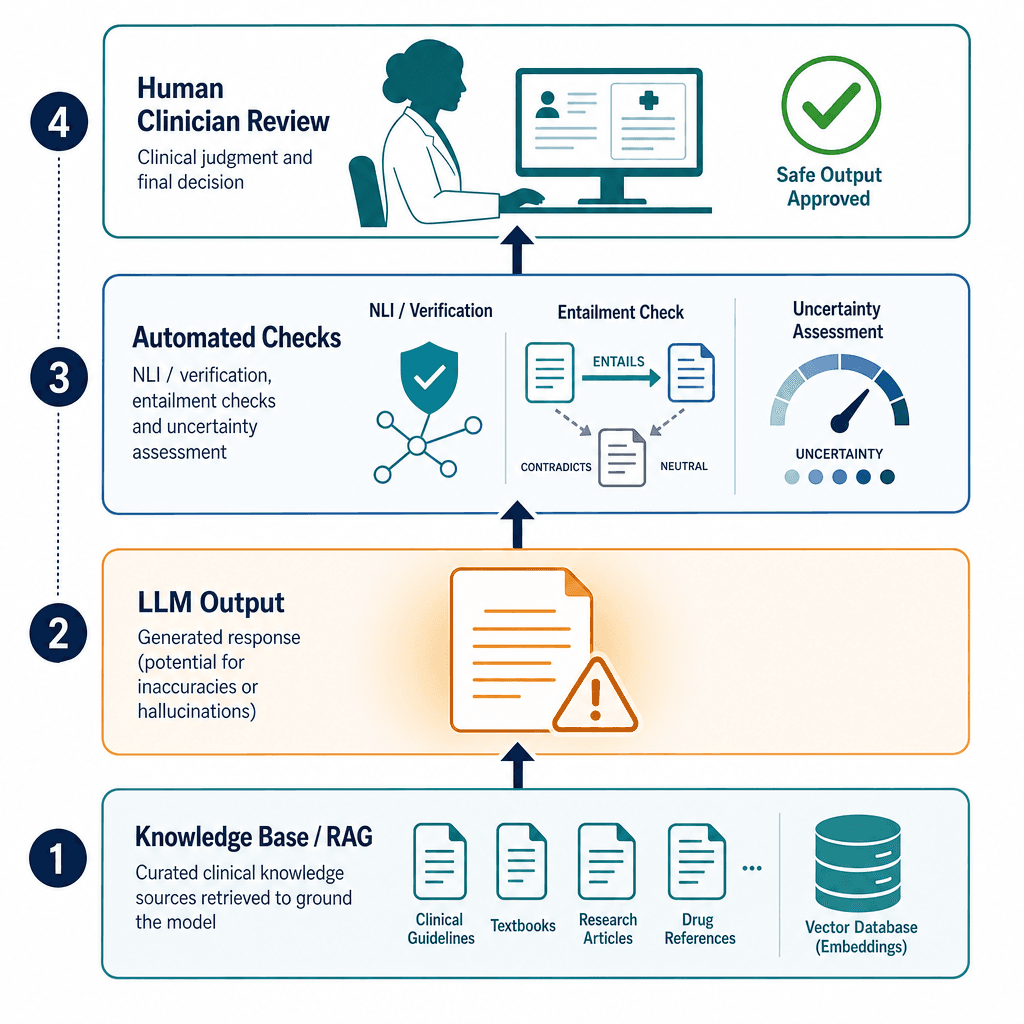
Mitigation of clinical hallucination requires a complementary stack of techniques. The research literature is unambiguous on one point: no single approach eliminates hallucination in clinical LLM outputs. The goal of mitigation is reduction to clinically acceptable rates, not elimination — and what constitutes an acceptable rate depends on the specific clinical task, consequence severity, and human oversight structure.
Retrieval-Augmented Generation (RAG)
RAG grounds model outputs in verified external knowledge sources — clinical guidelines, drug databases, curated literature — by retrieving relevant documents at inference time and conditioning the model's response on that retrieved content. It is the most widely deployed mitigation technique in clinical AI and is particularly effective for factual and outdated-knowledge hallucinations.
RAG outperforms model-only approaches on complex clinical reasoning tasks, but it does not resolve reasoning-chain failures — the 64–72% of residual hallucinations attributable to causal and temporal reasoning errors persist even when factual grounding is improved. RAG is a necessary component of a mitigation stack, not a sufficient one.
Chain-of-Thought Prompting
Chain-of-thought (CoT) prompting instructs the model to reason through intermediate steps before producing a final answer, improving both accuracy and hallucination resistance. Across the benchmarks analyzed by Kim et al., CoT prompting reduced hallucinations in 86.4% of tested comparisons. The effect was pronounced for frontier models: Gemini-2.5 Pro exceeded 97% accuracy with CoT prompting, compared to a base rate of 87.6% without it.
CoT is most effective for reasoning-chain hallucinations — the failure mode it directly targets by externalizing intermediate steps. It is less effective for factual hallucinations where the model's parametric knowledge is simply incorrect, and it does not address adversarial hallucination, where the model reasons coherently from a false premise.
Structured Prompt Engineering
Iterative prompt engineering — constraining the model's output format, specifying what information to include and exclude, and instructing the model to express uncertainty or decline to answer when evidence is insufficient — can meaningfully reduce hallucination rates. The Asgari et al. study found that iterative prompt engineering reduced major hallucinations by 75% in one experimental pair. Best-performing configurations achieved fewer errors per note than previously reported human note-taking rates.
For adversarial hallucination specifically, the Omar et al. study found that a targeted mitigation prompt reduced the overall mean hallucination rate from 65.9% to 44.2% — statistically significant but still leaving nearly half of adversarial inputs generating hallucinated outputs. Prompt engineering reduces adversarial vulnerability; it does not eliminate it.
Additional Mitigation Approaches
- Knowledge graphs. Structured medical knowledge graphs (e.g., SNOMED CT, RxNorm, UMLS) can constrain model outputs to verified concept relationships, reducing spurious correlation and fabricated association hallucinations.
- Critic and self-reflection architectures. Multi-agent configurations where a second model evaluates the primary model's output for factual accuracy and consistency can catch errors before they reach the end user. Self-reflection prompting — asking the model to review its own output — provides partial benefit but is less reliable than an independent critic model.
- Uncertainty communication. Explicitly surfacing model confidence levels, flagging low-confidence outputs, and declining to answer in high-uncertainty contexts are deployment-level mitigations that shift some detection burden to the clinician — appropriate only when the clinician has the domain expertise and time to evaluate the uncertainty signal.
- Human-in-the-loop workflows. Structural integration of clinical review before AI outputs reach decision points — not as a catch-all but as a designed workflow component — remains the most reliable mitigation for high-stakes clinical tasks. The question is not whether to include human review, but how to design it so it is not bypassed under time pressure.
Clinical Deployment Implications
Hallucination is not an edge case to be managed at the margins of clinical AI deployment. It is a structural property of current LLM architectures that must be addressed as a primary design constraint. Its implications span patient safety, clinical workflow design, regulatory compliance, and institutional liability.
Patient Safety and Trust
The Asgari et al. study found that 44% of hallucinations in clinical note summarization were classified as major — capable of impacting patient diagnosis and management. Hallucinations were more likely than omissions to be classified as major (44% vs. 16.7%), making them the higher-risk error type despite occurring at lower frequency than omissions. Major hallucinations occurred most commonly in the Plan section of clinical notes — the section containing direct care instructions.
Beyond individual patient harm events, persistent hallucination erodes clinician trust in AI tools. Trust erosion has a second-order effect: clinicians who have encountered hallucinations may over-scrutinize AI outputs (adding workflow burden) or disengage from AI tools entirely (forgoing potential benefits). Both responses have operational costs.
Regulatory Landscape
The FDA's existing Software as a Medical Device (SaMD) regulatory framework — encompassing 510(k) clearance, De Novo classification, and Premarket Approval (PMA) — was designed for deterministic systems with predictable, reproducible outputs. Generative AI systems produce stochastic outputs: the same input can generate different responses across runs, and the system can generate clinically plausible content that is factually incorrect. These properties are structurally incompatible with regulatory frameworks designed around fixed-function software.
The FDA acknowledged this gap explicitly, noting that the traditional regulatory paradigm "was not designed for adaptive artificial intelligence and machine learning technologies." The January 2025 Draft Guidance on Artificial Intelligence-Enabled Device Software Functions: Lifecycle Management and Marketing Submission Recommendations represents the agency's most current attempt to address generative AI deployment within the SaMD framework. As of publication, this guidance remains in draft form; health system administrators and clinical AI procurement teams should verify the current status of this document before making deployment decisions based on it.
Related guidance documents include the October 2021 Good Machine Learning Practice (GMLP) Guiding Principles, the October 2023 Predetermined Change Control Plans Guiding Principles, and the June 2024 Transparency for Machine Learning-Enabled Medical Devices Guiding Principles. None of these documents specifically addresses hallucination as a named failure mode, though the transparency and change control frameworks have direct relevance to hallucination monitoring and mitigation.
HIPAA requirements apply to LLMs deployed in clinical settings when they process protected health information. AMA guidelines position AI as augmentative of clinical judgment rather than a replacement — a framing that has direct implications for how human-in-the-loop workflows should be structured and documented.
Liability and Accountability
When an AI-generated hallucination contributes to a patient harm event, liability is ambiguous across the developer, the deploying institution, and the individual clinician. Current legal frameworks do not clearly allocate responsibility for AI-generated clinical errors, and the regulatory gap noted above means there is no established standard of care for hallucination risk management that could serve as a liability benchmark.
Institutions deploying clinical LLMs without documented hallucination validation, monitoring, and mitigation frameworks assume a liability position that is difficult to defend if a harm event occurs. The absence of regulatory clarity does not create a liability-free environment — it creates a liability-uncertain one, which is a distinct and potentially more problematic condition for risk management.
Minimum Deployment Safeguards
Based on the current evidence base, the following safeguards represent a minimum responsible deployment standard for clinical LLM applications. These are not regulatory requirements — they reflect the consensus of the clinical AI research literature on conditions necessary to reduce hallucination risk to clinically manageable levels.
- Task-specific clinical validation. Hallucination rates must be measured for the specific clinical task, patient population, and clinical context in which the system will be deployed — not extrapolated from general benchmarks or other deployment contexts.
- Ongoing hallucination rate monitoring. Hallucination rates change over time as model weights update, retrieval corpora evolve, and clinical use patterns shift. Post-deployment monitoring is not optional; it is a condition of responsible deployment.
- Human-in-the-loop workflows. For high-stakes clinical tasks (diagnostic reasoning, therapeutic planning, medication management), structured clinician review of AI outputs before they influence clinical decisions is required. The review workflow must be designed to be consistently followed under realistic clinical time pressure — not only under ideal conditions.
- Explicit uncertainty communication. End users must be informed when AI outputs carry elevated uncertainty, and the system must be capable of declining to answer or flagging low-confidence outputs rather than generating confident-sounding responses in all cases.
- Adversarial robustness testing. Pre-deployment evaluation should include adversarial testing — prompts containing fabricated clinical details — to characterize the system's vulnerability to adversarial hallucination before it is exposed to real-world clinical inputs that may contain errors or inconsistencies.
Key Evidence Summary
The following figures are drawn from the primary studies cited throughout this entry. Each should be interpreted in the context of its specific study design, patient population, and task conditions — not as universal population-level clinical hallucination rates.
| Finding | Figure | Source | Context |
|---|---|---|---|
| Clinicians who had encountered medical hallucinations | 91.8% | Kim et al. 2025 (arXiv:2503.05777) | Global clinician survey, n=70 |
| Clinicians who considered hallucinations capable of causing patient harm | 84.7% | Kim et al. 2025 (arXiv:2503.05777) | Same global survey, n=70 |
| Hallucination-free response rate: general-purpose frontier models (median) | 76.6% | Kim et al. 2025 (arXiv:2503.05777) | Benchmark comparison across model categories |
| Hallucination-free response rate: medical-specialized models (median) | 51.3% | Kim et al. 2025 (arXiv:2503.05777) | Benchmark comparison; p=0.012 vs. general-purpose |
| Gemini-2.5 Pro accuracy with chain-of-thought prompting | >97% | Kim et al. 2025 (arXiv:2503.05777) | CoT condition; base rate 87.6% |
| MedGemma accuracy range on hallucination benchmarks | 28.6–61.9% | Kim et al. 2025 (arXiv:2503.05777) | Medical-specialized model benchmark |
| CoT prompting reduced hallucinations in tested comparisons | 86.4% of comparisons | Kim et al. 2025 (arXiv:2503.05777) | Across model and task configurations |
| Residual hallucinations attributable to causal/temporal reasoning failures (post-CoT) | 64–72% | Kim et al. 2025 (arXiv:2503.05777) | Physician audit of residual errors after CoT mitigation |
| Overall hallucination rate in clinical note summarization | 1.47% | Asgari et al. 2025 (npj Digital Medicine) | 12,999 annotated sentences, 18 configurations |
| Proportion of hallucinations classified as major (capable of impacting care) | 44% | Asgari et al. 2025 (npj Digital Medicine) | Same study; vs. 16.7% for omissions |
| Fabrication as proportion of hallucination subtype | 43% | Asgari et al. 2025 (npj Digital Medicine) | Clinical note summarization task |
| Negation as proportion of hallucination subtype | 30% | Asgari et al. 2025 (npj Digital Medicine) | Clinical note summarization task |
| Iterative prompt engineering reduction in major hallucinations | 75% | Asgari et al. 2025 (npj Digital Medicine) | Best-performing experimental pair |
| Adversarial hallucination rate range across six LLMs | 50–83% | Omar et al. 2025 (Communications Medicine) | 300 physician-validated vignettes with one fabricated detail each |
| GPT-4o adversarial hallucination rate (default) | 50–53% | Omar et al. 2025 (Communications Medicine) | Best-performing model under adversarial conditions |
| Overall mean adversarial hallucination rate after targeted mitigation prompt | 44.2% (from 65.9%) | Omar et al. 2025 (Communications Medicine) | p<0.001; GPT-4o reduced from 53% to ~23% |
Comments
Join the discussion with an anonymous comment.