
Definition
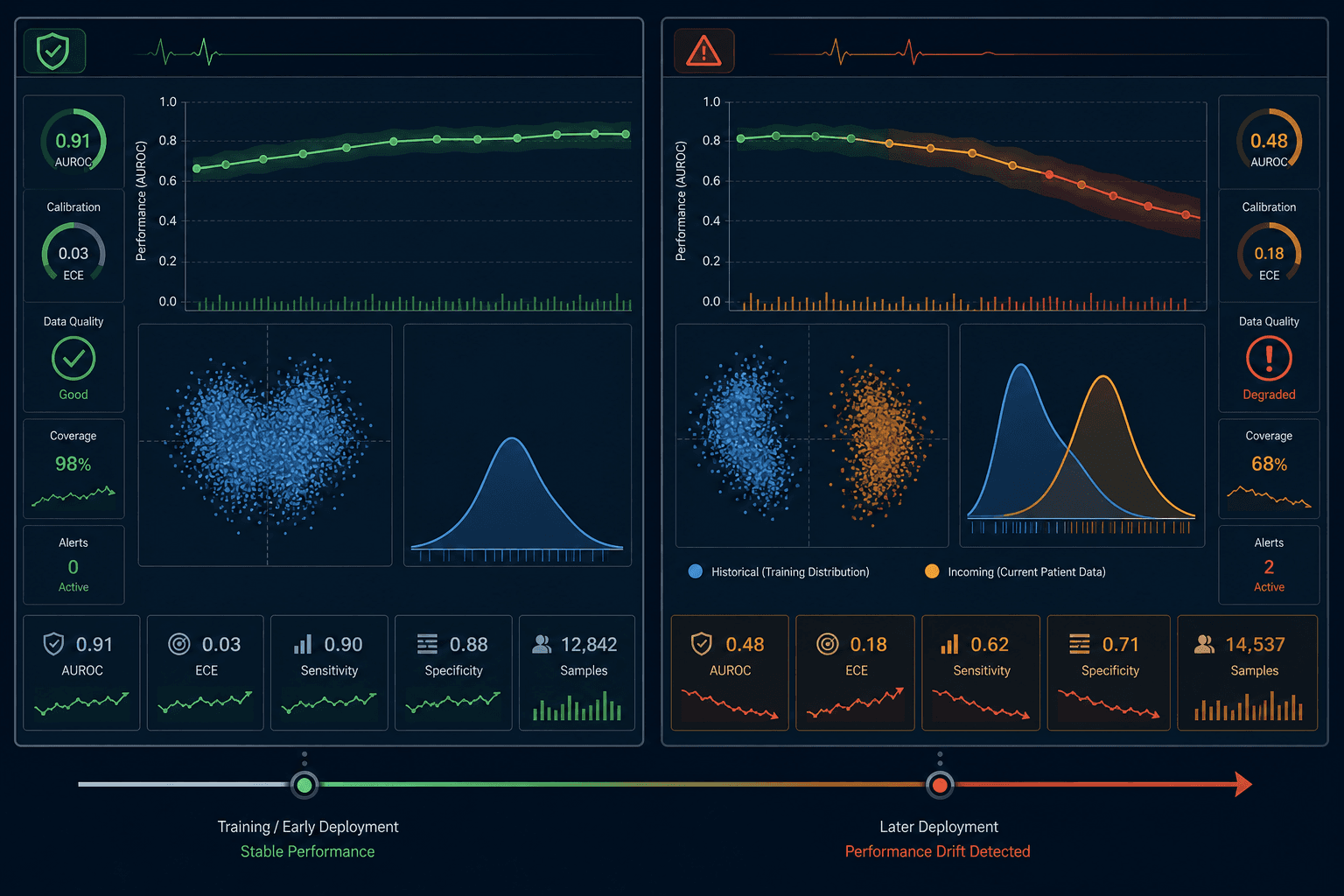
Model drift refers to the degradation of a deployed clinical AI system's predictive accuracy or reliability that occurs when conditions at the time of use diverge from conditions at the time of training. This mismatch can be spatial — arising when a model trained at one institution or on one equipment type is deployed at another — or temporal, arising when real-world conditions evolve after deployment while the model remains static.
Researchers at the FDA's Center for Devices and Radiological Health define data drift as "differences between the data used in training a machine learning model and that applied to the model in real-world operation." This definition, drawn from Sahiner et al. (2023), encompasses the full range of ways the real world can diverge from the conditions a model was built to handle — including shifts in patient populations, changes to clinical workflows, infrastructure upgrades, and the emergence of entirely new disease patterns.
The patient safety relevance is direct. A clinical AI tool — whether a sepsis early-warning algorithm, a radiology triage system, or a deterioration risk score — is validated against a specific dataset at a specific point in time. If the patients it encounters after deployment differ systematically from those in the training set, the model's stated performance characteristics no longer apply. Clinicians relying on that output may receive miscalibrated risk scores or incorrect classifications without any visible indication that the model has degraded.
Taxonomy of Subtypes
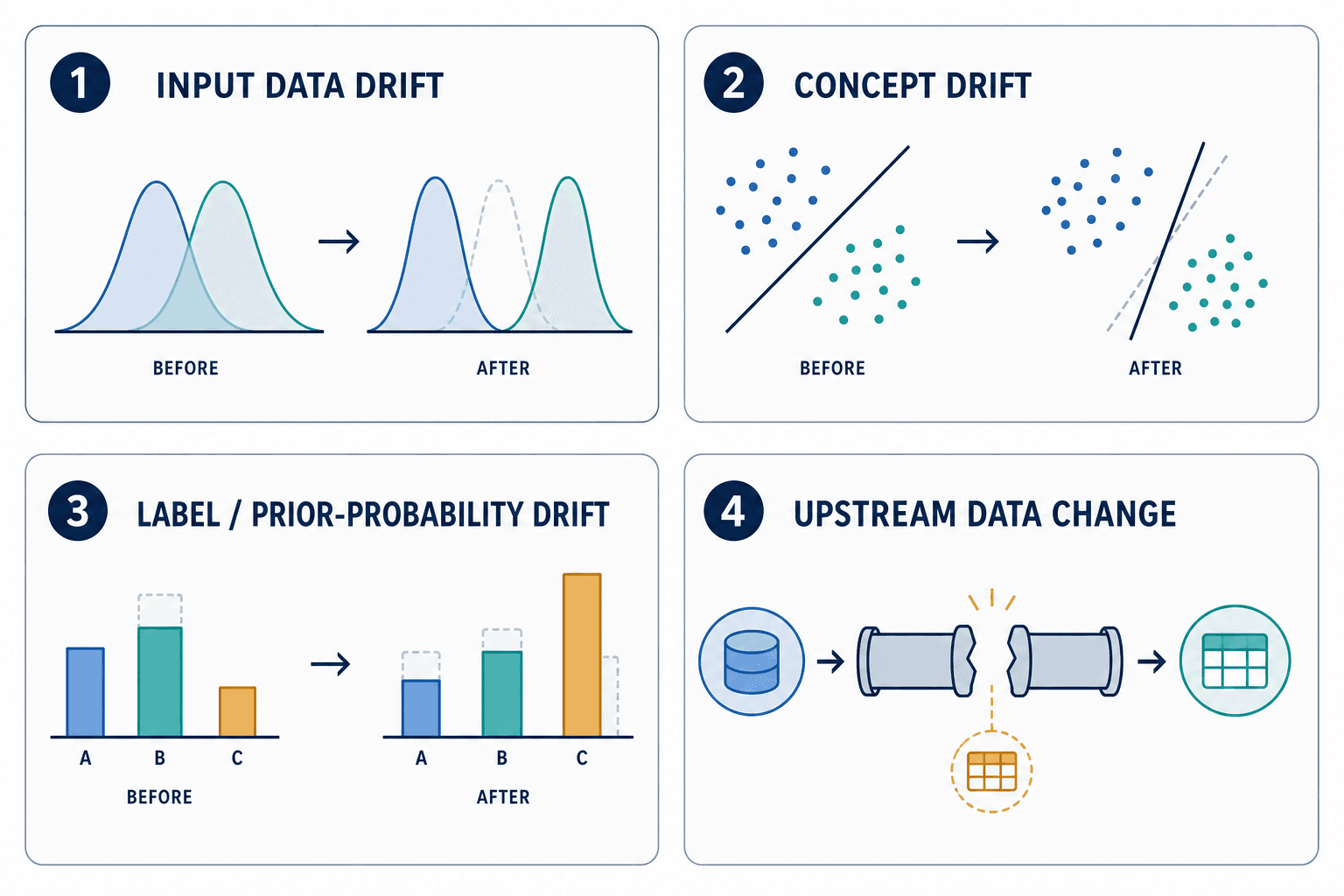
Four clinically relevant subtypes of model drift are recognized in the peer-reviewed literature. Each has a distinct mechanism and requires different detection and mitigation approaches. The taxonomy below follows the framework established by Sahiner et al..
| Subtype | Mechanism | Clinical Example |
|---|---|---|
| Input data drift / covariate shift | The statistical distribution of model inputs changes, while the underlying relationship between inputs and outcomes remains stable. | A chest CT lung nodule classifier trained on images from 64-slice scanners is deployed on a 256-slice scanner with different slice thickness and noise characteristics, shifting pixel-level feature distributions. |
| Concept drift | The functional relationship between model inputs and the clinical outcome changes — the decision boundary itself shifts. | After early 2020, patchy ground-glass opacities on chest radiographs began to be labeled COVID-19 pneumonia rather than bacterial pneumonia, altering the ground truth that a pneumonia classifier was trained to predict. |
| Label / prior-probability drift | Disease prevalence or outcome rate changes, altering the calibration of probabilistic model outputs without any change to input distributions or the input-outcome relationship. | A sepsis prediction model calibrated on a pre-pandemic ICU population encounters a post-pandemic cohort with a meaningfully different sepsis base rate, causing the model's probability outputs to be systematically over- or under-estimated. |
| Upstream data change | Changes to the data pipeline — EHR upgrades, coding system transitions, or preprocessing modifications — alter how model inputs are generated before they reach the model. | A billing-code-based readmission risk model trained on ICD-9 codes encounters ICD-10-coded encounters after a system transition, with structurally different code granularity and mapping conventions. |
Clinical Causes
Healthcare environments generate model drift through mechanisms that are largely absent from other domains where AI is deployed. The following causes are documented in the clinical AI literature and map directly to the drift subtypes above.
- Patient population shifts across sites or over time. A model trained on a tertiary academic medical center population may encounter a substantially different case mix — different age distributions, comorbidity profiles, and disease severity — when deployed at a community hospital or a different geographic region. The same model can also drift temporally as the patient population served by a single institution changes over years.
- EHR and IT infrastructure changes. Migrations between EHR platforms, upgrades within the same platform, or changes to data extraction pipelines can silently alter the format, completeness, or encoding of variables the model depends on — a form of upstream data change that may not be immediately visible to clinical users.
- ICD coding transitions. The shift from ICD-9 to ICD-10 substantially changed the granularity and structure of diagnosis codes. Models trained on ICD-9-derived features that are then applied to ICD-10 data — or vice versa — face systematic input distribution changes that can degrade performance unpredictably.
- Updated clinical classification systems. Revisions to reporting standards such as ACR RADS lexicons change how radiologists characterize findings, which in turn changes the labels and structured data that downstream models rely on. A model trained against one version of a RADS lexicon may encounter structurally different inputs after a lexicon update.
- New disease emergence. COVID-19 is the canonical documented example. Models trained before 2020 on pre-pandemic patient data encountered a fundamentally altered clinical landscape: new disease presentations, altered care pathways, changed ICU admission criteria, and modified treatment protocols — all of which shifted both input distributions and the input-outcome relationship simultaneously.
- Imaging scanner protocol variation. Differences in scanner manufacturer, model, acquisition protocol, and reconstruction algorithm produce images with different noise characteristics, resolution, and contrast properties. A model trained on images from one scanner type encounters a meaningfully different input distribution when deployed on another — even if the clinical task is identical.
- Automation bias altering the feedback data stream. When a clinical AI tool is effective, it changes clinician behavior. Clinicians may defer to AI outputs, order fewer confirmatory tests, or modify documentation practices in response to AI recommendations. Over time, this behavioral change can alter the outcome data that would be used to retrain or recalibrate the model — a feedback loop in which the AI's own influence corrupts the data used to evaluate it.
Documented Real-World Consequences
Model drift is not a theoretical concern. Peer-reviewed studies have documented clinically significant performance failures attributable to drift in deployed AI systems. Three quantified examples from Sahiner et al. illustrate the magnitude of these failures.
- Temporal drift in mortality prediction: Models trained on MIMIC clinical data to predict in-hospital mortality showed AUC drops of up to 0.29 when trained on historical data and tested prospectively on future patient cohorts. This magnitude of degradation — from, for example, an AUC of 0.85 to 0.56 — would render a model clinically unreliable.
- Cross-scanner error rate escalation in retinal disease classification: An OCT retinal disease classifier that achieved a 5.5% error rate on images from the scanner type used in training showed an error rate of 46.6% when applied to images from a different scanner type — an eightfold increase in errors attributable entirely to input data drift from scanner-type variation.
- COVID-era performance collapse in emergency department models: ED admission-risk and infection-prediction models showed significant performance drops during the COVID-19 pandemic, as the patient population, acuity mix, and clinical presentation patterns shifted in ways that the pre-pandemic training data had not captured. This example illustrates how new disease emergence can trigger simultaneous input data drift and concept drift.
Detection and Monitoring Methods
Drift detection operates at two levels: monitoring model outputs and performance metrics (performance-level monitoring), and monitoring the statistical properties of model inputs (input-level monitoring). Both levels are described in the clinical AI literature, including in Feng et al. (2022), which maps established hospital quality improvement tools to the clinical AI monitoring context.
Performance-Level Monitoring
Statistical process control (SPC) charts — tools long used in hospital quality improvement — can be applied to model performance metrics to detect when outputs shift beyond expected variation. Three SPC chart types are relevant to clinical AI monitoring:
- CUSUM (Cumulative Sum) charts accumulate deviations from a target value over time, making them sensitive to small but sustained shifts in model performance — particularly useful for detecting gradual drift.
- EWMA (Exponentially Weighted Moving Average) charts weight recent observations more heavily than older ones, providing a smoothed signal that is responsive to recent performance changes while dampening short-term noise.
- Shewhart charts apply fixed control limits to individual observations, flagging data points that fall outside expected bounds — most effective for detecting sudden, large performance shifts.
A practical challenge for performance-level monitoring is label latency: many clinical outcomes — readmission, mortality, long-term disease progression — are not known for days, weeks, or months after the AI generates its prediction. For models with long outcome latency, surrogate endpoint monitoring offers a partial solution. A surrogate endpoint (e.g., a physician's documented clinical assessment, a follow-up test result, or an interim clinical event) can serve as an earlier proxy for the true outcome, allowing monitoring to proceed before ground-truth labels are available.
Input-Level Distribution Monitoring
Input-level monitoring detects drift before it affects model outputs by comparing the statistical distribution of incoming data against the training distribution. Four statistical tests are commonly applied in this context:
| Method | What It Measures | Clinical Monitoring Application |
|---|---|---|
| Kolmogorov-Smirnov (KS) test | Whether two datasets originate from the same underlying distribution, based on the maximum difference between their cumulative distribution functions. | Comparing the distribution of a continuous input feature (e.g., patient age, lab value) in recent incoming data against the training dataset to detect statistically significant shifts. |
| Population Stability Index (PSI) | The degree of distributional change in a feature, expressed as a single index value — typically with thresholds distinguishing minor, moderate, and major shifts. | Monitoring categorical or binned continuous features (e.g., diagnosis code categories, risk score bins) for changes in frequency distribution over time. |
| Wasserstein distance (earth-mover's distance) | The minimum 'work' required to transform one probability distribution into another — providing a geometrically intuitive measure of how far apart two distributions are. | Quantifying the magnitude of distributional shift in continuous input features, enabling prioritization of which features require investigation. |
| KL divergence (Kullback-Leibler divergence) | The information lost when one probability distribution is used to approximate another — an asymmetric measure sensitive to differences in distribution tails. | Detecting shifts in input feature distributions, particularly useful for identifying changes in rare but clinically important feature values. |
For deep learning models — including convolutional neural networks used in medical imaging — input-level monitoring can also be applied to latent-feature representations rather than raw input variables. Monitoring the distribution of internal model activations or embeddings can detect distributional shifts that are not visible in the raw input data, such as subtle scanner-related image quality changes.
Mitigation Strategies
Mitigation strategies apply at two stages: before deployment (pre-deployment) and after drift is detected in a live system (post-deployment). The appropriate strategy depends on the drift subtype identified.
Pre-Deployment Mitigation
- Importance weighting for covariate shift. When training and deployment populations are known to differ, training samples can be reweighted to give more influence to cases that resemble the target deployment population, reducing the impact of input data drift.
- Bayesian prevalence correction for prior-probability drift. If the disease prevalence at the deployment site differs from the training prevalence, Bayes' theorem can be applied to adjust the model's probabilistic outputs to reflect the actual local prevalence — without retraining the model.
- Domain adaptation. Techniques that adapt a model trained in one domain (e.g., one institution's imaging data) to perform better in a target domain (e.g., a different institution's imaging data), using a small amount of target-domain data.
- Data augmentation. Deliberately expanding training data to include a wider range of scanner types, patient demographics, or acquisition conditions — improving the model's robustness to the input variation it will encounter in deployment.
Post-Deployment Mitigation
- Recalibration. When a model's probabilistic outputs are miscalibrated — for example, due to prior-probability drift — recalibration methods can correct the output scale without retraining the underlying model. Platt scaling (fitting a logistic regression layer to model outputs), isotonic regression (a non-parametric monotone mapping), and temperature scaling (a single-parameter rescaling of output logits) are the most commonly applied techniques. These are low-complexity options appropriate for calibration drift that does not involve changes to the input-outcome relationship.
- Model revision. Partial retraining or fine-tuning of specific model components using new data, preserving the majority of the original model's learned representations while adapting to the changed environment.
- Full retraining. Building a new model from scratch using updated training data. This is the most comprehensive response to severe or concept-level drift, but carries its own risks: catastrophic forgetting (loss of performance on the original task when trained predominantly on new data) and dependence on the quality and representativeness of the update dataset.
- Continual learning approaches. Reactive updating (triggered by detected drift events) and continual updating (ongoing incremental learning from new data) are both described in the literature, with tradeoffs between responsiveness and stability.
The organizational framework for managing these mitigation activities is the AI Quality Improvement (AI-QI) model proposed by Feng et al.. This model calls for dedicated hospital units — comprising clinicians, clinical informaticists, biostatisticians, IT professionals, and model developers — with ongoing responsibility for monitoring deployed AI tools, conducting root-cause analysis when performance signals are detected, and managing model updates. The AI-QI framework is explicitly modeled on existing hospital quality improvement programs, recognizing that the governance challenge of maintaining deployed AI is structurally analogous to the challenge of maintaining other complex clinical processes.
Regulatory Context
Drift monitoring is a formal regulatory requirement for AI-enabled Software as a Medical Device (SaMD) — not merely a best practice. Two regulatory frameworks establish this requirement.
The 2021 tri-national Good Machine Learning Practice (GMLP) Guiding Principles, issued jointly by the FDA, Health Canada, and the UK's MHRA, include Principle 10, which states that deployed models must be monitored for performance and that retraining risks must be managed. This principle establishes post-market performance monitoring as a baseline expectation for AI-enabled medical devices operating in all three jurisdictions.
The FDA's Predetermined Change Control Plan (PCCP) framework, for which a Final Guidance on Marketing Submission Recommendations was issued in August 2025, operationalizes this requirement for manufacturers seeking to make planned modifications to AI-enabled SaMD after market authorization. A PCCP must specify the planned modifications a manufacturer intends to make, the protocols for implementing those modifications, and the impact assessments that will demonstrate continued safety and effectiveness. The five guiding principles for PCCPs — Focused and Bounded, Risk-based, Evidence-Based, Transparent, and Total Product Lifecycle perspective — collectively require that manufacturers design drift monitoring and model-update procedures into their total product lifecycle management from the outset.
Related Terms
- Dataset shift — A broad statistical term describing any mismatch between the joint probability distributions of training and deployment data. Model drift is the clinical manifestation of dataset shift in a deployed AI system.
- Distributional shift — Often used interchangeably with dataset shift; refers to changes in the probability distribution of data across training and deployment contexts. Not specific to any one mechanism.
- Domain shift — Typically refers to spatial or institutional mismatches — differences between the domain in which a model was trained (e.g., one hospital system) and the domain in which it is deployed (e.g., a different hospital system). A subtype of the broader dataset shift concept.
- Covariate shift — A subtype of input data drift in which the marginal distribution of model inputs (covariates) changes between training and deployment, while the conditional relationship between inputs and outcomes remains stable. See: Input data drift / covariate shift above.
- Concept drift — A specific subtype of model drift in which the functional relationship between model inputs and the clinical outcome changes — meaning the decision boundary itself shifts. Concept drift is not synonymous with model drift; it is one of four recognized subtypes.
- Model decay — An informal synonym for model drift, used interchangeably in some industry literature. Carries the same meaning: degradation of a deployed model's performance over time due to changing real-world conditions.
- Population drift — A specific cause of input data drift in which the demographic or clinical characteristics of the patient population encountered in deployment differ from those of the training population. Distinct from concept drift in that the input-outcome relationship may remain stable even as the input distribution changes.