
What the 2021 Action Plan Was — and What It Was Not
The FDA's AI/ML SaMD Action Plan, published in January 2021, was an eight-page non-binding document issued by CDRH. It did not create new legal obligations, establish enforceable requirements, or modify existing premarket submission standards. It was a public commitment to a multi-year regulatory development agenda — a roadmap that identified five specific areas where FDA intended to issue guidance, develop frameworks, or conduct research.
The document emerged directly from a recognized regulatory problem. FDA's existing device framework was designed around "locked" algorithms — software whose logic is fixed at the time of clearance and does not change during deployment. Continuously learning algorithms, which update their parameters based on new data after authorization, did not fit this model. A device that changes its own behavior post-clearance raised a fundamental question: at what point does an update constitute a new device requiring a new submission?
FDA had surfaced this problem in a April 2019 Discussion Paper on AI/ML-based Software as a Medical Device, which solicited public comment on how the agency might adapt its regulatory approach. The 2021 Action Plan was FDA's structured response to that process — a five-point commitment translating the 2019 discussion into concrete regulatory work items.
The Five Action Items: Scope and Original Intent
The Action Plan organized FDA's commitments into five discrete action items. Each targeted a different dimension of the continuously learning algorithm problem — from pre-market change management to post-market monitoring to international harmonization.
| Action Item | Commitment Summary | Primary Scope |
|---|---|---|
| 1 — Tailored Premarket Review | Develop a regulatory framework that accommodates algorithm change through a Predetermined Change Control Plan (PCCP), enabling manufacturers to pre-specify anticipated modifications and the controls governing them | Manufacturers of continuously learning or adaptive AI/ML-enabled devices seeking premarket authorization |
| 2 — Good Machine Learning Practice (GMLP) | Establish and promote harmonized GMLP principles covering the full AI/ML development lifecycle — data management, model training, evaluation, and deployment — in coordination with international regulatory partners | All AI/ML SaMD developers; intended to apply across regulatory jurisdictions |
| 3 — Patient-Centered Transparency | Develop transparency standards requiring manufacturers to communicate AI/ML device performance and limitations in ways meaningful to patients, caregivers, and clinicians | Labeling and post-market communication requirements for authorized AI/ML devices |
| 4 — Regulatory Science for Bias and Robustness | Invest in methodological research on algorithmic bias, model robustness, and evaluation methods to support both FDA review and broader field development | FDA internal research capacity and engagement with external researchers; no direct developer obligation |
| 5 — Real-World Performance Monitoring | Develop a framework for monitoring AI/ML device performance in real-world clinical use, including pilot programs to test post-market surveillance approaches | Post-market obligations for authorized AI/ML devices; health systems and clinical sites as data contributors |
Action Items 1 and 2 were the most operationally concrete — they committed FDA to producing specific guidance documents that manufacturers could act on. Action Items 3 and 4 were more research-and-development oriented, with less defined deliverable endpoints. Action Item 5 was explicitly framed as requiring pilot programs before any formal framework could be established, making it the longest-horizon commitment in the plan.
Deliverable Timeline: From GMLP Principles to Lifecycle Draft (2021–2025)
Between October 2021 and January 2025, FDA issued six formal outputs traceable to the Action Plan. Each was a distinct document type — co-issued principles, draft guidance, guiding principles, or final guidance — and each mapped to one or more of the five action items.
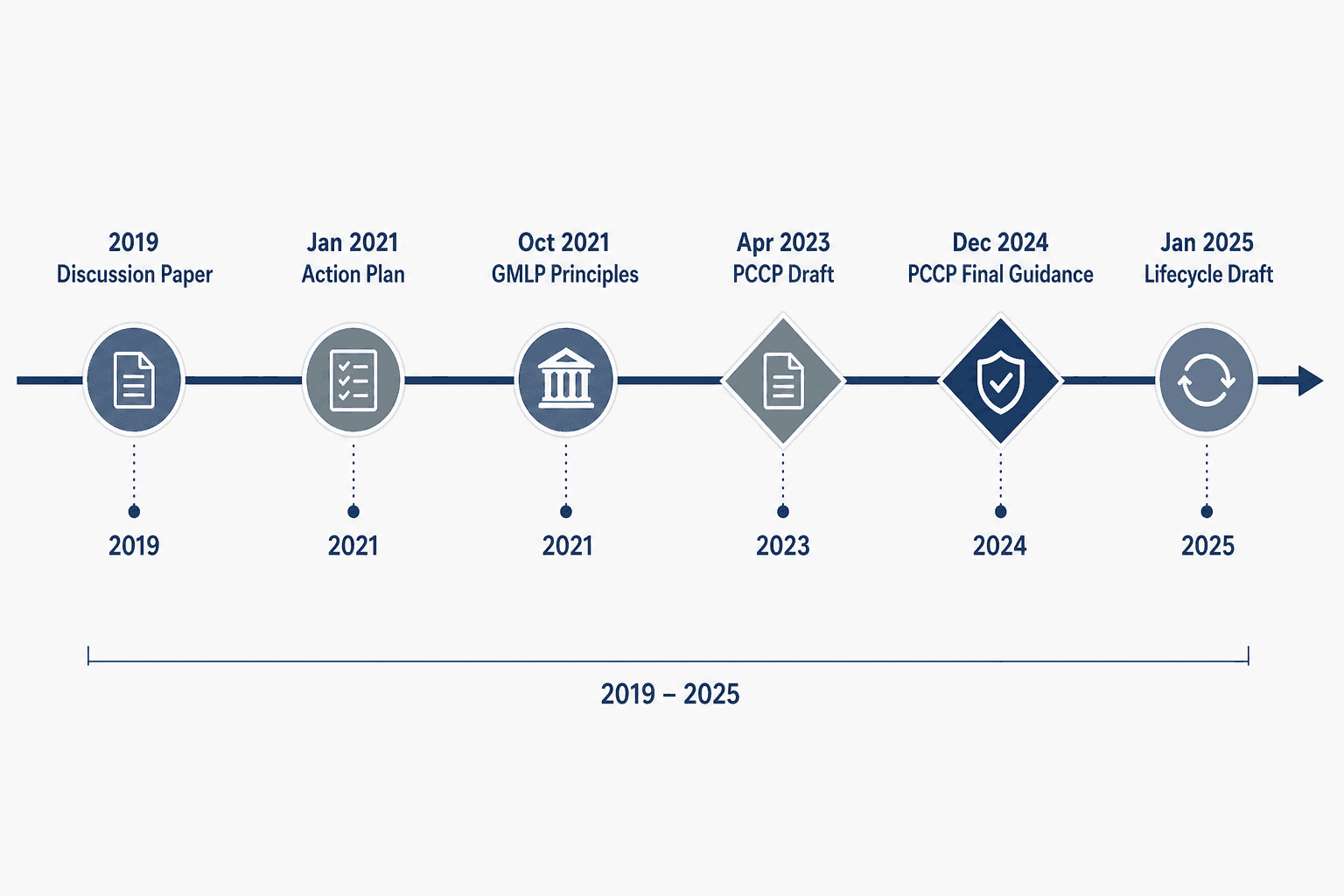
| Date | Document | Type | Action Item(s) | Status as of Q2 2026 |
|---|---|---|---|---|
| April 2019 | Discussion Paper: AI/ML-Based Software as a Medical Device | Discussion paper (precursor) | Precursor to all five | Historical reference — not a deliverable |
| January 2021 | AI/ML SaMD Action Plan | Non-binding roadmap | All five | The source document — not itself a deliverable |
| October 2021 | Good Machine Learning Practice for Medical Device Development: Guiding Principles | Co-issued guiding principles (FDA, Health Canada, MHRA) | Action Item 2 | Final — published and in effect |
| April 2023 | Marketing Submission Recommendations for a Predetermined Change Control Plan for AI/ML-Enabled Device Software Functions | Draft guidance | Action Item 1 | Superseded by December 2024 final guidance |
| October 2023 | Predetermined Change Control Plans for AI/ML-Enabled Devices: Guiding Principles | Co-issued guiding principles (FDA, Health Canada, MHRA) | Action Item 1 | Final — published and in effect |
| June 2024 | Transparency for Machine Learning-Enabled Medical Devices: Guiding Principles | Co-issued guiding principles (FDA, Health Canada, MHRA) | Action Item 3 | Final — published and in effect |
| December 2024 | Marketing Submission Recommendations for a Predetermined Change Control Plan for AI/ML-Enabled Device Software Functions | Final guidance | Action Item 1 | Final — the primary operative document for PCCP submissions |
| January 2025 | Artificial Intelligence-Enabled Device Software Functions: Lifecycle Management and Marketing Submission Recommendations | Draft guidance | Action Items 1, 3, 4, 5 | Draft — comment period closed April 7, 2025; finalization timeline unknown as of Q2 2026 |
The October 2021 GMLP principles were the first formal output and the only deliverable co-issued simultaneously with international partners at the time of publication. The December 2024 PCCP final guidance was the most operationally significant single document — it replaced the April 2023 draft and gave manufacturers a finalized framework for pre-specifying algorithm changes. The January 2025 draft lifecycle guidance is the most comprehensive document in the series, attempting to address the full device lifecycle, but it remains in draft form.
Fulfillment Status by Commitment as of Q2 2026
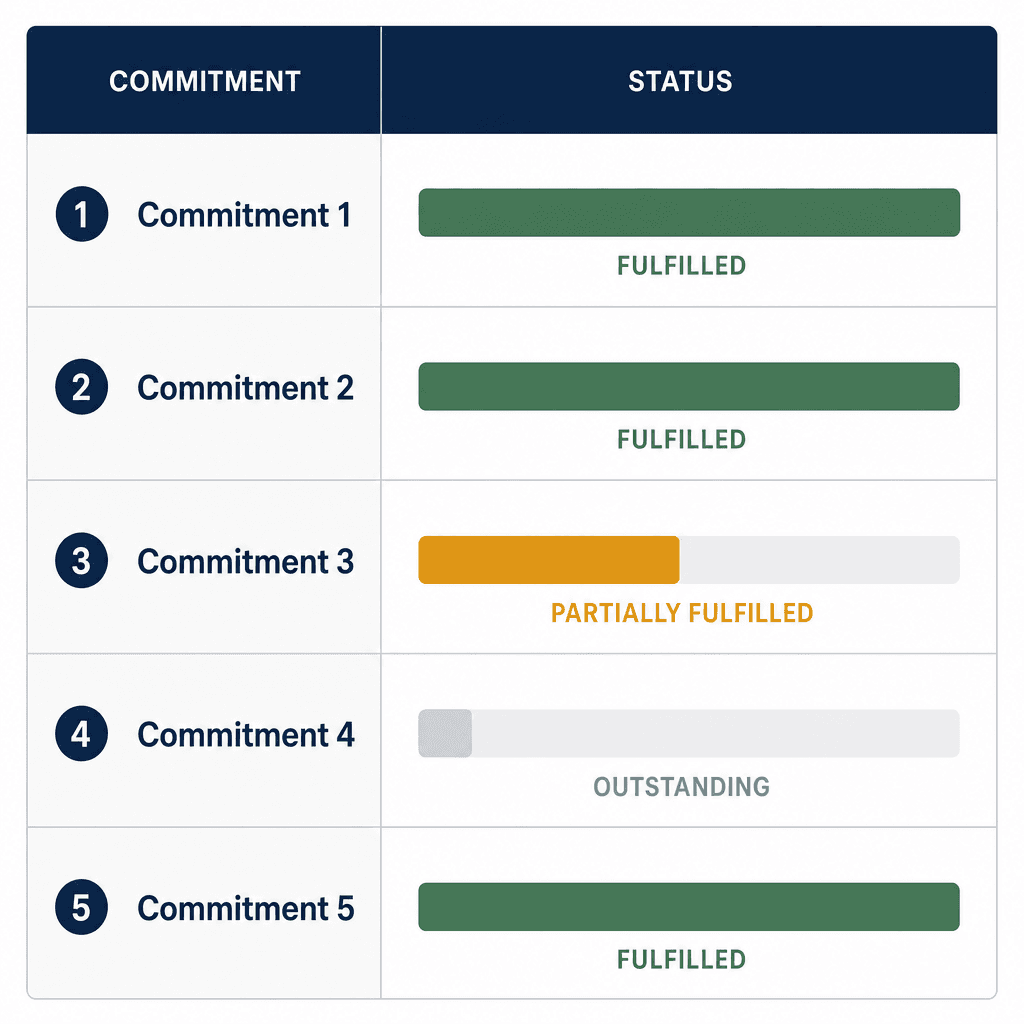
Assessing fulfillment requires distinguishing between finalized guidance that manufacturers can rely on, draft guidance still subject to revision, and commitments where no formal document has been published.
| Action Item | Fulfillment Status | Basis | Outstanding Elements |
|---|---|---|---|
| 1 — Tailored Premarket Review (PCCP) | Substantially fulfilled | December 2024 PCCP final guidance; October 2023 PCCP guiding principles | January 2025 draft lifecycle guidance (still draft) expands on PCCP context but is not required for PCCP submission |
| 2 — GMLP Harmonization | Substantially fulfilled | October 2021 GMLP guiding principles, co-issued with Health Canada and MHRA | No formal rulemaking; principles are non-binding but operationally referenced |
| 3 — Patient-Centered Transparency | Partially fulfilled | June 2024 transparency ML guiding principles; transparency expectations in January 2025 draft lifecycle guidance | No finalized binding transparency labeling requirements; January 2025 draft guidance containing transparency detail remains unfinalized |
| 4 — Regulatory Science / Bias and Robustness | Partially fulfilled | Methodological investments referenced in draft lifecycle guidance; bias evaluation discussed in GMLP principles | No standalone finalized guidance on algorithmic bias evaluation methods for AI/ML devices |
| 5 — Real-World Performance Monitoring | Not fulfilled (formal framework absent) | No published pilot program structure or formal RWP framework as of Q2 2026 | January 2025 draft lifecycle guidance references post-market monitoring expectations but does not constitute a formal RWP pilot framework |
PCCP in Practice: Early Uptake of the Action Plan's Most Novel Mechanism
The Predetermined Change Control Plan is the Action Plan's most structurally novel contribution to the regulatory landscape. A PCCP allows a manufacturer to pre-specify, at the time of authorization, the types of algorithm modifications it anticipates making post-clearance — along with the performance standards, testing protocols, and safety controls that will govern those changes. If the modifications stay within the pre-approved envelope, the manufacturer can implement them without submitting a new premarket notification.
Uptake in the framework's first operational years has been limited. As of end-2024, approximately 53 AI/ML-authorized devices had an approved PCCP, out of roughly 1,016 total AI/ML-authorized devices on the FDA's tracking list at that time. By early 2026, the FDA's AI-enabled devices list had grown to approximately 1,451 entries, though counting methodologies differ across sources and the FDA's own list carries a disclaimer that it is not exhaustive.
The low PCCP adoption rate in the framework's first years reflects several practical factors. Drafting a PCCP requires manufacturers to anticipate, at the time of initial submission, what algorithm modifications they will want to make — and to specify the performance boundaries and testing protocols that will govern those changes. This demands a level of pre-deployment planning that many development pipelines are not structured to support. The April 2023 draft guidance introduced uncertainty about final requirements, which may have discouraged early adoption. The December 2024 final guidance resolved that uncertainty, and adoption may accelerate in subsequent years.
Outstanding Gaps: Generative AI, Foundation Models, and Real-World Performance Monitoring
The Action Plan's five commitments were designed around a specific class of AI/ML device: adaptive algorithms embedded in cleared medical devices that update their parameters based on new data. This design scope left three major categories of technology without a specific regulatory framework as of Q2 2026.
- Generative AI and large language models (LLMs). None of the five Action Plan deliverables — including the January 2025 draft lifecycle guidance — address generative AI or LLM-based clinical applications. As of Q2 2026, no generative AI medical device has received FDA authorization. The regulatory boundary between an LLM-based clinical tool and a regulated medical device remains unresolved under existing guidance.
- Foundation models. Large pre-trained models adapted for clinical tasks through fine-tuning or prompting do not map cleanly onto the PCCP framework, which was designed for a single device with pre-specified change parameters. A foundation model that could be adapted for multiple clinical tasks raises distinct questions about intended use scope, validation requirements, and change control that the Action Plan's deliverables do not address.
- Real-world performance monitoring. Action Item 5 committed FDA to developing pilot programs and, eventually, a formal framework for monitoring AI/ML device performance in clinical deployment. No such framework exists as of Q2 2026. Post-market surveillance obligations for AI/ML devices currently operate under the same general Medical Device Reporting and post-market surveillance requirements that apply to all medical devices — not under any AI-specific monitoring structure.
Regulatory Context: The Trump Administration's AI Posture and Its Relationship to CDRH Guidance
The White House issued its "America's AI Action Plan" in July 2025. That document is an executive-level technology policy statement emphasizing deregulatory posture, innovation acceleration, and reducing regulatory barriers to AI development and deployment. It is not a CDRH document and does not directly modify FDA's guidance development procedures, premarket submission requirements, or the specific deliverable track of the 2021 AI/ML SaMD Action Plan.
CDRH guidance documents are developed through a separate administrative process — notice-and-comment rulemaking for binding rules, and internal development with public comment periods for guidance documents. The White House's policy direction can influence FDA's regulatory priorities and enforcement posture over time, but it does not retroactively alter finalized guidance or accelerate or halt specific guidance development timelines.
What the deregulatory posture may affect in practice is enforcement trajectory and the pace at which outstanding Action Plan commitments — particularly the unfinished lifecycle management guidance and the absent real-world performance monitoring framework — are prioritized for completion. That effect is not yet visible in the formal guidance record as of Q2 2026.
Practical Implications for SaMD Developers and Procurement Evaluators
The Action Plan's uneven fulfillment status means that developers and evaluators are working with a partially constructed regulatory framework. The following orientation reflects what is finalized, what is draft, and where no formal framework exists — not a compliance checklist, but a structured account of the current regulatory record.
- Finalized and operative: PCCP framework. The December 2024 PCCP final guidance is the primary document for developers seeking to pre-specify algorithm changes in a marketing submission. The October 2023 PCCP guiding principles (co-issued with Health Canada and MHRA) provide supporting context. Both are final and can be relied upon for submission planning.
- Finalized and operative: GMLP principles. The October 2021 GMLP guiding principles establish ten principles for AI/ML development practice across the device lifecycle. They are non-binding but are internationally harmonized with Health Canada and MHRA and are referenced in FDA review contexts.
- Finalized and operative: Transparency guiding principles. The June 2024 transparency ML guiding principles (also co-issued with Health Canada and MHRA) establish expectations for how AI/ML device performance and limitations should be communicated. They are non-binding principles, not labeling requirements.
- Draft — subject to revision: January 2025 lifecycle management guidance. This draft guidance is the most comprehensive single document in the Action Plan series, covering the full device lifecycle including design controls, transparency, and post-market monitoring. Its comment period closed April 7, 2025. As of Q2 2026, no final version has been published and the finalization timeline is unknown. Developers should treat its content as indicative of FDA's direction but not as finalized requirements.
- No formal framework: Real-world performance monitoring. Post-market surveillance obligations for authorized AI/ML devices currently fall under general Medical Device Reporting requirements, not any AI-specific monitoring framework. Developers should not assume that Action Item 5's eventual framework will resemble current general post-market requirements.
- No formal framework: Generative AI, LLMs, and foundation models. None of the Action Plan's deliverables address these technology categories. Developers building clinical applications on generative AI foundations are operating without a specific regulatory framework and should engage directly with CDRH through pre-submission meetings rather than attempting to map their products onto the existing PCCP or GMLP frameworks without agency guidance.
For procurement evaluators assessing AI/ML-enabled devices, the practical implication is that a device's PCCP status is now a meaningful differentiator. A device with an approved PCCP has undergone FDA review of its intended change envelope — meaning the agency has assessed not just the device as cleared but the manufacturer's planned evolution of the device. A device without a PCCP is not deficient, but any post-authorization algorithm modifications would require a new submission rather than operating within a pre-approved change framework.
Discussion
Commentary from compliance officers, policy professionals, and legal counsel is welcome. For formal corrections or regulatory updates, use the contact page.
Comments
Join the discussion with an anonymous comment.