
Document Identification
| Field | Value |
|---|---|
| Docket Number | FDA-2022-D-2628 |
| Issuing Centers | CDRH and CBER (joint) |
| Document Type | Final Guidance (with August 2025 update) |
| Current Status | Final — operative as of December 2024; updated August 2025 |
| Applicable Submission Pathways | Traditional 510(k), Abbreviated 510(k), De Novo, PMA |
| Excluded Pathway | Special 510(k) — explicitly prohibited by final guidance |
| Jurisdiction | United States |
| Primary FDA Source | FDA Guidance: Marketing Submission Recommendations for a Predetermined Change Control Plan for Artificial Intelligence-Enabled Device Software Functions |
Statutory Foundation: FDORA 2022 and FD&C Act Section 515C
The FDA's authority to authorize Predetermined Change Control Plans as part of premarket submissions derives from a specific legislative act, not from preexisting FDA discretion. The Consolidated Appropriations Act of 2023, which included the Food and Drug Omnibus Reform Act of 2022 (FDORA), was enacted on December 29, 2022. Section 3308 of FDORA inserted Section 515C into the Federal Food, Drug, and Cosmetic Act (FD&C Act).
Section 515C is titled "Predetermined Change Control Plans for Devices" and establishes the statutory framework within which the PCCP guidance operates. Prior to this enactment, FDA had no explicit statutory basis for accepting a plan for future device modifications as part of an initial premarket authorization — the PCCP mechanism existed only as a policy concept in FDA discussion papers and action plans.
The statute imposes one constraint with direct implications for competitive device strategy: only the version of a device that existed before any PCCP-authorized modification may serve as a predicate device in a subsequent 510(k) submission. Post-modification versions of a device are disqualified from predicate use. This constraint is structural — it prevents manufacturers from using a continuously updated AI device as a moving predicate baseline for competitors.
- Statutory authority: FDORA 2022, Section 3308 — inserting FD&C Act Section 515C
- Effective date of statutory authority: December 29, 2022 (date of FDORA enactment)
- Predicate constraint: only the pre-modification (pre-PCCP) device version may serve as a 510(k) predicate
- Scope of authority: applies to 510(k), De Novo, and PMA submission pathways
- Pre-statutory history: PCCP concept existed in 2019 discussion paper and 2021 Action Plan, but without legislative backing
Regulatory Chronology
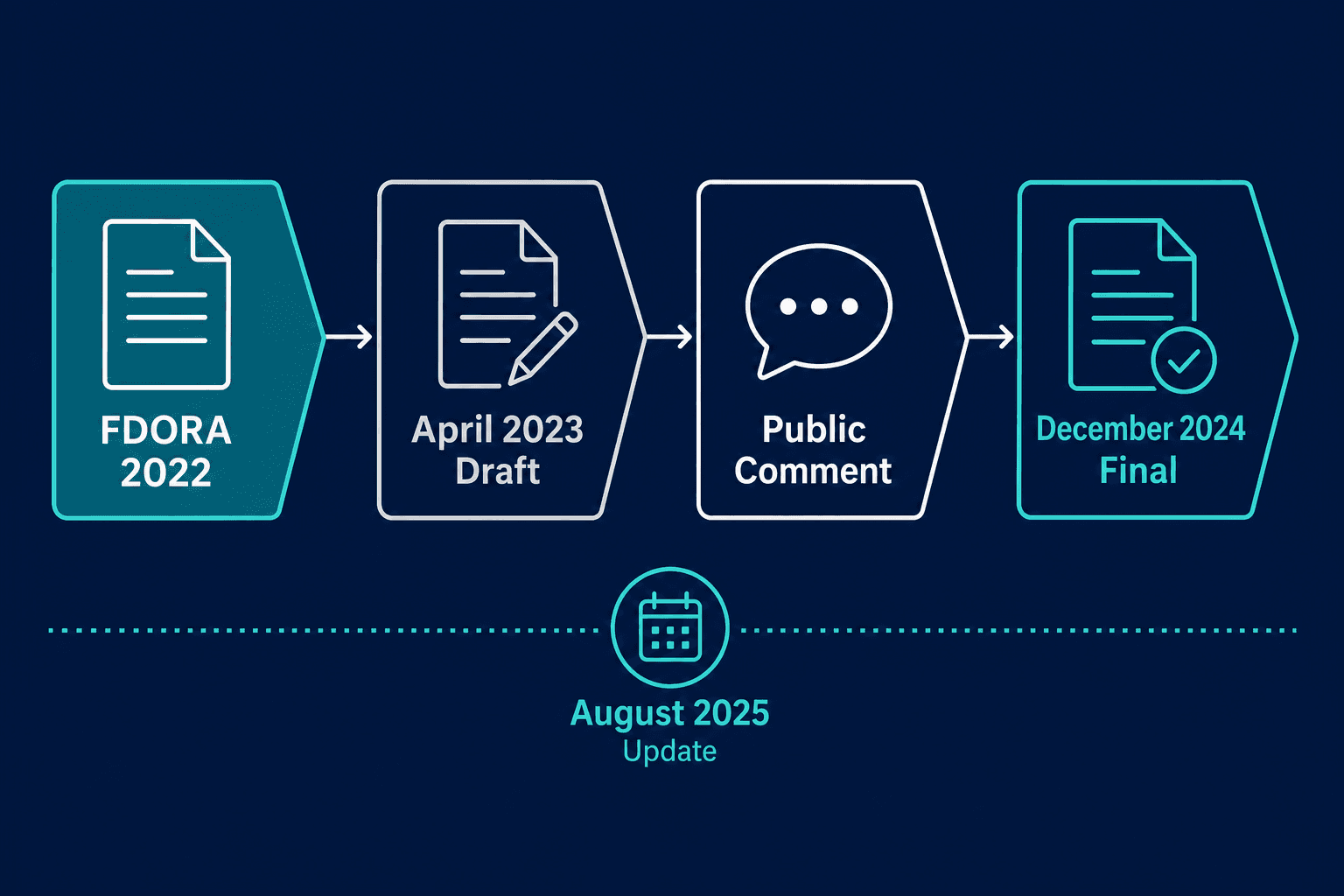
| Date | Document / Event | Significance |
|---|---|---|
| 2019 | FDA Discussion Paper: Artificial Intelligence and Machine Learning in Software as a Medical Device | First public articulation of a predetermined change control plan concept for AI/ML SaMD; no formal regulatory status |
| January 2021 | FDA AI/ML-Based SaMD Action Plan | Committed FDA to developing a PCCP framework as one of five action items; referenced Good Machine Learning Practice (GMLP) as a parallel workstream |
| October 2021 | Good Machine Learning Practice (GMLP) Guiding Principles | Joint FDA/Health Canada/MHRA principles establishing foundational expectations for ML-enabled medical devices; contextual precursor to PCCP requirements |
| April 2023 | Draft Guidance: Marketing Submission Recommendations for a Predetermined Change Control Plan for AI/ML-Enabled Device Software Functions (Docket FDA-2022-D-2628) | First formal FDA guidance document specifying PCCP requirements; scoped to ML-enabled devices only; opened 90-day public comment period |
| October 2023 | Joint FDA/Health Canada/MHRA Guiding Principles for Good Machine Learning Practice (updated) | Companion international principles update; not a US-only regulatory action |
| August 2024 | Draft Guidance: Predetermined Change Control Plans for Medical Devices (all device types) | Broader PCCP framework draft extending beyond AI/ML devices to all medical device types; remained in draft as of Q2 2026 |
| December 2024 | Final Guidance: Marketing Submission Recommendations for a Predetermined Change Control Plan for Artificial Intelligence-Enabled Device Software Functions | Operative final guidance; expanded scope from ML-only to all AI-enabled devices; added definitions aligned to Biden EO on AI; added labeling, diversity, and combination product provisions; prohibited Special 510(k) pathway |
| January 2025 | Draft Guidance: Lifecycle Management Considerations for AI-Enabled Devices | Companion document addressing post-market modification management; remained in draft as of Q2 2026 |
| August 2025 | Updated Final Guidance (same docket, FDA-2022-D-2628) | Current operative version as of Q2 2026; exact scope of changes from December 2024 version not fully characterized in public secondary sources — verify against FDA guidance page |
Draft-to-Final Comparison: Six Key Changes
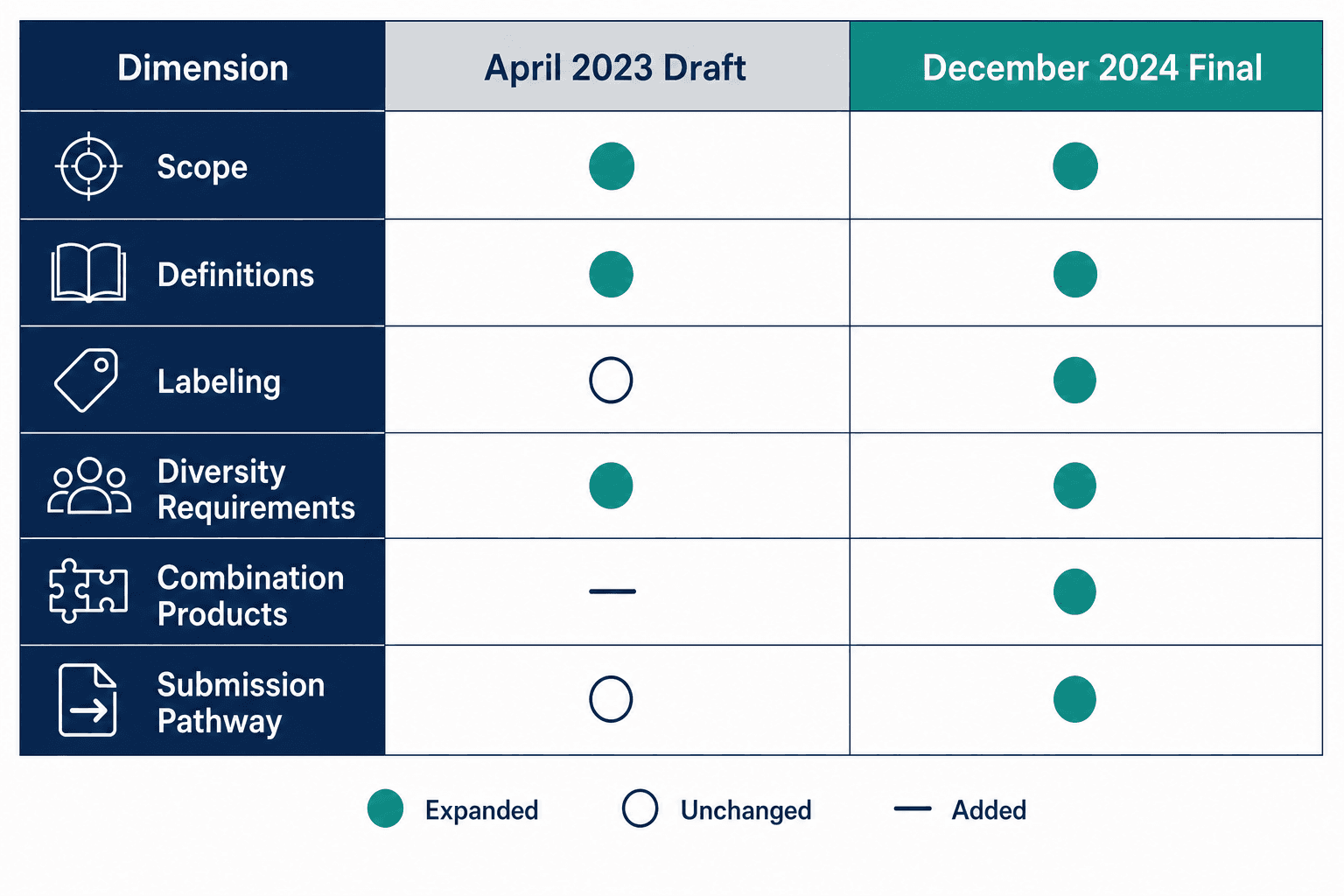
The April 2023 draft and the December 2024 final guidance share the same docket number but differ materially across six dimensions. These differences are not editorial refinements — they represent substantive changes in scope, definitional alignment, and submission requirements that affect how manufacturers structure PCCP submissions.
| Dimension | April 2023 Draft | December 2024 Final | Regulatory Significance |
|---|---|---|---|
| Scope | Limited to ML-enabled device software functions | Expanded to all AI-enabled device software functions, including rule-based and non-ML AI systems | Manufacturers of non-ML AI tools (e.g., rule-based clinical decision support classified as AI) now fall within scope |
| Definitions | AI/ML terminology based on prior FDA guidance and internal usage | Definitions aligned to the Biden administration's October 2023 Executive Order on Safe, Secure, and Trustworthy AI | Creates definitional dependency on a Biden EO that was subsequently rescinded in January 2025; policy context requires monitoring |
| Labeling Requirements | General labeling expectations referenced | Added mandatory obligations for manufacturers to notify users when PCCP-authorized modifications are implemented | Introduces a positive update-notification duty not present in the draft; affects post-market labeling workflows |
| Diversity and Equity | Not specifically addressed as a standalone requirement | Added explicit requirements for manufacturers to address performance across diverse patient populations in PCCP methodology sections | Operationalizes FDA's broader AI equity policy position as a submission requirement, not merely a recommendation |
| Combination Products | Limited treatment of combination product scenarios | Added detailed provisions for AI-enabled combination products (device + drug or device + biologic) | Addresses a gap that affected manufacturers of AI-enabled drug-device combinations and diagnostic-therapeutic combinations |
| Submission Pathway | Special 510(k) pathway not explicitly addressed | Explicitly prohibited: PCCPs may not be submitted through the Special 510(k) pathway; restricted to traditional 510(k), abbreviated 510(k), De Novo, and PMA | Eliminates a potential efficiency pathway; manufacturers must use traditional or abbreviated 510(k) routes for PCCP submissions |
Current PCCP Requirements: Three Required Sections
Under the final guidance, a conforming PCCP submission must contain three substantive sections. This record summarizes each section's function; manufacturers preparing PCCP submissions should consult the full guidance document and the existing site reference on the PCCP framework for submission-level detail.
- Description of Modifications: A specific, bounded description of the types of modifications the manufacturer anticipates making to the AI-enabled device software function. This section defines the envelope of what the PCCP authorizes — modifications outside this description require a new premarket submission.
- Methodology for Implementing and Validating Modifications: The technical and procedural methods the manufacturer will use to implement each modification type and verify that the modified device continues to meet its intended use and performance specifications. This section must address the diversity and equity population requirements added in the final guidance.
- Methodology for Monitoring Performance: The post-deployment surveillance methods the manufacturer will use to monitor the device's real-world performance after modifications are implemented. This section connects the PCCP to post-market obligations and must be consistent with the manufacturer's broader Quality Management System.
Adoption Data and FDA Database Status
PCCP adoption among AI/ML device manufacturers has been measured in two ways: counts of authorized devices with PCCPs, and FDA's own database infrastructure for tracking PCCP status. Both data sources carry important limitations.
Based on FDA data cited in peer-reviewed literature, approximately 53 medical devices had authorized PCCPs as of the end of 2024. Of these, approximately 15 were AI/ML-enabled devices. These figures reflect the period when the April 2023 draft guidance was operative — the December 2024 final guidance had not yet taken effect for most of this period.
In May 2025, FDA added a dedicated PCCP search feature to its 510(k), De Novo, and PMA submission databases. This infrastructure change allows users to filter authorized devices by PCCP status — a capability that did not previously exist in the public-facing database. The addition enables more systematic tracking of PCCP uptake over time and supports the kind of cross-referencing this site's device registry is designed to support.
| Data Point | Value | Source Date | Limitation |
|---|---|---|---|
| Total devices with authorized PCCPs (all types) | ~53 | End-2024 | Secondary literature citing FDA data; verify against current FDA database |
| AI/ML-enabled devices with authorized PCCPs | ~15 | End-2024 | Subset of above; same sourcing caveat applies |
| FDA PCCP database search feature added | May 2025 | May 2025 | Infrastructure change; does not directly indicate new PCCP authorizations |
| Specialty distribution of PCCP-authorized devices | Not systematically available in public sources as of Q2 2026 | — | FDA database may support manual extraction but no aggregate breakdown confirmed |
Companion Documents and Open Items
The final guidance for AI-enabled devices (docket FDA-2022-D-2628) does not operate in isolation. Several companion documents affect how the guidance functions in practice, and several open policy questions remain unresolved as of Q2 2026.
- January 2025 Draft — Lifecycle Management Considerations for AI-Enabled Devices: Addresses how manufacturers should manage post-market modifications to AI-enabled devices, including the relationship between PCCP-authorized changes and broader lifecycle obligations. Remained in draft as of Q2 2026; comment period closed but final guidance not yet issued.
- August 2024 Draft — Predetermined Change Control Plans for Medical Devices (all device types): Proposes a PCCP framework applicable to all medical device types, not only AI-enabled devices. Remained in draft as of Q2 2026. Until finalized, the AI-specific final guidance (docket FDA-2022-D-2628) remains the operative document for AI/ML SaMD manufacturers.
- Q-Submission (Pre-Submission) Pathway: FDA guidance encourages manufacturers developing novel or complex PCCPs to use the Q-submission program to obtain FDA feedback before formal submission. This dependency is not explicit in the statutory text but is a practical operational constraint for manufacturers with first-of-kind PCCP designs.
- QMS Integration Gap: The final guidance references Quality Management System integration for the performance monitoring section of a PCCP, but the specific QMS requirements for AI-enabled devices remain addressed only in non-binding guidance. No final rule has codified QMS obligations specific to AI/ML SaMD as of Q2 2026.
Sources and Primary Document Links
- FDA Guidance — Marketing Submission Recommendations for a Predetermined Change Control Plan for Artificial Intelligence-Enabled Device Software Functions (Docket FDA-2022-D-2628, current version August 2025): fda.gov/regulatory-information/search-fda-guidance-documents — search docket FDA-2022-D-2628 for the current posting
- FDORA 2022 Statutory Text — FD&C Act Section 515C: Consolidated Appropriations Act of 2023 (P.L. 117-328), Division FF, Title III, Section 3308, enacted December 29, 2022
- FDA AI-Enabled Medical Devices List: fda.gov/medical-devices/software-medical-device-samd/artificial-intelligence-and-machine-learning-aiml-enabled-medical-devices — primary source for device-level PCCP authorization data
- August 2024 Draft Guidance — Predetermined Change Control Plans for Medical Devices (all device types): Available via FDA docket search; remained in draft as of Q2 2026
- January 2025 Draft Guidance — Lifecycle Management Considerations for AI-Enabled Devices: Available via FDA docket search; remained in draft as of Q2 2026
- FDA 510(k), De Novo, and PMA Databases (PCCP search feature added May 2025): accessdata.fda.gov/scripts/cdrh/cfdocs/cfpmn/pmn.cfm — 510(k) database with PCCP filter
Discussion
Commentary from compliance officers, policy professionals, and legal counsel is welcome. For formal corrections or regulatory updates, use the contact page.
Comments
Join the discussion with an anonymous comment.