

Why Ambient AI Documentation Is Under the Microscope
Physicians in the United States spend roughly two hours on EHR documentation for every hour of direct patient care. That ratio has driven significant interest in ambient AI tools — systems that listen to clinical encounters, transcribe the conversation, and generate structured notes using large language models — as a potential remedy for documentation burden and its downstream effects on clinician well-being.
Commercial products operating in this space include Nuance DAX (now Microsoft DAX Copilot), Suki, and Abridge, among others. These tools have been deployed across major health systems and have attracted substantial investment. Vendor-reported metrics — typically citing minutes saved per note or reductions in after-hours documentation — have circulated widely in health system communications and trade press.
What those metrics rarely reflect is the standard of evidence required to inform a clinical adoption decision. Vendor-reported figures are not peer-reviewed, are not independently validated, and are not subject to the methodological scrutiny that separates a plausible claim from a demonstrated finding. As health systems move from pilot programs to enterprise-scale deployments, clinicians, informaticists, and administrators need a clearer picture of what the published, peer-reviewed literature actually shows — and where it falls short.
The Evidence Landscape: Rapid Growth, Methodological Immaturity
The peer-reviewed literature on ambient AI clinical documentation has expanded sharply since 2023. A PubMed search using the term "ambient AI clinical documentation" with a 2023–2026 date filter returned 1 record in 2023, 8 in 2024, 54 in 2025, and 72 through early June 2026 — a total of more than 128 indexed records over approximately three years. That growth curve reflects genuine scientific attention to the technology.
| Year | PubMed Records | Notes |
|---|---|---|
| 2023 | 1 | Nascent literature; single indexed record |
| 2024 | 8 | Early adoption studies begin appearing |
| 2025 | 54 | Rapid scaling of implementation research |
| 2026 (through early June) | 72 | Accelerating publication rate; evidence base still maturing |
Volume alone does not indicate quality. The dominant study designs in this literature are: retrospective EHR log analysis (measuring time-in-system before and after tool deployment), single-group pre-post observational studies (comparing the same clinicians across periods without a concurrent control), mixed-methods prospective designs (combining quantitative EHR metrics with qualitative interviews or surveys), and scoping reviews aggregating findings across multiple primary studies.
Each design carries specific limitations. EHR log data captures time the system was open, not cognitive effort or documentation quality. Pre-post designs without control groups cannot rule out the Hawthorne effect — performance improvement attributable to observation rather than the intervention itself. Scoping reviews synthesize heterogeneous studies that often use incompatible outcome measures, limiting the conclusions that can be drawn.
A 2026 scoping review published in the Journal of Medical Systems applied the Technology Readiness Level (TRL) framework to the digital scribe literature and found that most tools remain at TRL 3–4 — early development stages where validation relies on simulated or retrospective data rather than real-world clinical integration. Only a small number of systems have progressed to sustained real-world workflow integration. Validation methods across studies were highly heterogeneous, making cross-system performance comparisons unreliable.
Key Implementation Studies: Design, Population, and Setting
Four peer-reviewed studies form the primary evidence base for this digest. Each is summarized below with explicit attention to study design, sample size, setting, and funding — the dimensions that determine how much weight any finding can bear.
| Study | Journal / Year | Design | Sample | Setting | Funding |
|---|---|---|---|---|---|
| NYU Langone ambulatory evaluation | J Gen Intern Med, 2026 | Single-group pre-post observational | 97 ambulatory clinicians, multi-specialty | US academic health system, outpatient | No industry or philanthropic funding disclosed |
| Erasmus MC / Netherlands (van Linschoten et al.) | npj Digital Medicine, 2026 | Prospective multicentre mixed-methods; gold-standard continuous external observation | 535 consultations, 12 GPs | Netherlands primary care | Not vendor-funded; tool: Juvoly QuickConsult (Netherlands-based, not US commercial product) |
| ICE-AID Queensland (Kapoor et al.) | J Paediatr Child Health, 2026 | Retrospective-prospective cohort | 131 participants (medical, allied health, nursing) | Quaternary children's hospital, Australia | Not disclosed in abstract; single-center |
| Laryngoscope otolaryngology scoping review (Nallapaneni et al.) | Laryngoscope, 2026 | PRISMA-ScR scoping review | 12 studies (164 screened), ambulatory specialties | Multiple settings; no otolaryngology-specific studies isolated | Not applicable (review) |
A fifth data source — an npj Digital Medicine perspective from Mayo Clinic and Singapore General Hospital authors — synthesizes real-world deployment data from Mass General Brigham, Permanente Medical Group, and Intermountain Health. These deployments involve commercial ambient AI tools but the perspective does not name specific vendor products, limiting brand-specific attribution.
Time Efficiency: Heterogeneous, Often Modest Findings
Time savings is the outcome most prominently featured in vendor marketing and health system communications. The peer-reviewed evidence presents a substantially more complicated picture.
The largest ambient AI deployment reported in the literature — Permanente Medical Group — found only 18 seconds saved per appointment compared to non-users. Mass General Brigham observed a median total EHR time reduction of 5.6 minutes per appointment — a more substantial figure, but one drawn from a different health system, patient population, and workflow context. Intermountain Health's matched cohort reported no statistically significant productivity gains at all.
The NYU Langone 6-month evaluation of two commercial tools across 97 ambulatory clinicians found a reduction of 0.35 minutes per note and 2.07 minutes per day — a statistically detectable but operationally modest finding. The study authors noted that implementation complexity consumed much of the potential efficiency gain, with workflow integration, training resource requirements, and technical support needs all identified as material challenges.
The Erasmus MC study — using continuous external observation rather than EHR log data — found documentation time reduced by 42.7 seconds per consultation (95% CI −56.29 to −30.78; p<0.0001), while total consultation time did not change significantly. This finding is particularly important: it suggests that time saved on documentation may be absorbed elsewhere in the encounter, rather than translating to shorter appointments or increased throughput.
The Laryngoscope scoping review of 12 studies found time-saved-per-note ranging from 0.2 to 2.1 minutes, and after-hours documentation reductions ranging from 1.6 to 15.2 minutes across studies. The width of those ranges — an order of magnitude difference — reflects genuine heterogeneity across settings, specialties, and tool implementations, not merely statistical noise.
| Source | Setting | Time Savings Reported | Study Design |
|---|---|---|---|
| Permanente Medical Group (via npj perspective) | Large integrated health system, US | 18 seconds/appointment vs. non-users | Real-world deployment data; design not specified in perspective |
| Mass General Brigham (via npj perspective) | Academic health system, US | −5.6 min/appointment median EHR time | Real-world deployment data; design not specified in perspective |
| Intermountain Health (via npj perspective) | Integrated health system, US | No statistically significant productivity gains | Matched cohort |
| NYU Langone (J Gen Intern Med 2026) | Ambulatory, multi-specialty, US | −0.35 min/note; −2.07 min/day | Single-group pre-post observational, n=97 |
| Erasmus MC (npj Digital Medicine 2026) | Primary care, Netherlands | −42.7 s/consultation; no change in total consultation time | Prospective mixed-methods, gold-standard observation, n=535 |
| Laryngoscope scoping review 2026 | Multiple ambulatory specialties | 0.2–2.1 min/note; 1.6–15.2 min after-hours reduction | Scoping review, 12 studies |
Cognitive Burden and Burnout: The Most Consistent Signal
Where the time-efficiency evidence is heterogeneous, the evidence on perceived cognitive burden is more consistent. Across multiple studies using validated instruments, clinicians report meaningful reductions in the subjective experience of documentation load after adopting ambient AI tools.
The Laryngoscope scoping review reported two validated burnout instrument findings: Stanford Physician Fulfillment Index (PFI) scores decreased from 4.16 to 3.16 out of 10 (p=0.005), and NASA Task Load Index (NASA-TLX) mental demand decreased by 6.12 points (p<0.001). These are the most rigorously measured burnout-adjacent findings in the current literature and represent a genuinely reproducible signal.
The ICE-AID study at a Queensland quaternary children's hospital found that 80% of participating clinicians reported improved well-being and 66% reported improved work-life balance following ambient AI documentation adoption. The UK GP survey (n=598, npj Digital Medicine 2026) found that efficiency and timeliness were the most widely perceived benefits among current users, with 40% of surveyed GPs reporting current use.
- Stanford PFI: 4.16 → 3.16/10 (p=0.005) — a statistically significant reduction in perceived physician fulfillment burden, as reported in the Laryngoscope scoping review.
- NASA-TLX mental demand: −6.12 points (p<0.001) — a validated measure of subjective cognitive workload, also from the Laryngoscope scoping review.
- ICE-AID (children's hospital): 80% of clinicians reported improved well-being; 66% reported improved work-life balance.
- UK GP survey: Efficiency and timeliness were the most widely cited perceived benefits among current ambient AI scribe users.
Note Quality and Patient Safety: An Underappreciated Gap
The most clinically significant finding in the current literature is one that receives far less attention than time-savings data: ambient AI documentation tools can degrade the quality of clinical notes in ways that matter for patient care, even when clinicians review the output before finalizing.
The Erasmus MC prospective study — the only study in this digest using continuous external observation — found that AI-generated notes were longer than GP-written notes and contained more documented signs and treatment plans, but fewer symptom descriptions and fewer measurement variables. This is a documented quality degradation specifically in physical examination documentation — a domain critical to diagnostic accuracy and clinical decision-making. GPs reported that AI-generated summaries were not always accurate and required review and adjustment in nearly every case.
This finding deserves emphasis because it runs counter to the implicit assumption underlying most ambient AI adoption arguments: that AI-generated notes are at worst equivalent to clinician-written notes and at best superior. The Erasmus MC data suggests that even with clinician review, specific clinical content — symptom descriptions, physical examination measurements — may be systematically underrepresented in AI-assisted notes.
- Hallucinations: Factually incorrect content in AI-generated notes, reported qualitatively across multiple studies. No standardized quantitative benchmarks exist for hallucination frequency in clinical notes.
- Note bloat: AI systems capturing excess verbatim content, producing longer records that may obscure clinically relevant findings. Identified as a recognized risk in the npj Digital Medicine barriers perspective.
- Missing symptom and measurement data: The Erasmus MC gold-standard observation study found fewer symptom and measurement variables in AI-generated notes compared to GP-written notes — even after clinician review.
- Near-universal review requirement: GPs in the Erasmus MC study required review and adjustment of AI-generated summaries in nearly every case, contradicting the framing of ambient AI as a fully automated documentation solution.
Methodological Critique: What the Current Evidence Cannot Support
The evidence base on ambient AI documentation is growing rapidly, but its methodological constraints are substantial enough to limit the conclusions any single study — or the literature as a whole — can currently support.
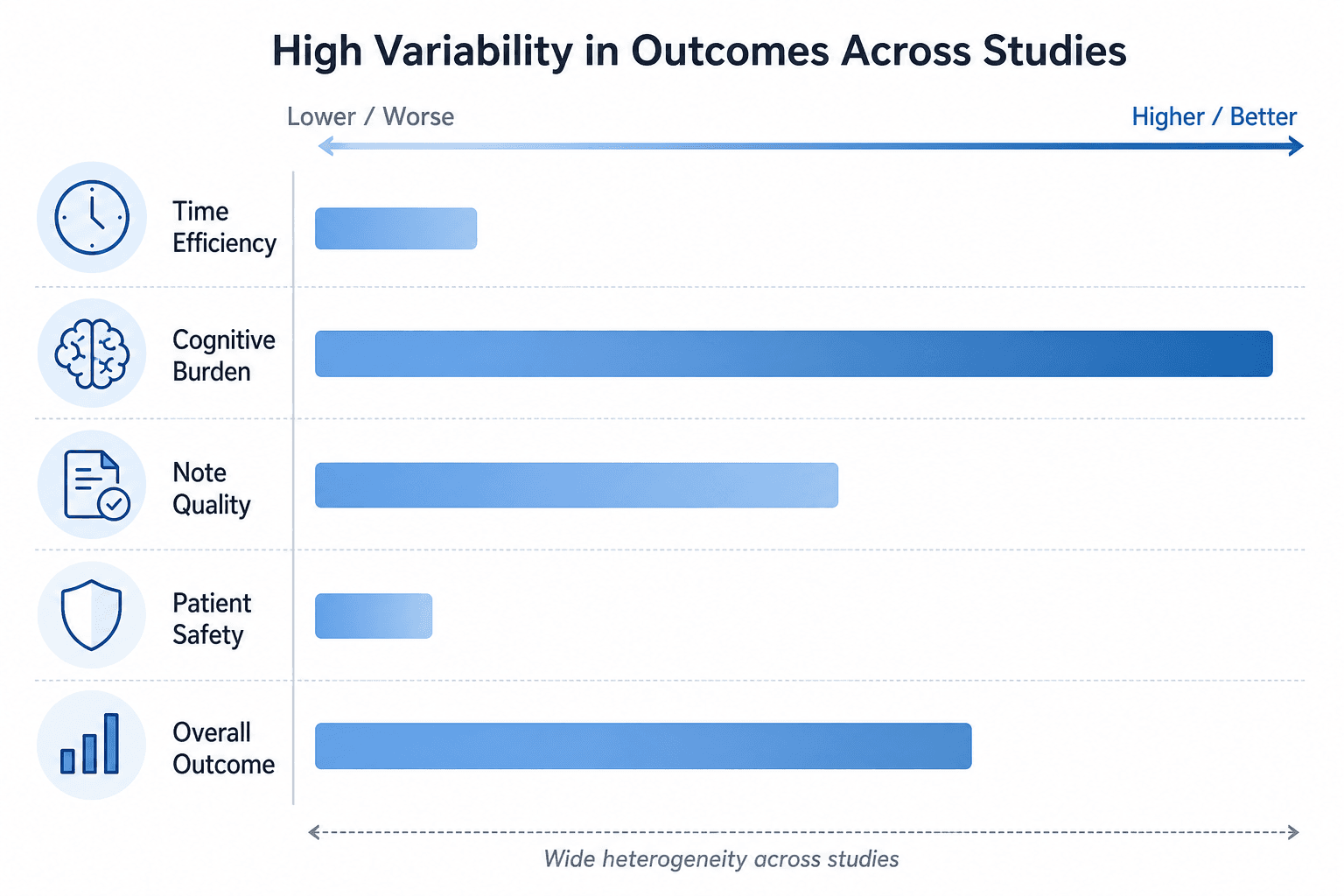
- Absence of randomized controlled trials. The near-total absence of RCTs is the most significant gap. Without randomization, it is impossible to separate the effect of the tool from the effect of increased attention to documentation that accompanies any technology evaluation.
- Single-center, single-group pre-post designs. Most primary studies compare the same clinicians before and after tool adoption without a concurrent control group. This design is highly vulnerable to the Hawthorne effect and secular trends in EHR use.
- EHR log data as a proxy for documentation burden. Time recorded in the EHR system does not capture cognitive effort, documentation quality, or the time spent reviewing and correcting AI output — all of which are clinically relevant.
- Heterogeneous outcome measures. Studies use different time metrics (per note, per day, per appointment, after-hours), different burnout instruments, and different quality assessment tools, making cross-study comparison unreliable. SCRIBE and MedHelm are emerging as evaluation frameworks but have not yet produced standardized benchmarks.
- Industry funding conflicts and vendor-reported metrics. Vendor-reported figures — including those frequently cited in health system communications — are not subject to peer review. The distinction between vendor-reported metrics and independently validated findings is critical and often obscured in secondary coverage.
- Technology Readiness Level immaturity. The J Med Syst scoping review found most digital scribes at TRL 3–4, indicating that most tools in the published literature have not yet been tested under real-world clinical conditions at scale.
- No patient outcome data. No peer-reviewed study to date has demonstrated improved patient clinical outcomes — diagnostic accuracy, treatment appropriateness, adverse event rates — attributable to ambient AI documentation. This is the most consequential evidence gap for clinical adoption decisions.
Scaling Challenges: High-Acuity Settings, Equity, and Regulatory Uncertainty
Most peer-reviewed evidence on ambient AI documentation comes from ambulatory primary care and outpatient specialty settings. The evidence base for high-acuity environments — emergency departments, inpatient wards, intensive care units — is substantially thinner.
The npj Digital Medicine barriers perspective notes that vendors have begun marketing ED-specific ambient AI solutions without supporting clinical evidence for those settings. The documentation workflow, interruption frequency, and cognitive demands of emergency medicine differ substantially from ambulatory care, and findings from outpatient settings cannot be assumed to transfer.
- Linguistic and equity gaps. Ambient AI tools rely on automatic speech recognition and natural language processing trained predominantly on English-language clinical speech. Non-English-speaking patients, patients with accented speech, and linguistically diverse clinical populations are underrepresented in both training data and published implementation studies. No peer-reviewed study in this digest explicitly reports performance stratified by patient language or clinician accent.
- High-acuity setting evidence gap. Published evidence is concentrated in ambulatory and primary care settings. ED, inpatient, and ICU deployments lack supporting peer-reviewed evidence at comparable depth.
- Regulatory and medicolegal uncertainty. The UK GP survey (npj Digital Medicine 2026) found that safety and medicolegal concerns were the predominant reasons for non-adoption, and noted that AI scribe use continues despite recent official guidance to cease use in some NHS contexts. This international signal reflects unresolved questions about liability for AI-generated clinical documentation errors that apply across jurisdictions.
- Patient perspectives remain under-investigated. The UK GP survey authors explicitly note that patient perspectives on ambient AI documentation and equitable use within practices remain under-investigated. The ICE-AID study reported highly positive patient feedback (over 90% reporting improved clinician-patient interaction), but this finding comes from a single pediatric setting and has not been replicated across diverse patient populations.
Clinical and Administrative Takeaways: What the Evidence Does and Does Not Support
The peer-reviewed literature on ambient AI clinical documentation is sufficient to draw some bounded conclusions — and to identify the claims that the evidence does not yet support. Clinicians and health system leaders making adoption decisions should operate within those boundaries.
What the evidence supports:
- Reduction in perceived cognitive burden and documentation-related mental demand, measured by validated instruments (Stanford PFI, NASA-TLX), across multiple studies and settings.
- Some measurable time savings in specific ambulatory settings, ranging from approximately 0.35 minutes per note (NYU Langone) to 42.7 seconds per consultation (Erasmus MC) to 5.6 minutes per appointment (Mass General Brigham) — with the important caveat that the Erasmus MC gold-standard study found no change in total consultation time despite documentation time savings.
- Acceptable usability scores (SUS 69–78.8/100) in ambulatory settings, indicating that clinicians can learn to use these tools without excessive friction.
- Meaningful outpatient letter turnaround improvements in specific workflow contexts (ICE-AID: 7.9 days to 14 minutes), though this finding comes from a single pediatric setting and should not be generalized.
What the evidence does not yet support:
- Universal or reliable time efficiency gains. The range from 18 seconds (Permanente) to no significant gain (Intermountain) to 5.6 minutes (Mass General Brigham) means no single deployment can be assumed to replicate another health system's results.
- System-level burnout reduction. Individual perceived cognitive load reduction is not the same as organizational burnout prevention, and no study has demonstrated the latter.
- Patient safety assurance. The Erasmus MC finding of degraded symptom and measurement documentation — even with clinician review — is a patient safety signal that has not been resolved by subsequent research.
- Improved patient clinical outcomes. No peer-reviewed study has demonstrated improved diagnostic accuracy, treatment appropriateness, or adverse event rates attributable to ambient AI documentation.
- Performance in high-acuity settings. ED, inpatient, and ICU deployments lack peer-reviewed evidence comparable in depth to ambulatory studies.
- Equitable performance across patient populations. Non-English-speaking patients and linguistically diverse populations are underrepresented in both training data and published studies.
For institutions currently evaluating or expanding ambient AI documentation deployments, the evidence suggests three operational requirements that go beyond typical technology procurement:
- Establish pre-specified outcome metrics before deployment. Define what success looks like in measurable, clinically meaningful terms — not just time-in-EHR metrics, but note quality indicators and, where feasible, patient outcome proxies.
- Require independent validation rather than relying on vendor-reported data. Vendor-reported metrics are not peer-reviewed and are not subject to the methodological scrutiny that peer-reviewed studies receive. Health systems should treat vendor claims as hypotheses to be tested in their own context, not as established findings.
- Monitor note quality and accuracy as a patient safety domain. The Erasmus MC finding that AI-generated notes contained fewer symptom and measurement variables than clinician-written notes — even after review — should prompt ongoing audit of documentation completeness, not just usability satisfaction surveys.
Discussion
Professional commentary from clinicians, researchers, and policy professionals is welcome. Please ground discussion in published evidence or clinical experience.
Comments
Join the discussion with an anonymous comment.