
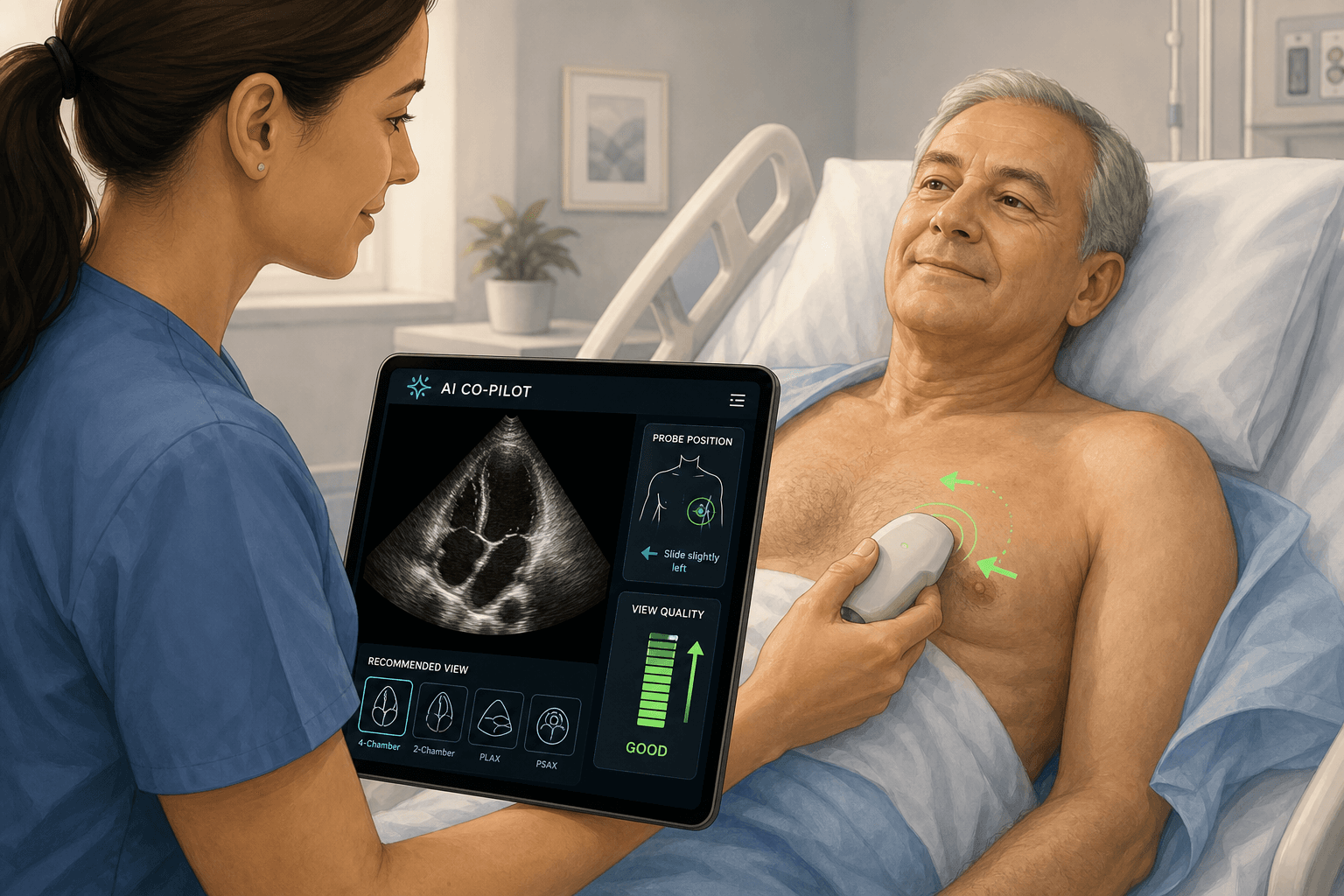
Technology Snapshot: Caption Health, GE HealthCare, and the Caption AI Platform
Caption Health was founded in 2013 under the name Bay Labs, Inc. — the corporate identity under which its landmark FDA De Novo application was filed. The company developed Caption AI, an AI-guided cardiac ultrasound platform built for use by clinicians without formal sonographer training. Its core value proposition is enabling non-specialists to acquire diagnostic-quality echocardiographic images at the point of care.
In February 2023, GE HealthCare announced its acquisition of Caption Health, integrating the platform into its Point of Care and Handheld business portfolio. As of the September 2024 submission of the most recent 510(k) clearance, Caption Health, Inc. continues to operate as a legal subsidiary at its San Mateo, California address.
Caption AI consists of two cleared software components: Caption Guidance, which provides real-time probe-positioning instructions during image acquisition, and Caption Interpretation AutoEF, which automatically calculates left ventricular ejection fraction (LVEF). The platform commercially launched on the GE HealthCare Vscan Air SL handheld ultrasound system at the ACC Annual Scientific Session in Atlanta in April 2024.
| Component | Function | FDA Authorization |
|---|---|---|
| Caption Guidance | Real-time probe-positioning prompts across 10 standard echo views; Quality Meter, AutoCapture, Save Best Clip | De Novo DEN190040 (Feb 2020); 510(k) K243065 (Jan 2025) |
| Caption Interpretation AutoEF | Automated LVEF calculation from PLAX, AP2, and AP4 views | 510(k) clearance (Jul 2020) |
The Clinical Problem: Cardiac Ultrasound Access, Sonographer Shortage, and POCUS Underutilization
Echocardiography is among the most clinically valuable diagnostic tools in cardiology, yet its use at the point of care remains constrained by a structural bottleneck: the requirement for trained cardiac sonographers to acquire interpretable images. In high-acuity settings — emergency departments, intensive care units, and inpatient wards — access to a sonographer is frequently unavailable, particularly outside of business hours or at smaller facilities.
Point-of-care ultrasound (POCUS) has expanded the clinical footprint of bedside imaging, but image quality and diagnostic reliability remain highly operator-dependent. Conditions such as heart failure, pericardial effusion, and reduced ventricular function — all detectable via echocardiography — often go unassessed at the initial point of contact because the clinician present lacks the training to acquire usable images.
The parasternal long-axis (PLAX) view is particularly relevant in this context. Because it can be acquired without repositioning the patient — unlike apical views that require lateral decubitus positioning — PLAX is often more accessible in ICU, anesthesia preoperative, and emergency settings where patients cannot turn on their sides. Caption AI's inclusion of PLAX-based AutoEF was designed with this clinical reality in mind.
How Caption AI Works: Deep Learning Architecture, Guidance Features, and AutoEF
Caption AI applies deep learning to two distinct tasks in the echocardiographic workflow: real-time image acquisition guidance and automated quantification of left ventricular function.
Caption Guidance: Real-Time Acquisition Assistance
Caption Guidance delivers over 90 types of real-time visual instructions, emulating the turn-by-turn feedback an expert sonographer would provide. The system analyzes the live ultrasound feed and prompts the user to make specific transducer movements — tilting, rotating, sliding — to optimize image quality for each target view.
- 10 standard echo views supported: PLAX, PSAX-AV, PSAX-MV, PSAX-PM, AP2, AP3, AP4, AP5, SubC4, SC-IVC
- Quality Meter: a real-time visual indicator that rises as the probe approaches the optimal position, turning green when the image meets diagnostic quality thresholds
- AutoCapture: automatically records the video clip when image quality is sufficient, removing the need for manual triggering
- Save Best Clip: continuously tracks image quality across the scanning session and retains the highest-quality clip from each view
- Users can customize scanning protocols by enabling or disabling individual views based on clinical context
Caption Interpretation AutoEF: Automated Ejection Fraction Calculation
Caption Interpretation AutoEF applies end-to-end deep learning to automatically calculate LVEF from acquired clips. Rather than tracing endocardial borders — the conventional manual method — the algorithm analyzes every pixel and frame in a given clip to produce its measurement.
AutoEF can calculate LVEF from any single view or any combination of PLAX, AP2, and AP4. The calculation increases in accuracy as additional views are incorporated. Results are mapped against ASE and ACEP guidelines to indicate whether LVEF falls within the normal range.
FDA Authorization Timeline: From Breakthrough Device Designation to the 2025 510(k)

Caption AI's regulatory history is the most complete in the AI-guided cardiac ultrasound category. It begins with a Breakthrough Device designation and progresses through a first-in-class De Novo authorization to a series of 510(k) clearances that extended and updated the platform.
| Year | Regulatory Action | Submission / ID | Device Name | Applicant | Key Detail |
|---|---|---|---|---|---|
| 2018 | Breakthrough Device Designation | — | Caption Guidance | Caption Health (Bay Labs) | FDA granted expedited review pathway for AI-guided image acquisition |
| Feb 7, 2020 | De Novo Marketing Authorization | DEN190040 | Caption Guidance | Bay Labs, Inc. | First-ever FDA authorization for AI-guided medical imaging acquisition; created product code QJU under 21 CFR 892.2100 |
| Jul 23, 2020 | 510(k) Clearance | Not confirmed in primary record | Caption Interpretation AutoEF | Caption Health, Inc. | Automated LVEF from PLAX, AP2, AP4; PLAX-based AutoEF was an industry first at clearance |
| Jan 15, 2025 | 510(k) Clearance (Traditional) | K243065 | Cardiac Guidance | Caption Health, Inc. | Substantially Equivalent; product code QJU; Radiology panel; no PCCP authorized |
Press materials from 2020 reference Caption Health receiving three FDA clearances that year, with the AutoEF 510(k) described as the company's "third FDA clearance" of 2020. Only two of those authorizations — DEN190040 and the AutoEF 510(k) — have been fully verified and described here. The identity of any additional 2020 clearance should be confirmed directly from the FDA 510(k) database before citing.
Regulatory Mechanics: Why De Novo, What Product Code QJU Means, and the Predicate Network
When Caption Health (then Bay Labs) submitted its De Novo request in August 2019, no predicate device existed for AI-guided real-time medical imaging acquisition. A 510(k) submission requires a substantially equivalent predicate — without one, the only available pathways were De Novo (for novel low-to-moderate risk devices) or PMA (for high-risk devices requiring clinical trials). The De Novo pathway was appropriate given the technology's risk profile and the absence of a prior regulatory classification.
The February 2020 De Novo decision did more than authorize Caption Guidance. It created product code QJU, classified under 21 CFR 892.2100 (the Radiology regulation), with the device classification name "Image Acquisition And/Or Optimization Guided By Artificial Intelligence." This classification did not previously exist. By establishing it, the De Novo decision opened a 510(k) pathway for any subsequent device of the same type — a structural consequence that extends well beyond Caption AI itself.
For background on how the De Novo pathway functions mechanically — including how it differs from 510(k) substantial equivalence review and PMA clinical trial requirements — see the site's overview of how FDA-cleared AI medical devices actually work. The IDx-DR De Novo (DEN180001) in ophthalmology and the Paige Prostate De Novo (DEN200080) in computational pathology are structural parallels — each created a first-in-class regulatory category in its specialty.
DEN190040 has since become a predicate hub. Predicate network analysis of 2025 cardiology AI/ML clearances identifies DEN190040 with 4 direct downstream citations and 5 indirect citations, ranking it among the most-cited predicate devices in the cardiology AI clearance landscape. Product code QJU appeared in at least 2 clearances in 2025 alone, including a submission from Deski (K242807) for its HeartFocus cardiac guidance software.
Clinical Validation Evidence: The Pivotal Study and Performance Data
The De Novo authorization was supported by a prospective multi-center pivotal study designed to evaluate whether untrained clinicians using Caption Guidance could acquire echocardiographic images of diagnostic quality. The study enrolled 8 registered nurses with zero prior ultrasound experience at two institutions: Northwestern Medicine and Minneapolis Heart Institute at Allina Health.
Each nurse performed 30 exams, yielding 240 total patient encounters. The patient population was stratified to include a wide range of body mass indices and cardiac pathologies, testing the system's performance across challenging acquisition conditions. Five expert cardiologists, blinded to which images were acquired by nurses versus trained sonographers, assessed image quality and diagnostic suitability.
| Primary Endpoint | Success Rate | 95% Confidence Interval |
|---|---|---|
| LV size assessment | 98.8% | 96.7–100% |
| LV function assessment | 98.8% | 96.7–100% |
| RV size assessment | 92.5% | 88.1–96.9% |
| Pericardial effusion assessment | 98.8% | 96.7–100% |
All four primary endpoints were met. A second study involving 50 trained sonographers scanning with and without Caption Guidance confirmed that the AI-assisted workflow produced images comparable in quality to standard sonographer acquisition, establishing the baseline against which non-expert performance was measured.
Deployment: GE HealthCare Integration and Clinical Settings
Caption AI became commercially available on the Vscan Air SL wireless handheld ultrasound system with its debut at the ACC Annual Scientific Session in Atlanta on April 6–8, 2024. The Vscan Air SL is a dual-probe handheld device; Caption AI runs as an application on iOS and Android, accessible through the Vscan Air app.
GE HealthCare holds approximately 60 AI-enabled medical device authorizations in the US, of which approximately 30 are AI-enabled ultrasound innovations. Caption AI represents the company's entry into AI-guided image acquisition specifically — a distinct capability from AI-assisted interpretation tools that analyze images after acquisition.
The intended clinical deployment contexts for Caption AI align directly with the settings that motivated its development:
- Emergency departments: rapid cardiac assessment by ED physicians or nurses without waiting for a sonographer
- Intensive care units: bedside evaluation of ventricular function, pericardial effusion, and volume status in critically ill patients who cannot be repositioned
- Primary care and outpatient settings: initial cardiac screening by non-cardiologist clinicians, particularly for heart failure monitoring
- Alternate care sites: Caption Health's Caption Care services arm had previously deployed trained technicians for cardiac ultrasounds in non-traditional settings; the Vscan Air SL integration extends this model to device-based deployment
Known Limitations and Open Questions
Caption AI is a mature platform with a well-documented regulatory history, but several limitations and unresolved questions are relevant to procurement and adoption decisions.
- Physician oversight is required for final interpretation. Caption AI is an assistive acquisition and quantification tool. The FDA clearance explicitly requires cardiologist review of images for final patient assessment. The system does not produce autonomous diagnoses.
- Primary clinical evidence predates the GE HealthCare integration. The pivotal trial was conducted on earlier compatible hardware before the February 2023 acquisition and April 2024 Vscan Air SL launch. Post-acquisition real-world clinical data on the GE platform has not been published in peer-reviewed sources identified to date.
- Population diversity and generalizability require further study. The pivotal study enrolled 8 nurses at two US academic and community institutions. Generalizability across diverse patient populations, imaging environments, and international clinical settings has not been independently validated in published literature.
- Reimbursement pathways for non-sonographer-acquired images remain unresolved. CMS reimbursement for echocardiographic studies typically assumes acquisition by a trained sonographer or physician. Whether images acquired by nurses using Caption AI qualify for existing reimbursement codes is not settled, and this gap is a practical barrier to broad deployment.
- A third 2020 FDA clearance referenced in press materials was not confirmed. The July 2020 AutoEF press release identifies it as Caption Health's "third FDA clearance" of 2020, implying a second 510(k) beyond DEN190040 and the AutoEF clearance. That additional clearance has not been independently verified from the FDA database for this profile.
- Caption LungAI has no confirmed FDA clearance. A ClinicalTrials.gov registration (NCT05992324) exists for a Caption LungAI validation study, and GE HealthCare's acquisition announcement referenced a pipeline for pulmonary applications. No FDA clearance for lung ultrasound AI has been confirmed in available sources.
Competitive Landscape Context: QJU Clearances and AI Cardiac Ultrasound Comparators
Caption AI's De Novo directly shaped the competitive landscape it now operates in. By creating product code QJU, DEN190040 established the 510(k) on-ramp for any subsequent AI cardiac imaging guidance device. Companies entering this space do not need to pursue a new De Novo — they can cite Caption Guidance as a predicate and proceed through the faster 510(k) pathway, provided their device is substantially equivalent.
UltraSight is among the companies that have pursued QJU-class clearances using the predicate infrastructure Caption Health created. UltraSight received an expanded FDA clearance in January 2026 for multi-device echo guidance under the same product code. Deski's HeartFocus (K242807) is another QJU clearance from 2025, notable for including an authorized Predetermined Change Control Plan — a regulatory feature that K243065 (Caption Health's most recent clearance) does not carry.
In the broader POCUS AI landscape, Butterfly iQ and DiA Imaging Analysis operate in adjacent spaces — AI-assisted image analysis and automated quantification — but their regulatory pathways and intended use claims differ from Caption Guidance's acquisition-guidance focus. The QJU product class is specifically scoped to AI-guided acquisition and optimization, not post-acquisition interpretation alone.
Regulatory Significance: What Caption Health's De Novo Established for the Field
DEN190040 is not simply a regulatory milestone for one company's product. It is the founding document of an entirely new device classification — the first time the FDA formally recognized AI-guided real-time medical imaging acquisition as a distinct, regulated category of software as a medical device.
The structural consequences are measurable. Product code QJU, created by that single De Novo decision, has been cited as a predicate in at least 4 direct downstream 510(k) submissions and 5 indirect citations as of 2025 predicate network analysis — making it one of the most-cited predicate devices in the cardiology AI clearance landscape. The Breakthrough Device designation that preceded it also demonstrated a viable regulatory pathway for AI imaging acquisition tools seeking expedited review.
The parallel to other first-in-class AI De Novos is instructive. The IDx-DR De Novo (DEN180001) in diabetic retinopathy screening similarly created a product class that enabled subsequent autonomous AI diagnostic submissions in ophthalmology. Caption Health's De Novo performs the same function in cardiac imaging acquisition — not autonomous diagnosis, but the upstream task of making diagnostic-quality images available in the first place.
For regulatory professionals tracking the AI cardiac ultrasound space, the key items to monitor going forward include: post-acquisition clinical evidence from GE HealthCare on the Vscan Air SL platform; CMS reimbursement policy development for non-sonographer-acquired echocardiographic studies; and whether Caption Health pursues PCCP authorization in future 510(k) submissions, given that K243065 was cleared without it.
Feedback & Corrections
Corrections, deployment experience notes, and questions from clinicians and procurement professionals are welcome. For formal corrections, use the contact page.
Comments
Join the discussion with an anonymous comment.