
 Waystar AltitudeAI (including AltitudeCreate, AltitudeAssist, and Iodine IodineIQ)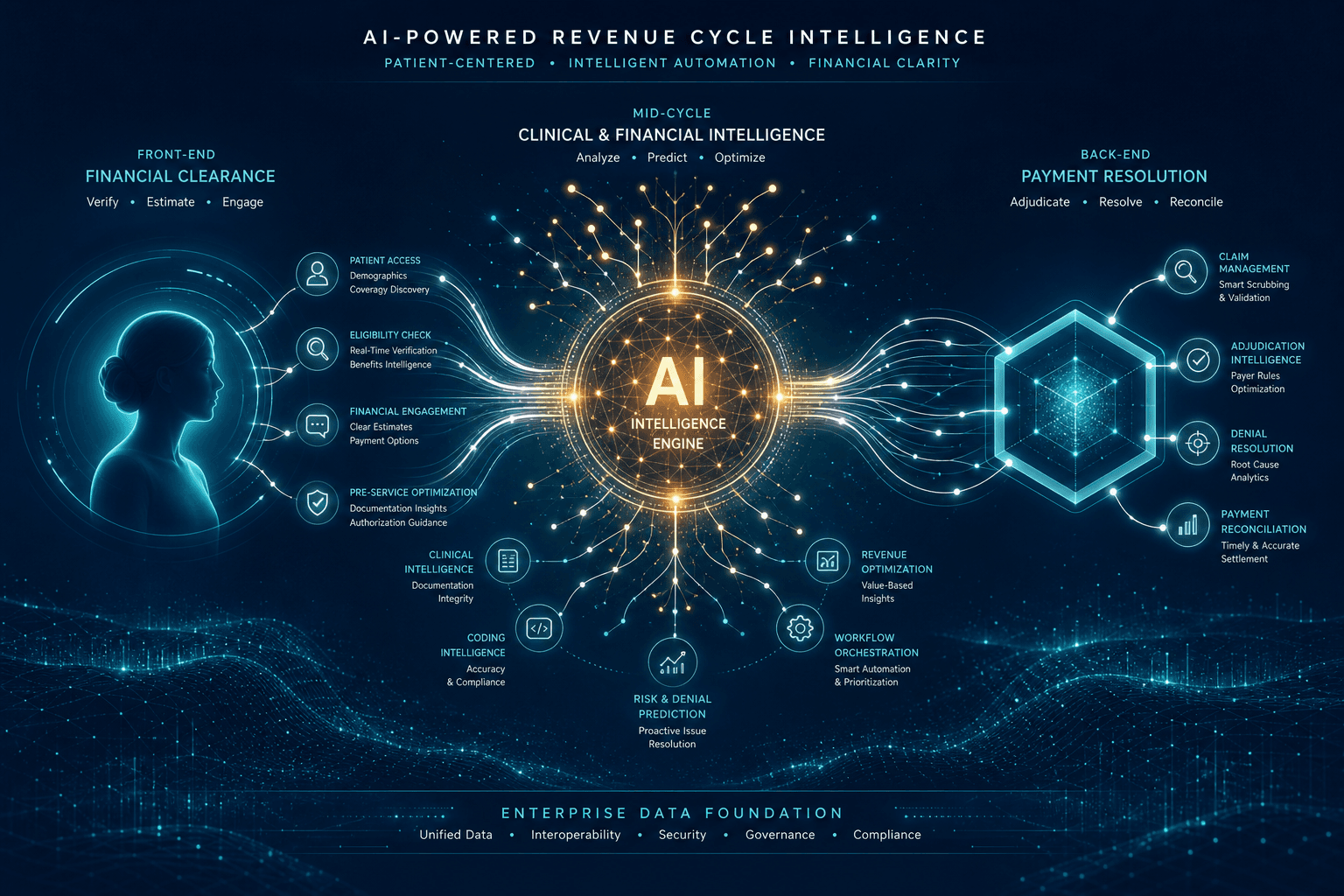
Company Snapshot
Waystar (Nasdaq: WAY) was formed in November 2017 through the merger of Navicure and ZirMed, two established healthcare payment technology companies, backed by Bain Capital and EQT. The combined entity adopted the Waystar brand in 2018 and went public in June 2024, raising $968 million in its Nasdaq IPO. The company maintains dual headquarters in Lehi, Utah and Louisville, Kentucky, and is led by CEO Matt Hawkins.
By scale, Waystar serves more than 30,000 client organizations and over one million individual providers. Its platform handles claims for 16 of the 20 U.S. News Best Hospitals and processes approximately $2.4 trillion in annual gross claims. Following the October 2025 close of the Iodine Software acquisition, the combined company is positioned to serve 17 of the 20 U.S. News Best Hospitals.
Readers seeking broader context on the healthcare AI vendor landscape beyond Waystar can refer to the structured landscape of active AI developers in healthcare, which maps the market across clinical, administrative, and operational domains.
Platform Architecture and Transaction Scale
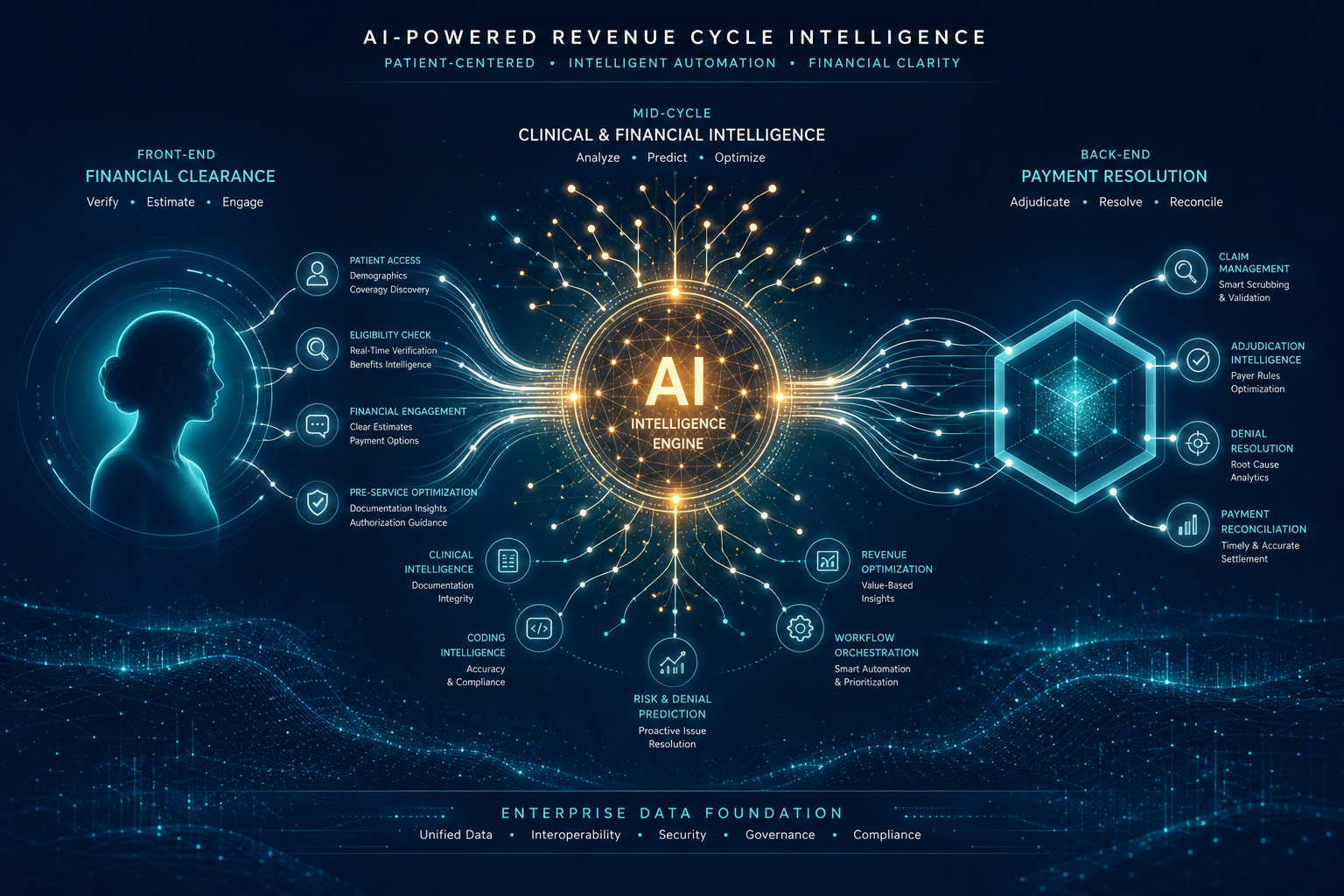
Waystar operates a unified end-to-end revenue cycle management platform that spans the full financial lifecycle of a healthcare claim — from pre-service patient financial clearance through post-adjudication payment reconciliation. The platform processes more than 7.5 billion transactions annually, covering approximately 60% of U.S. patients and one in three hospital discharges, according to Waystar's April 2026 Spring Showcase announcement.
The platform is organized across six solution modules covering patient access, claims management, payment accuracy, denial management, patient financial care, and clinical documentation integrity. Approximately 500 integrations with EHR and practice management systems connect Waystar into existing clinical and administrative workflows without requiring a wholesale technology replacement.
The clearinghouse data scale is architecturally significant for AI purposes. Processing billions of transactions across a large share of the U.S. payer-provider market generates the training signal and feedback loops that underpin AltitudeAI's predictive and generative capabilities. Waystar's historical clearinghouse infrastructure is the data substrate, not the primary product narrative.
- 7.5 billion+ annual transactions processed across the platform
- ~60% of U.S. patients covered by payer-provider connections
- 1-in-3 U.S. hospital discharges flowing through the combined Waystar-Iodine platform
- ~500 EHR and practice management system integrations confirmed
- Six solution modules spanning front-end through back-end RCM
AltitudeAI: Components and Architecture
Waystar launched AltitudeAI in January 2025, positioning it as the first generative AI capability purpose-built for denial prevention and recovery in the RCM market. The suite has since expanded through two named components and a broader agentic AI infrastructure.
- AltitudeCreate: A generative AI component that automates the drafting of denial appeal letters. According to Waystar company data, AltitudeCreate reduced the time to build 100 appeal packages by 90% and produced a 40% higher denial overturn rate compared to manual processes.
- AltitudeAssist: An AI-powered workflow assistant that orchestrates repetitive tasks across the revenue cycle, reducing manual intervention in high-volume, rules-based workflows.
- Agentic AI network: Introduced in January 2026, this layer comprises more than 150 AI-trained models deployed across front-end, mid-cycle, and back-end RCM stages. The models operate in coordination rather than as isolated point solutions.
In March 2026, Waystar announced an expanded collaboration with Google Cloud to integrate Gemini large language models and hyperscale data infrastructure into AltitudeAI workflows. The partnership is designed to accelerate agentic AI deployment and enable what both companies describe as a self-learning revenue cycle — one that continuously improves upstream prior authorization, patient coverage identification, and denial prevention through a compounding data flywheel. Google Cloud's Aashima Gupta stated in the March 2026 announcement that the integration moves "past simple automation toward a self-learning revenue cycle."
AI Capabilities Across the Revenue Cycle
Waystar organizes its AI capabilities by RCM stage. The following summarizes documented capabilities as of Q2 2026, with outcome metrics attributed to Waystar company data and press releases where noted.
Front-End: Patient Access and Financial Clearance
Front-end capabilities focus on insurance eligibility verification and prior authorization. The eligibility verification layer uses AI to identify coverage gaps and patient financial risk before the point of service, reducing downstream claim failures. Prior authorization automation uses proactive clinical justification — drawing on Iodine's clinical data assets post-acquisition — to submit more complete authorization requests and reduce payer denials at the front end.
Waystar's prior authorization automation capabilities, including the proactive clinical justification workflow and how they compare to payer-side PA tools, are covered in depth in the Cohere Health and Waystar prior authorization automation comparative profile. That profile addresses the PA topic with greater specificity than this standalone company overview.
Mid-Cycle: Clinical Documentation Integrity and Coding Accuracy
Mid-cycle capabilities were significantly expanded by the Iodine Software acquisition. Iodine's IodineIQ engine provides AI-driven clinical documentation integrity (CDI), identifying documentation gaps before claims are submitted. The combined platform also addresses charge capture accuracy and coding precision — reducing undercoding, overcoding, and documentation-related denial risk.
A capability introduced at the Spring 2026 showcase uses agentic AI to identify documentation opportunities before a clinical documentation reviewer begins their manual review, reducing correction workloads by up to 40% according to Waystar company data. This figure is company-reported and has not been independently validated in peer-reviewed literature.
Back-End: Denial Management and Recoupment Recovery
Back-end capabilities represent the most publicly documented area of AltitudeAI performance. AltitudeCreate's denial appeal automation, as described above, is the flagship back-end tool. Waystar reports that AltitudeAI prevented $15.5 billion in denied claims in under one year of deployment — a figure attributed to Waystar company data.
In April 2026, Waystar launched what it describes as the industry's first AI-powered solution for payer recoupments — post-payment adjustments commonly called "silent denials." According to a Waystar analysis of proprietary and industry data, payer recoupments cost providers more than $40 billion annually and are growing at twice the rate of overall claim volume. The Recoupment Manager uses AltitudeAI to automatically match recoupment notices to originating claims, reducing reconciliation time by more than 80% in early adopter deployments.
| RCM Stage | AI Capability | Reported Outcome Metric | Source Attribution |
|---|---|---|---|
| Front-end | Insurance eligibility verification | Reduced downstream claim failures | Waystar platform documentation |
| Front-end | Prior authorization with proactive clinical justification | Reduced payer denials at submission | Waystar press releases |
| Mid-cycle | Clinical documentation integrity (Iodine IodineIQ) | Pre-submission gap identification for 1-in-3 US inpatient discharges | Waystar/Iodine acquisition materials |
| Mid-cycle | Agentic documentation opportunity identification | Up to 40% reduction in manual correction workload | Waystar Spring 2026 Showcase (company data) |
| Back-end | AltitudeCreate denial appeal drafting | 90% reduction in time to build 100 appeal packages; 40% higher overturn rate | Waystar company blog / press releases |
| Back-end | AltitudeAI denial prevention | $15.5B in denied claims prevented | Waystar company data |
| Back-end | Recoupment Manager (silent denials) | 80% reduction in reconciliation time; $32M surfaced for one early adopter health system | Waystar press release, April 2026 |
| Patient financial care | Personalized patient payment offers | Up to 50% increase in collections (projected) | Waystar Spring 2026 Showcase (company data) |
Iodine Software Acquisition
Waystar announced the acquisition of Iodine Software in July 2025 and closed the transaction in October 2025 for $1.25 billion, funded on a roughly 50/50 cash-and-stock basis. Iodine equity holders received approximately 8% of the combined company. Iodine was previously owned by Advent International.
What Iodine adds to the platform is primarily a clinical data asset and a trained AI engine. Iodine's proprietary models were trained on clinical data representing more than one-third of all U.S. inpatient discharges, according to the acquisition close announcement. The IodineIQ engine trains continuously on millions of patient encounters, providing CDI, utilization management, and prebill revenue leakage identification. Iodine had an installed base of approximately 1,000 hospitals and health systems at the time of acquisition.
- Transaction value: $1.25 billion (50/50 cash and stock)
- Announced July 2025; closed October 2025
- Clinical data asset: AI models trained on 1-in-3 U.S. inpatient discharges
- Installed base at acquisition: ~1,000 hospitals and health systems
- Identified cost synergies: $15 million+ in run-rate synergies within 18–24 months
- TAM expansion: expected to expand Waystar's total addressable market by more than 15%
- Financial accretion: expected to be accretive to non-GAAP EPS in 2027
Financial Performance
Waystar reported full-year 2025 revenue of $1.099 billion, representing 17% year-over-year growth, according to its FY2025 earnings release. Adjusted EBITDA reached $462.1 million, equating to a 42% margin. GAAP net income was $112.1 million. Subscription revenue grew 22% year-over-year to $558.4 million, while volume-based revenue reached $534.8 million, up 11%.
Net revenue retention (NRR) of 112% indicates that existing clients are expanding their use of the platform year over year. The company ended FY2025 with 1,391 clients generating more than $100,000 in trailing twelve-month revenue, a 16% increase from the prior year.
First quarter 2026 revenue was $313.9 million, up 22% year-over-year, with GAAP net income of $43.3 million and adjusted EBITDA of $135.4 million. Non-GAAP EPS of $0.42 exceeded analyst consensus estimates of $0.39, according to FierceHealthcare's Q1 2026 earnings coverage. Approximately 40% of new bookings in Q1 were driven by AI capabilities. Volume headwinds from a weaker flu season, winter storms, and ACA subsidy expiration were offset by subscription revenue strength.
| Metric | FY2025 | Q1 2026 | FY2026 Guidance |
|---|---|---|---|
| Total Revenue | $1.099B (+17% YoY) | $313.9M (+22% YoY) | $1.274–$1.294B |
| Adj. EBITDA | $462.1M (42% margin) | $135.4M | $530–$540M |
| GAAP Net Income | $112.1M | $43.3M | Not guided |
| Non-GAAP EPS | — | $0.42 (beat est. $0.39) | — |
| Net Revenue Retention | 112% | Not reported separately | — |
| Clients >$100K LTM | 1,391 (+16% YoY) | — | — |
| Subscription Revenue | $558.4M (+22% YoY) | — | — |
Market Position and Independent Validation
The most substantial third-party validation available as of Q2 2026 comes from the Black Book Market Research Q1 2026 benchmark, which surveyed more than 750 senior healthcare leaders evaluating 49 RCM vendors. Waystar earned the top overall ranking with a composite score of 9.75 out of 10 across 18 key performance indicators. The next highest competitor scored 8.27 — a gap of nearly 1.5 points on the same scale. Waystar also achieved the highest aggregate AI execution score at 9.56, compared to a benchmark average of 7.75, across dimensions including time-to-value, workflow quality, ROI clarity, and security and governance, per the investor relations announcement.
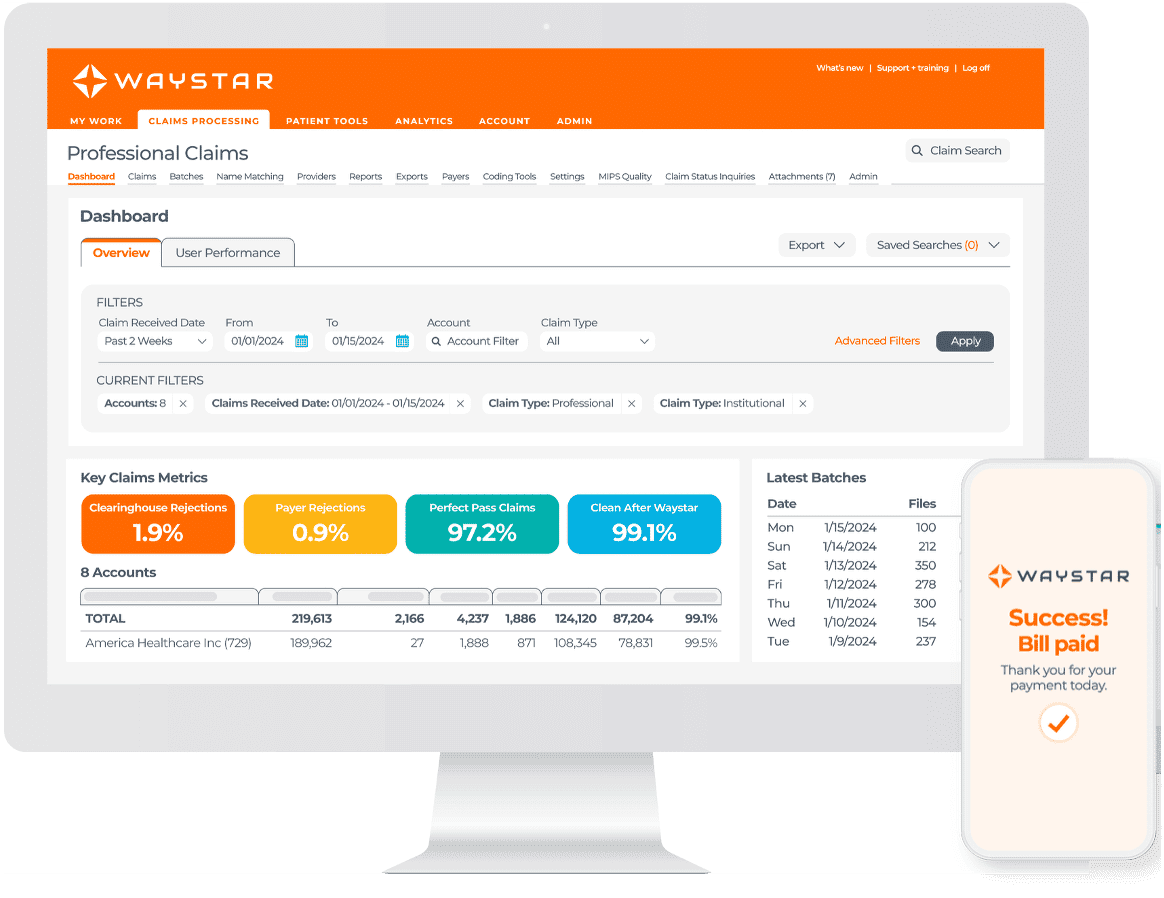
Additional independent recognition includes KLAS Best in KLAS honors across more than ten consecutive years, Inc. Best in Business recognition for AI Implementation, and a "category leader in end-to-end RCM software" designation from William Blair analyst Ryan Daniels following the Q1 2026 earnings call. The platform is described as consistently achieving approximately 99% clean claim and first-pass acceptance rates — a figure that is company-reported.
Competitive Landscape
Waystar competes in the RCM technology market, but its primary competitors operate on meaningfully different business models. Understanding these differences is important for procurement decisions, as a like-for-like comparison is not straightforward.
| Competitor | Business Model | Key Differentiator vs. Waystar | Notable Consideration |
|---|---|---|---|
| R1 RCM | Full managed-service outsourcing with embedded teams and Phare OS | Provides human staff alongside technology; manages $30B+ in annual net patient revenue | Fundamentally different model — organizations outsource RCM operations, not just technology |
| Optum / Change Healthcare | Payer-owned technology platform with Optum Integrity One | Unmatched payer-side data access and cross-payer intelligence | Payer ownership raises conflict-of-interest concerns for many provider organizations |
| Availity | Clearinghouse network and payer connectivity | Broad payer connectivity and eligibility infrastructure | Not a full-service RCM platform; does not cover the complete revenue cycle |
| FinThrive | Technology platform for RCM | Peer technology-only platform with similar positioning | Also requires capable internal staff to operate, similar to Waystar |
Waystar's stated competitive differentiator is its position as the only large publicly traded, pure-play RCM technology platform that combines financial clearinghouse scale with clinical AI data — the latter acquired through Iodine. This combination is intended to address both the financial and clinical sides of revenue cycle failure without the conflict-of-interest concerns associated with payer-owned platforms.
For readers evaluating the payer-side perspective on prior authorization AI — a domain where Waystar operates on the provider side — the Cohere Health company profile covers how payer-side clinical AI platforms approach the same PA workflow from the opposite side of the transaction.
Known Limitations and Procurement Considerations
The following limitations are documented from third-party practitioner sources, independent analyst commentary, and the nature of Waystar's business model. They are presented without mitigation framing.
- Steep initial deployment learning curve: Third-party practitioner reviews report a steep learning curve during initial deployment. This is relevant for organizations with limited internal RCM technology expertise or high staff turnover.
- Premium pricing: Waystar's pricing reflects its technology investment and market position. The platform is not positioned as a cost-competitive entry-level solution.
- AI outcome metrics are company-reported: All major AltitudeAI performance figures — the $15.5 billion in denials prevented, 90% reduction in appeal time, 40% higher overturn rate, and 80% reconciliation time reduction — are sourced from Waystar press releases and earnings communications. No independent peer-reviewed validation of these specific figures was identified. Procurement teams should request client-specific performance data under real-world conditions.
- Payer recoupment AI accuracy variance: The Recoupment Manager's ability to match recoupments to originating claims may vary by payer, claim type, and the completeness of underlying claims data. Early adopter results should not be assumed to generalize uniformly.
- AltitudeAI is not FDA-cleared SaMD: AltitudeAI capabilities are administrative and financial workflow automation tools. They are not software as a medical device and carry no FDA clearance. Clinical informatics teams should not apply SaMD evaluation criteria to these tools.
- Regulatory and reimbursement environment headwinds: Q1 2026 results were affected by ACA subsidy expiration, a weaker flu season, and winter storms — all of which reduced claim volume. These external factors are not unique to Waystar but illustrate the platform's exposure to payer policy and utilization dynamics.
- Iodine integration outcomes not yet fully verifiable: The Iodine acquisition is described as running ahead of internal plan, but full technical and clinical data unification has not been independently assessed. Organizations evaluating the combined clinical-financial AI platform should account for ongoing integration risk.
Documented Deployment Context
Waystar has disclosed several client examples in press releases and investor communications. All figures below are company-disclosed outcomes, not independently verified case studies.
Piedmont Healthcare reported improved authorization accuracy using the Waystar platform. Sheila Granda of Piedmont Healthcare stated in a Waystar investor release:
Leveraging Waystar, our accuracy rate is in the 90s, which is tremendous.
Piedmont also reported a significant reduction in human-touch requirements for authorization workflows, though specific volume or FTE figures were not disclosed in available sources.
Novocure, a medical device company, deployed the Recoupment Manager for silent denials. Munday Letourneau of Novocure stated in the April 2026 product launch release:
Waystar's Recoupment Manager cut that to minutes and gave us something we've never had: a clear view of what's being taken back and why.
Novocure reported that the tool surfaced $32 million in previously hidden recoupments. A separate early adopter health system with approximately $4 billion in annual revenue also participated in the silent denials program, with Waystar reporting that $32 million in revenue risk was surfaced — equivalent to approximately 27,000 hours of manual reconciliation work, or roughly 13 FTEs. This early adopter figure is drawn from the same April 2026 press release and should be understood as a single deployment result, not a generalizable benchmark.
For a broader view of the healthcare AI company landscape, including other RCM, clinical decision support, and administrative AI vendors, see the AI companies in healthcare structured landscape overview.
Comments
Join the discussion with an anonymous comment.