
Clinical and Regulatory Context
On September 21, 2021, the FDA granted De Novo marketing authorization to Paige Prostate under decision number DEN200080 — making it the first AI system in any pathology specialty to receive FDA marketing authorization in the United States. That regulatory milestone is documented in full in the Paige Prostate (DEN200080) FDA De Novo Authorization Record on this site, which covers the device identity, regulatory pathway, product code, and post-authorization status. This digest does not repeat those details.
What matters for evidence consumers — pathologists, urologic oncologists, clinical researchers, and procurement decision-makers — is the quality of the clinical validation study the FDA relied upon when granting that authorization. The pivotal study is Raciti et al. 2023, published in the Archives of Pathology and Laboratory Medicine (PMID 36538386, DOI: 10.5858/arpa.2022-0066-OA). This digest provides a structured critical appraisal of that study: what it measured, how it was designed, what the results show, where the methodology falls short, and what the combined evidence actually supports for clinical decision-making.
Study Design Classification
The Raciti 2023 study is a multi-reader, multi-case (MRMC) reader study conducted under simulated clinical practice conditions. In an MRMC design, multiple readers (pathologists) each evaluate multiple cases (whole slide images), allowing the study to estimate both within-reader and between-reader variability in performance — a methodologically appropriate choice for evaluating a diagnostic AI adjunct.
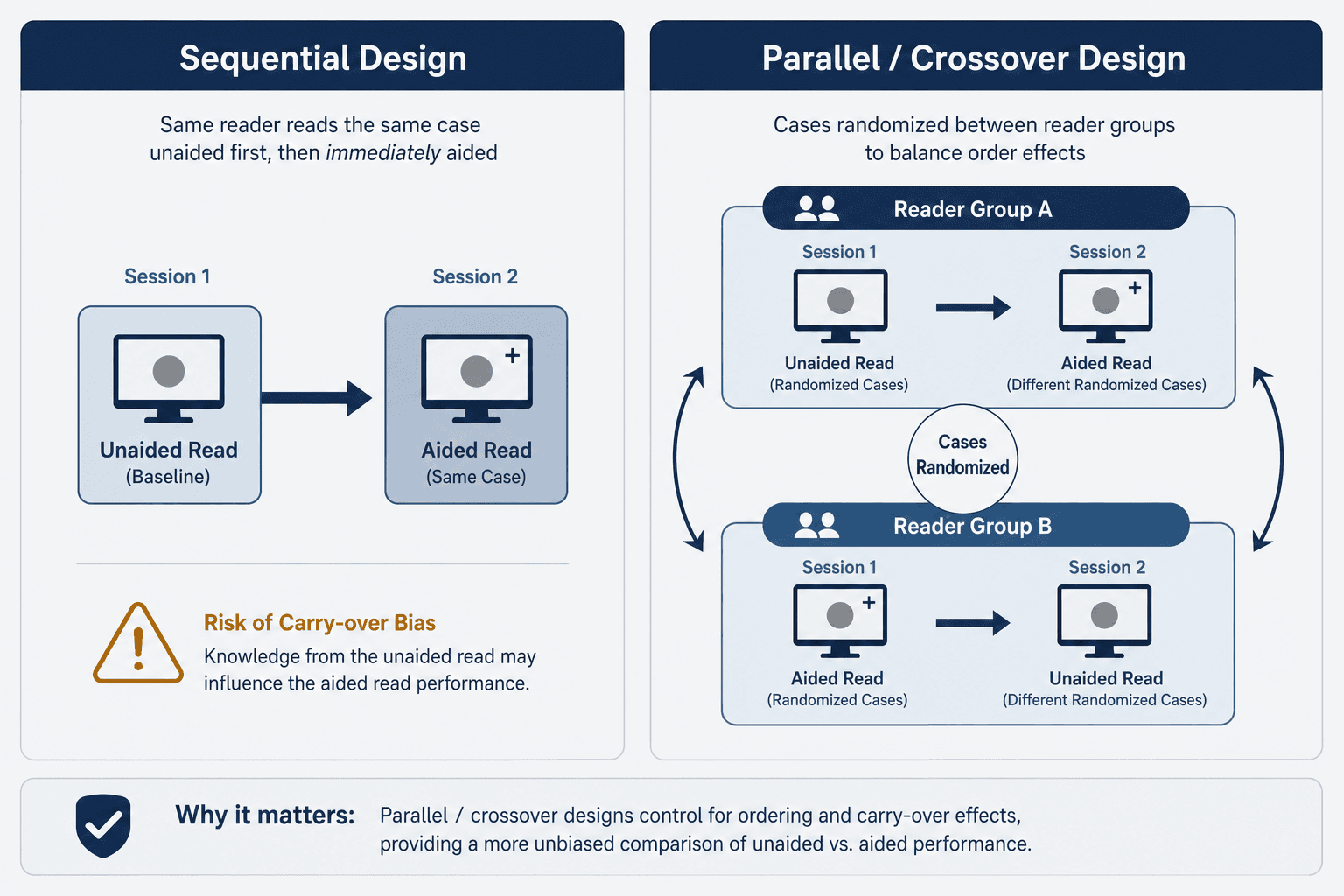
The critical structural feature — and the central methodological concern for evidence consumers — is the sequential unblinded read design. Each pathologist evaluated every whole slide image twice: first without AI assistance, and then immediately afterward with Paige Prostate active. Both reads were performed in the same sitting, on the same case, by the same reader.
This is not a parallel design (where different readers are randomized to aided vs. unaided conditions) and not a crossover design (where the same readers evaluate different case sets under each condition with a washout period). In a sequential same-session design, the pathologist who just read a slide unaided then immediately re-reads it with the AI result visible. That reader already knows the case. The second read is not independent.
Population and Dataset
The study enrolled 18 pathologists and presented each with 610 prostate needle core biopsy whole slide images. The slide set was prepared across 218 institutions, which is a meaningful strength: multi-institutional slide preparation introduces variation in tissue processing, staining protocols, and scanner characteristics that a single-institution dataset would not capture. This increases the likelihood that the image set reflects the kind of heterogeneity pathologists encounter in routine practice.
The reader panel, however, warrants scrutiny. Of the 18 pathologists, only 2 were genitourinary (GU) subspecialists; the remaining 16 were general pathologists. Prostate biopsy interpretation is a task where subspecialty expertise is clinically meaningful — GU subspecialists routinely handle edge cases involving atypical small acinar proliferation, high-grade PIN, and mimics of adenocarcinoma that challenge general pathologists. A panel weighted toward general pathologists may produce larger apparent AI benefit gains than would be observed in a subspecialist-dominant practice setting.
- 610 prostate needle core biopsy whole slide images (WSIs) evaluated per reader
- Slides prepared at 218 institutions — supporting image diversity across processing and scanning environments
- 18 pathologist readers: 2 GU subspecialists, 16 general pathologists
- Each reader evaluated every slide twice: unaided first, then immediately aided by Paige Prostate
- No patient demographic data (age, race, ethnicity, PSA level, clinical stage) reported in the abstract; full-text access required to assess whether this information was collected or analyzed
AI System Description: Paige Prostate (PaPr)
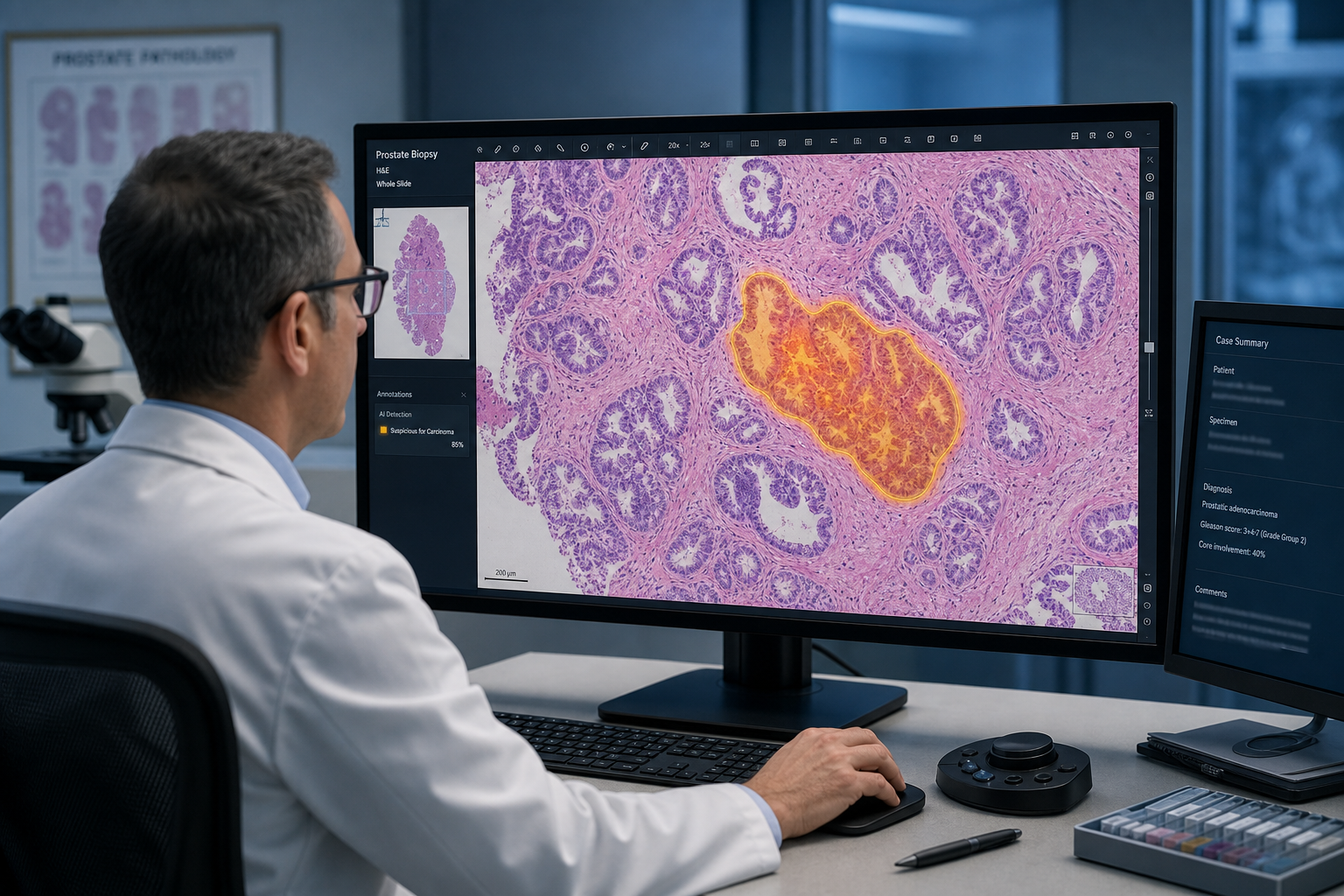
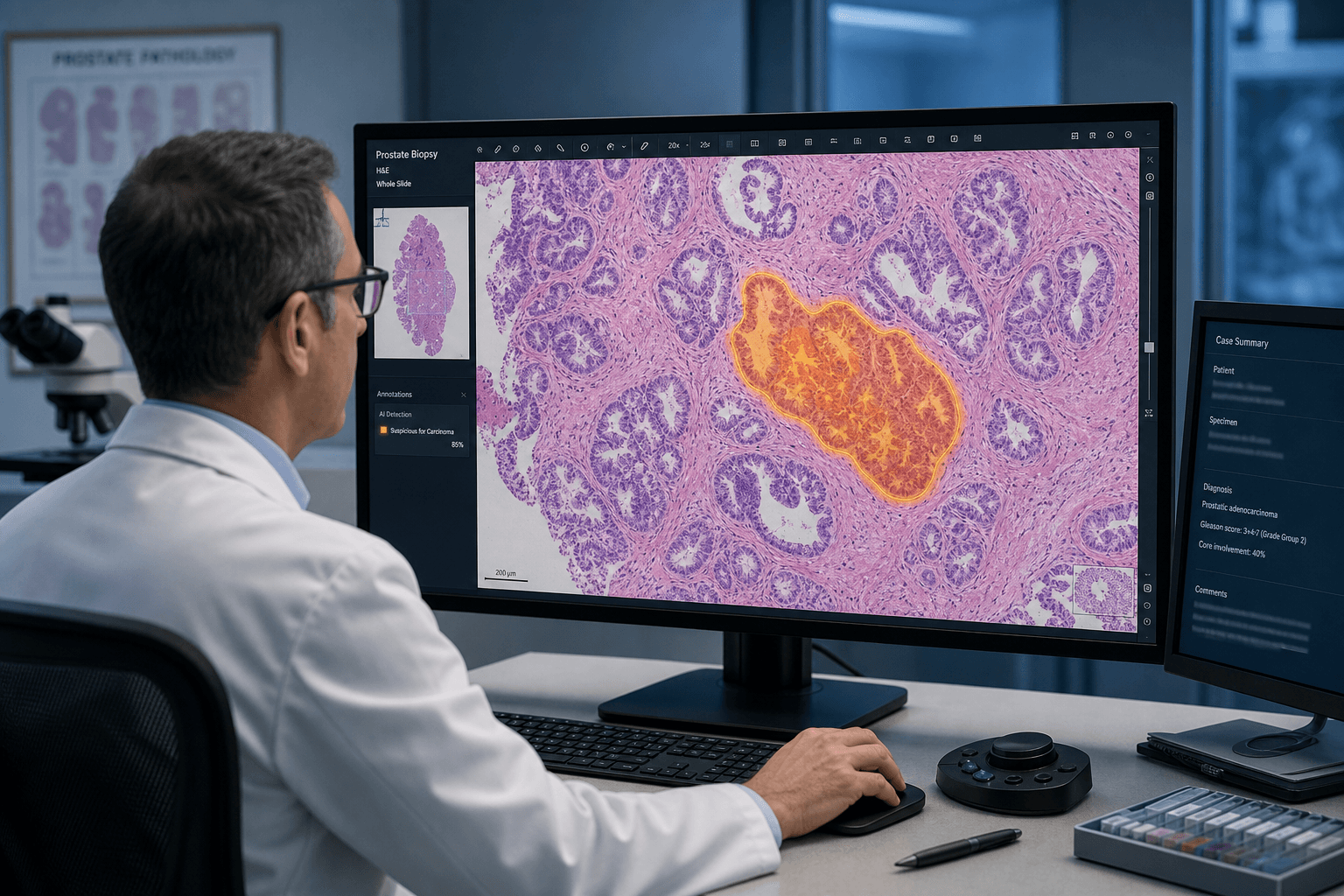
Paige Prostate (PaPr) is a deep learning-based system built on a convolutional neural network architecture. Its function in the study — and as authorized by the FDA — is to serve as a second-review adjunct: it processes a whole slide image and returns two outputs.
- Binary WSI-level classification: the system classifies each slide as either suspicious for cancer or benign
- Localization output: on slides classified as suspicious, the system identifies the region with the highest probability of harboring cancer, providing the pathologist with a spatial anchor for their review
The system does not produce a Gleason grade, a diagnostic report, or a clinical recommendation. It flags and localizes — the pathologist is required to interpret the flagged region, make the final diagnosis, and take clinical responsibility for every case. This is consistent with the FDA's authorized intended use, which explicitly positions the tool as an adjunct requiring pathologist supervision, not an autonomous diagnostic system.
Primary Results: What the Pivotal Study Reported
According to the published abstract of Raciti et al. 2023, pathologists using Paige Prostate improved their sensitivity and specificity across all histologic grades and tumor sizes compared to their unaided reads. Accuracy gains were observed on both benign and cancerous WSIs, and those gains were attributable to the AI system's output.
A particularly notable finding is that Paige Prostate correctly classified 100% of the WSIs where pathologists changed their diagnosis in the AI-assisted phase. In other words, in every instance where a pathologist reversed or revised their unaided call after seeing the AI output, the AI's classification was the correct one. This is a strong signal about the system's directional accuracy in cases of diagnostic uncertainty.
Secondary Evidence: Da Silva et al. 2021 Independent Validation
The most substantive independent, non-industry validation of Paige Prostate published to date is da Silva et al. 2021 in the Journal of Pathology (PMID 33904171). This study evaluated Paige Prostate on 600 transrectal ultrasound-guided prostate needle core biopsy part-specimens from 100 consecutive patients at a single center in Brazil. Critically, it was conducted outside the industry context and used real patient material in a real diagnostic workflow, rather than a simulated reader study.
| Metric | Part-Specimen Level | Patient Level |
|---|---|---|
| Sensitivity | 0.99 (CI 0.96–1.0) | 1.0 (CI 0.93–1.0) |
| NPV (Negative Predictive Value) | 1.0 (CI 0.98–1.0) | 1.0 (CI 0.91–1.0) |
| Specificity | 0.93 (CI 0.90–0.96) | 0.78 (CI 0.64–0.89) |
The study identified four additional patients whose diagnoses were upgraded from benign or suspicious to malignant — cancers that had not been diagnosed by three experienced histopathologists in the initial read. The 27 part-specimens flagged as suspicious by Paige Prostate that ultimately received a benign final diagnosis consisted primarily of atrophy (n=14), apical or benign prostate tissue (n=9), adenosis (n=2), and post-atrophic hyperplasia (n=1). The system also produced an estimated 65.5% reduction in diagnostic time for the analyzed material.
Limitations Analysis
A structured appraisal of the evidence requires naming the limitations explicitly. The following six concerns are material for any reader using this study to inform a clinical or procurement decision.
- Sequential read order effects (carry-over bias): The study's design — unaided read followed immediately by an aided read on the same case — does not include randomization, blinding, or a washout period between reads. A pathologist who has just reviewed a slide unaided is not a naive reader when they review it again with AI assistance moments later. Memory of the first read, anchoring to an initial impression, and the psychological effect of seeing the AI flag a region can all influence the second read in ways that inflate the measured benefit. No parallel control group exists to separate the AI effect from the re-read effect.
- Industry conflict of interest: Multiple co-authors on the Raciti 2023 study were employees of Paige.AI at the time of the study. This is a declared conflict of interest under standard journal COI disclosure norms. Industry co-authorship does not invalidate a study's findings, but it is a standard credibility signal that evidence consumers must weigh. The concern is not necessarily fabrication — it is the subtler influence of industry involvement on study design choices, endpoint selection, and framing of results. Readers should apply the same scrutiny they would to any industry-sponsored device validation.
- Simulated practice vs. prospective clinical deployment: The study evaluated pathologist performance under simulated diagnostic conditions. No patient management decisions were made, no follow-up outcomes were tracked, and no real-time workflow data were captured. Performance in a controlled reader study setting does not automatically transfer to a live clinical environment where time pressure, case volume, EHR integration friction, and clinical consequence are all present.
- Small and subspecialty-skewed reader panel: Eighteen pathologists is a limited sample for an MRMC study. With only 2 GU subspecialists and 16 general pathologists, the panel is weighted toward readers for whom AI assistance may provide greater marginal benefit than it would for subspecialists who are already highly accurate on prostate biopsies. The reported performance gains may not generalize to subspecialist-dominant academic centers.
- Absence of patient outcome and demographic data: The study reports diagnostic accuracy metrics but not downstream patient outcomes — there is no data on whether AI-assisted diagnosis changed treatment decisions, reduced time to treatment, or affected clinical outcomes. Additionally, no patient demographic data (race, ethnicity, age, PSA level) are reported in the abstract, making it impossible to assess whether performance was consistent across demographic subgroups.
- Limited generalizability of the independent validation: The only independent real-world validation study (da Silva et al. 2021) was conducted at a single center in Brazil with 100 consecutive patients. Single-center, single-country studies carry inherent generalizability limitations across different patient populations, laboratory protocols, and healthcare contexts. No multi-center independent validation has been published as of mid-2026.
Clinical Relevance Assessment
Taking the available evidence together — the Raciti 2023 pivotal study and the da Silva 2021 independent validation — the most defensible conclusion is that Paige Prostate demonstrates a consistent directional signal: AI assistance appears to improve sensitivity and reduce missed cancers, particularly in cases where the unaided reader is uncertain. The 100% correct classification rate on revised diagnoses and the identification of four additional cancer patients in the independent study are meaningful findings.
The evidence does not, however, support treating these performance figures as precise estimates of what pathologists will experience in prospective clinical deployment. The sequential design, industry co-authorship, simulated setting, and absence of outcome data collectively mean that the magnitude of benefit in practice may be different — and could be lower — than the pivotal study suggests.
The workforce context of adoption matters significantly. In a general pathology practice where prostate biopsies are read by non-subspecialists, the potential benefit from an AI second-review adjunct is plausibly larger than in a GU subspecialty center where pathologists already achieve high baseline accuracy. Procurement decisions should account for the local practice environment, not assume uniform benefit across all settings.
Study Metadata Reference
| Field | Raciti et al. 2023 (Pivotal Study) | Da Silva et al. 2021 (Independent Validation) |
|---|---|---|
| PMID | 36538386 | 33904171 |
| DOI | 10.5858/arpa.2022-0066-OA | Not reproduced here — see PubMed record |
| Journal | Archives of Pathology and Laboratory Medicine | Journal of Pathology |
| Publication Year | 2023 | 2021 |
| Study Design | Multi-reader, multi-case (MRMC) reader study; sequential unblinded design; simulated clinical practice | Real-world single-center validation; consecutive patient series |
| Dataset Size | 610 prostate needle core biopsy WSIs prepared at 218 institutions | 600 part-specimens from 100 consecutive patients |
| Reader Panel | 18 pathologists (2 GU subspecialists, 16 general) | Not a reader study — evaluated system output against expert consensus |
| AI Technique | Deep learning CNN; binary WSI-level classification (suspicious/benign) + cancer localization heatmap | Same system (Paige Prostate) evaluated in deployment context |
| Key Metric (abstract-confirmed) | Sensitivity and specificity improved across all histologic grades and tumor sizes; 100% correct classification on revised diagnoses | Sensitivity 0.99 (part-specimen); NPV 1.0 (part-specimen); Sensitivity 1.0 (patient); Specificity 0.78 (patient) |
| External Validation | No — pivotal study conducted by developer-affiliated team | Yes — independent, non-industry, single center |
| Industry COI | Yes — multiple Paige.AI employee co-authors declared | No industry affiliation reported |
| Patient Demographic Data | Not reported in abstract; full text required | Not detailed in abstract |
| Patient Outcome Data | Not collected — simulated diagnostic practice | Not reported |
| FDA Authorization Reference | DEN200080, De Novo, decision date September 21, 2021 | Pre-authorization study; does not constitute regulatory submission |
| Evidence Currency | Pivotal study published 2023; no post-authorization independent validation identified as of mid-2026 | Most recent independent real-world study; single-center, single-country |
Comments
Join the discussion with an anonymous comment.