
Company Overview
Tempus AI (NASDAQ: TEM) was founded in 2015 by Eric Lefkofsky in Chicago, Illinois. The company's stated mission is to make precision medicine practical at the point of care — translating genomic, clinical, and molecular data into actionable information for oncologists and their patients. Lefkofsky, previously a co-founder of Groupon, launched Tempus after a family member's cancer diagnosis exposed what he described as a fragmented and data-poor clinical environment.
Tempus completed its initial public offering on the NASDAQ in June 2024 at $37 per share. As of Q2 2026, the company operates as a vertically integrated precision medicine platform with two principal business segments: a Diagnostics segment offering FDA-authorized genomic testing services, and a Data and Applications segment that includes an AI clinical decision support platform, digital pathology tools, and a pharma data-licensing business.
The company's business model is unusual within healthcare AI in that it combines regulated diagnostic testing with software and data licensing under one corporate structure. This integration is central to its revenue strategy: genomic testing generates clinical data at scale, which in turn feeds the AI tools and the data assets licensed to pharmaceutical partners. For a broader survey of active AI developers across healthcare domains, see the structured overview of the active healthcare AI landscape.
Product Architecture
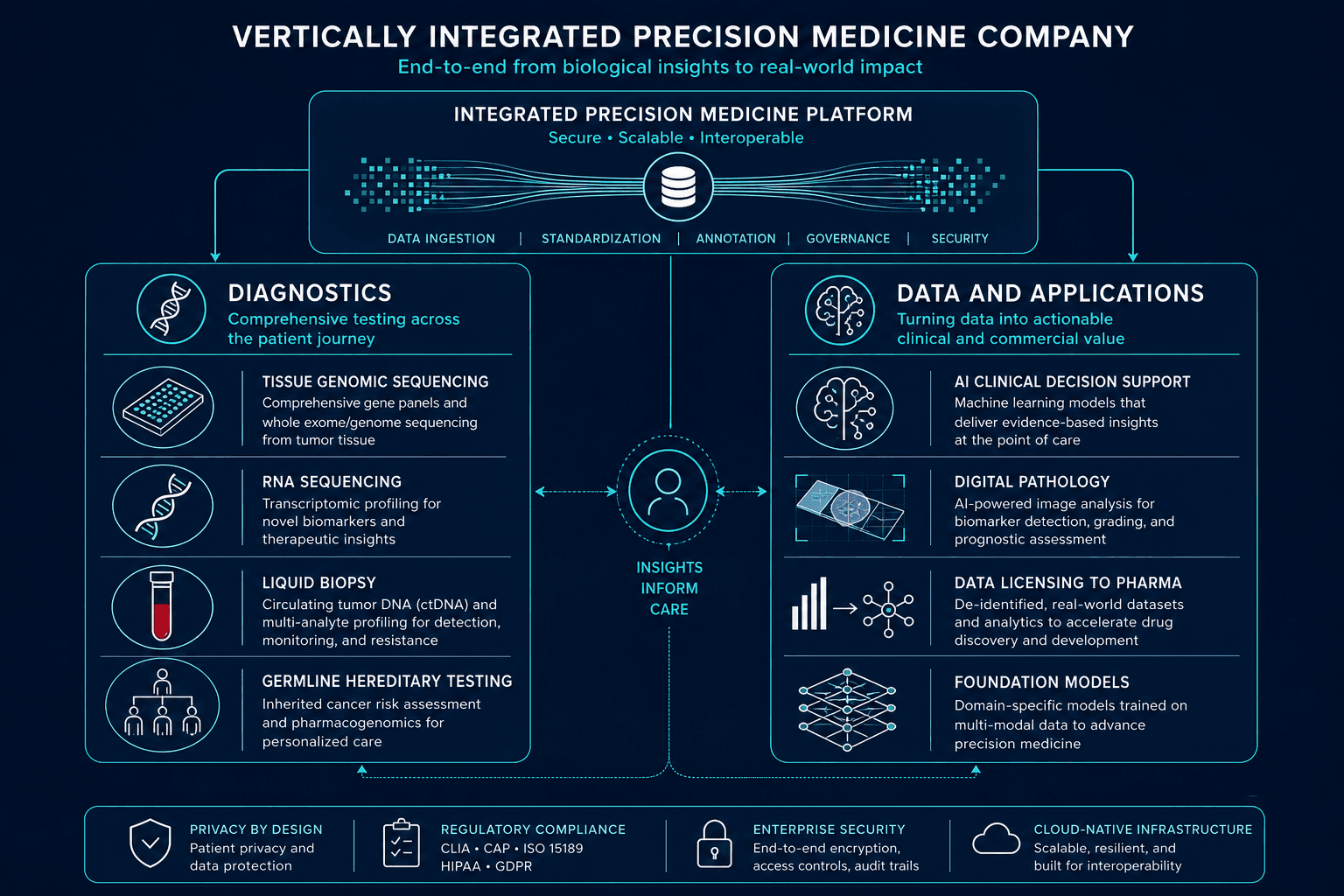
Tempus organizes its products across two segments. The Diagnostics segment covers genomic testing services ordered by clinicians. The Data and Applications segment covers software tools, digital pathology, and data licensing products sold to health systems and pharmaceutical companies. The two segments share an underlying data infrastructure but operate with different customers, pricing structures, and regulatory frameworks.
Diagnostics Segment
| Product | Type | Primary Application | Notes |
|---|---|---|---|
| xT CDx | 648-gene tissue NGS panel (tumor-normal and tumor-only) | Solid tumor companion diagnostic | FDA-approved; two distinct indications — see FDA Regulatory Record section |
| xR IVD | Whole-transcriptome RNA sequencing | Gene fusion detection (BRAF, RET, and others) | FDA 510(k) cleared September 2025 (K241868) |
| xF+ | Liquid biopsy (circulating tumor DNA) | Tumor profiling from blood; MRD monitoring | Regulatory status not confirmed in available sources as of Q2 2026 |
| Ambry Genetics panels | Hereditary germline NGS testing | Hereditary cancer risk assessment; pharmacogenomics (via OneOme) | Acquired February 2025; includes BRCA, Lynch syndrome, and multi-gene panels |
| MRD (minimal residual disease) | ctDNA-based post-treatment monitoring | Residual disease detection in treated patients | Referenced in product portfolio; specific regulatory status not confirmed in available sources |
Data and Applications Segment
| Product | Function | Origin | Notes |
|---|---|---|---|
| Next (AI-CDSS) | AI clinical decision support — analyzes unstructured EHR data to identify patients missing guideline-directed biomarker testing | Tempus-developed | Prospective NSCLC study presented at ASCO 2026 (n=662); see Clinical Evidence section |
| Paige Predict | Digital pathology — biomarker prediction from standard H&E slides (123 biomarkers, 16 cancer types) | Inherited via Paige acquisition (August 2025) | Previously Paige Prostate Detect platform; rebranded post-acquisition; FDA clearances are inherited, not original Tempus authorizations |
| Insights | Pharma data licensing — de-identified multimodal clinical data licensed to pharmaceutical and biotech partners | Tempus-developed | Grew 38% FY2025; 69.5% Q4 2025 excluding AstraZeneca warrant impact; named clients include AstraZeneca, Bristol Myers Squibb, Pfizer |
| Foundation models | Large-scale multimodal AI models trained on genomic, imaging, and clinical data | Tempus-developed (accelerated via Paige acquisition) | Scale claims (e.g., 'largest oncology foundation model') are from company communications; independent validation of scale not available |
| Cardiology / mental health / neurology platforms | Care gap identification and clinical intelligence in non-oncology domains | Tempus-developed | Referenced in FY2025 earnings materials; no FDA-cleared non-oncology AI devices confirmed in available sources as of Q2 2026 |
FDA Regulatory Record
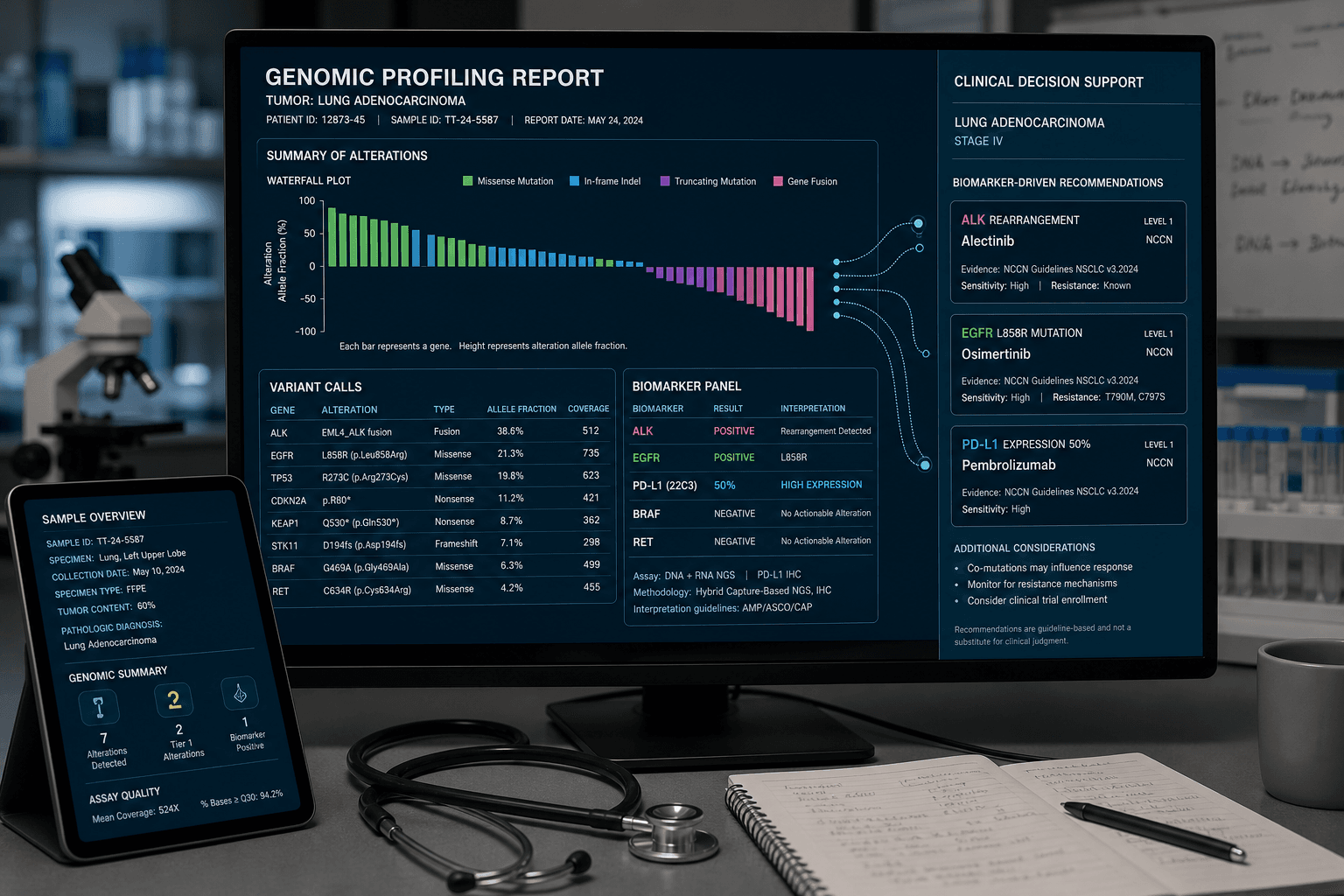
Tempus holds multiple FDA authorizations across its diagnostics and digital pathology portfolios. These authorizations were obtained through different regulatory pathways and at different times; two of them were inherited through the August 2025 Paige acquisition rather than developed through Tempus's own submissions. The entries below treat each authorization as a distinct regulatory event. For multi-company FDA clearance comparisons in AI diagnostics, see the structured landscape of active AI developers with FDA device records.
| Authorization | Pathway | Date | Scope | Origin |
|---|---|---|---|---|
| xT CDx (tumor-normal matched) | PMA | April 2023 | 648-gene tissue NGS companion diagnostic for solid tumors; tumor-normal matched indication | Tempus original submission |
| xT CDx (tumor-only) | PMA supplement / new indication | May 2026 | Tumor-only indication added; Tempus reported as first U.S. lab to hold both tumor-normal and tumor-only indications for a single CGP panel | Tempus original submission |
| xR IVD (whole-transcriptome RNA-seq) | 510(k) — K241868 | September 19, 2025 | In vitro diagnostic for whole-transcriptome RNA sequencing; enables gene fusion detection including BRAF and RET rearrangements | Tempus original submission |
| Paige Prostate Detect | De Novo | Prior to August 2025 (exact date: Paige pre-acquisition) | AI-based detection of prostate cancer on digital pathology whole-slide images | Inherited via Paige acquisition (August 2025); originally authorized to Paige AI, Inc., which spun off from Memorial Sloan Kettering Cancer Center in 2017 |
| Additional Paige 510(k) clearances | 510(k) | Prior to August 2025 (dates: Paige pre-acquisition) | Additional digital pathology AI applications cleared prior to acquisition | Inherited via Paige acquisition; specific submission numbers not confirmed in available sources |
Clinical Evidence Base
The published and conference-presented evidence for Tempus's platform spans three primary bodies of work as of Q2 2026: a prospective multi-center study of the Next AI-CDSS platform in NSCLC, a peer-reviewed community oncology CGP study, and immunotherapy prediction data for the Immune Profile Score. Each is addressed below with explicit evidence quality labels.
Next Platform — NSCLC Biomarker Testing Study (ASCO 2026)
A prospective multi-center observational study of the Next AI clinical decision support platform was presented at ASCO 2026. The study enrolled 662 patients with early-stage non-small cell lung cancer across six diverse U.S. community health systems. The platform analyzed unstructured EHR data in real time to identify patients missing guideline-directed biomarker testing and delivered alerts to ordering clinicians.
Reported outcomes included absolute testing rate increases within 90 days of pathologic diagnosis: +24 percentage points for ALK, +18 percentage points for EGFR, and +13 percentage points for PD-L1. Among patients who received treatment following Next-triggered testing, 89% received guideline-concordant therapy.
Comprehensive Genomic Profiling in Community Oncology — JCO Precis Oncol 2026
A study published in JCO Precision Oncology 2026 (PMC12991331) examined the clinical utility of Tempus's CGP panel (xT 648-gene, xR RNA-seq, and xF liquid biopsy) in a value-based community oncology network. The pilot cohort included 85 patients at The Oncology Institute.
| Finding | Pilot Cohort (n=85) | Expanded Retrospective Cohort (n=465) |
|---|---|---|
| Patients with potentially actionable alterations | 49.4% | 31% |
| Actionable findings dependent on advanced features (tumor-normal matching, RNA-seq, or liquid biopsy reflex) not available in-network | 12% of those with actionable findings (5/42) | 12% of those with actionable findings (17/146) |
| Prior authorization evaluated | 72 patients | Not reported |
| Prior authorization denied | 58.8% (50/72) | Not reported |
| Denied patients with at least one actionable alteration | 50% of denied patients (25/50) | Not reported |
Immune Profile Score — Immunotherapy Outcome Prediction
Tempus's FY2025 earnings materials referenced data on the Immune Profile Score (IPS), a proprietary biomarker for predicting immunotherapy outcomes. According to Tempus's communications, IPS more accurately predicted immunotherapy outcomes than conventional biomarkers in their dataset, identifying 13% of colorectal cancer patients and 17% of rare cancer patients who would not have been captured by standard testing (e.g., MSI, TMB, or PD-L1 alone). The underlying study design, publication status, and independent validation status for these figures were not confirmed in available sources as of Q2 2026.
Business Model and Financials
Tempus operates a dual revenue model. The Diagnostics segment generates revenue from genomic testing services reimbursed by payers or paid directly by patients and health systems. The Data and Applications segment generates revenue from software subscriptions, data licensing contracts with pharmaceutical and biotech companies, and health system platform agreements. The two segments carry different gross margins, with Data and Applications substantially higher.
The data-licensing component — branded as Insights — is structurally significant: it converts the clinical data generated through diagnostic testing into a recurring, high-margin revenue stream. This model is a defining characteristic of Tempus's positioning relative to pure-play diagnostic laboratories. For context on how this data-licensing model compares across the broader AI-in-healthcare sector, see AI companies in healthcare: a structured landscape overview.
| Metric | FY2025 | Q4 2025 | Q1 2026 | 2026 Guidance |
|---|---|---|---|---|
| Total Revenue | $1,271.8M (+83.4% YoY) | $367.2M (+83.0% YoY; 33.5% organic ex-Ambry) | $348.1M (+36.1% YoY) | ~$1.59B (~25% growth) |
| Diagnostics Revenue | $955.4M (+111.5% YoY) | Not separately disclosed | Not separately disclosed | Not separately disclosed |
| Data and Applications Revenue | $316.4M (+30.9% YoY) | Not separately disclosed | Not separately disclosed | Not separately disclosed |
| Insights Growth (YoY) | +38.0% FY2025 | +69.5% (excl. AstraZeneca warrant) | Not separately disclosed | Not separately disclosed |
| Diagnostics Non-GAAP Gross Margin | 59.6–60.3% | Not separately disclosed | Not separately disclosed | Not separately disclosed |
| Data and Applications Non-GAAP Gross Margin | 72.3–73.3% | Not separately disclosed | Not separately disclosed | Not separately disclosed |
| Adjusted EBITDA | −$7.4M (FY2025) | +$12.9M (Q4 2025) | Not separately disclosed | ~$65M |
| Cash and Marketable Securities | $759.7M (Dec 31, 2025) | — | — | — |
| Total Remaining Contract Value | >$1.1B | — | — | — |
| Net Revenue Retention | 126% | — | — | — |
Known Limitations and Risks
Active Class-Action Litigation: Genetic Data Privacy
Multiple class-action lawsuits were filed against Tempus AI in early 2026 and consolidated on April 15, 2026 as Farrier et al v. Tempus AI, Inc. in the U.S. District Court for the Northern District of Illinois. The 21-count consolidated complaint alleges that Tempus compelled Ambry Genetics — acquired by Tempus in February 2025 — to disclose its genetic database to train Tempus AI models and to share with third-party pharmaceutical partners including AstraZeneca, Bristol Myers Squibb, and Pfizer, without the consent of the individuals whose genetic data was involved.
The complaint cites the Illinois Genetic Information Privacy Act (GIPA) and multi-state consumer protection laws. Plaintiffs seek a jury trial, damages, injunctive relief, and an order requiring Tempus to obtain written consent before sharing genetic data. The lawsuit argues that genetic data cannot be effectively de-identified because it constitutes an inherently unique biomarker.
Tempus disputes the allegations. The litigation was ongoing as of Q2 2026; no judgment or settlement had been reached. The pharma data licensing contracts referenced in the complaint (totaling $1.1B in stated value) are also referenced in Tempus's earnings disclosures as core to the Insights business.
Payer Prior Authorization Barriers
The JCO Precis Oncol 2026 study (PMC12991331) documented a 58.8% prior authorization denial rate for Tempus CGP testing in a single community oncology network. This figure is from 72 evaluable patients at a network described as HMO-heavy. It is not representative of payer behavior across all practice settings, insurance types, or geographies. However, it documents a real access barrier that affected more than half of the patients in that specific network, including patients with actionable findings who were denied access to testing that could have informed their treatment.
Clinical Evidence Quality
- No independent randomized controlled trials for core Tempus platform claims had been published as of Q2 2026.
- The Next platform NSCLC study (ASCO 2026, n=662) is a prospective observational study without a randomized control arm. Peer-reviewed publication had not been confirmed as of Q2 2026.
- The JCO Precis Oncol 2026 CGP study (PMC12991331) is co-authored by Tempus employees and supported by Tempus funding. It should not be treated as independent validation.
- The Immune Profile Score immunotherapy prediction data referenced in FY2025 earnings had not been confirmed as published in a peer-reviewed journal as of Q2 2026.
- External validation of Tempus AI models in independent institutional datasets had not been documented in the available peer-reviewed literature as of Q2 2026.
Expansion Beyond Oncology
Tempus's FY2025 earnings materials and product roadmap communications reference expansion into cardiology, mental health, and neurology. The cardiology platform is described as a care gap identification tool designed to flag patients at risk for cardiovascular events based on EHR data. Mental health and neurology applications are referenced in product roadmap language.
For context on how other healthcare AI companies are approaching multi-specialty expansion, see the healthcare AI companies structured landscape overview, which covers active developers across oncology, cardiology, radiology, and primary care domains.
Key Acquisitions and Partnerships Timeline
| Date | Event | Value / Terms | Strategic Significance |
|---|---|---|---|
| February 2025 | Acquisition: Ambry Genetics | ~$600M | Added hereditary germline testing capabilities; Oncology and Hereditary volumes each grew 26–29% YoY in FY2025; also the source of the genetic data privacy litigation filed in 2026 |
| Early 2025 | Acquisition: Deep 6 AI | $17.4M | Clinical trial patient matching and recruitment AI; referenced in FY2025 earnings materials |
| FY2025 (date not confirmed) | Acquisition: OneOme | Not disclosed | Pharmacogenomics testing; referenced in FY2025 earnings as part of Diagnostics portfolio expansion |
| August 2025 | Acquisition: Paige | $81.25M (primarily stock; also assumed Microsoft Azure cloud commitment) | ~7M digitized pathology slides from 45 countries; FDA de novo clearance for Paige Prostate Detect; foundation model trained on 1M slides; Paige had previously raised >$220M and spun off from Memorial Sloan Kettering Cancer Center in 2017 |
| FY2025 | Partnership: NYU Langone Health | Multi-year strategic collaboration; financial terms not disclosed | Named as a key health system partner in FY2025 earnings; specific scope of collaboration not confirmed in available sources |
| FY2025 | Partnership: Northwestern Medicine | Expansion terms not disclosed | Named as health system expansion in FY2025 earnings |
| Ongoing | Pharma data licensing: AstraZeneca, Bristol Myers Squibb, Pfizer | Referenced in litigation filings and earnings disclosures; total contract value >$1.1B across all Insights partners | Core to the Data and Applications revenue model; also referenced in the Farrier et al consolidated complaint |
The Paige acquisition is strategically notable for two reasons beyond the financial terms. First, it transferred approximately 7 million digitized pathology slide images and associated molecular data from 45 countries into Tempus's data infrastructure — a dataset that directly supports the foundation model development program. Second, it transferred FDA regulatory authorizations, including the de novo clearance for Paige Prostate Detect, to Tempus's regulatory portfolio. Paige was acquired at a price representing less than 40% of its disclosed total funding, which exceeded $220 million prior to the sale.
Feedback & Corrections
Corrections, deployment experience notes, and questions from clinicians and procurement professionals are welcome. For formal corrections, use the contact page.
Comments
Join the discussion with an anonymous comment.