
The Clinical Problem: Screening Gap and Workforce Constraints
Diabetic retinopathy (DR) affects an estimated 9.6 million Americans and is the leading cause of new blindness in working-age adults in the United States. Between 12,000 and 24,000 people lose vision to DR each year. More than 90% of that vision loss is considered preventable with timely detection and treatment — which makes the screening gap not merely a clinical inconvenience but a preventable public health failure.
Annual dilated eye exams are the standard of care for adults with diabetes, yet only 50–70% of patients with diabetes adhere to this recommendation. In 2020, just 58.3% of US adults with diabetes reported having an eye exam in the prior year — down from 64.8% in 2019. Adherence is even lower among Black (48.9%) and Hispanic (48.2%) patients compared to non-Hispanic White patients (55.6%).
The structural barriers are compounded by workforce constraints. Ophthalmologists and optometrists are unevenly distributed across the US, with rural and underserved areas facing acute shortages. Primary care physicians — who see the majority of patients with diabetes — are not trained to perform retinal exams, and referring patients to a specialist introduces delays, transportation barriers, and appointment attrition that further erode adherence.
- ~9.6 million Americans currently have diabetic retinopathy
- 12,000–24,000 Americans lose vision to DR annually
- Over 90% of DR-related vision loss is preventable with early detection
- Only 50–70% of patients with diabetes adhere to recommended annual eye exams
- Adherence rates are significantly lower in Black and Hispanic patient populations
AI Approach: Deep Learning for Fundus Image Analysis
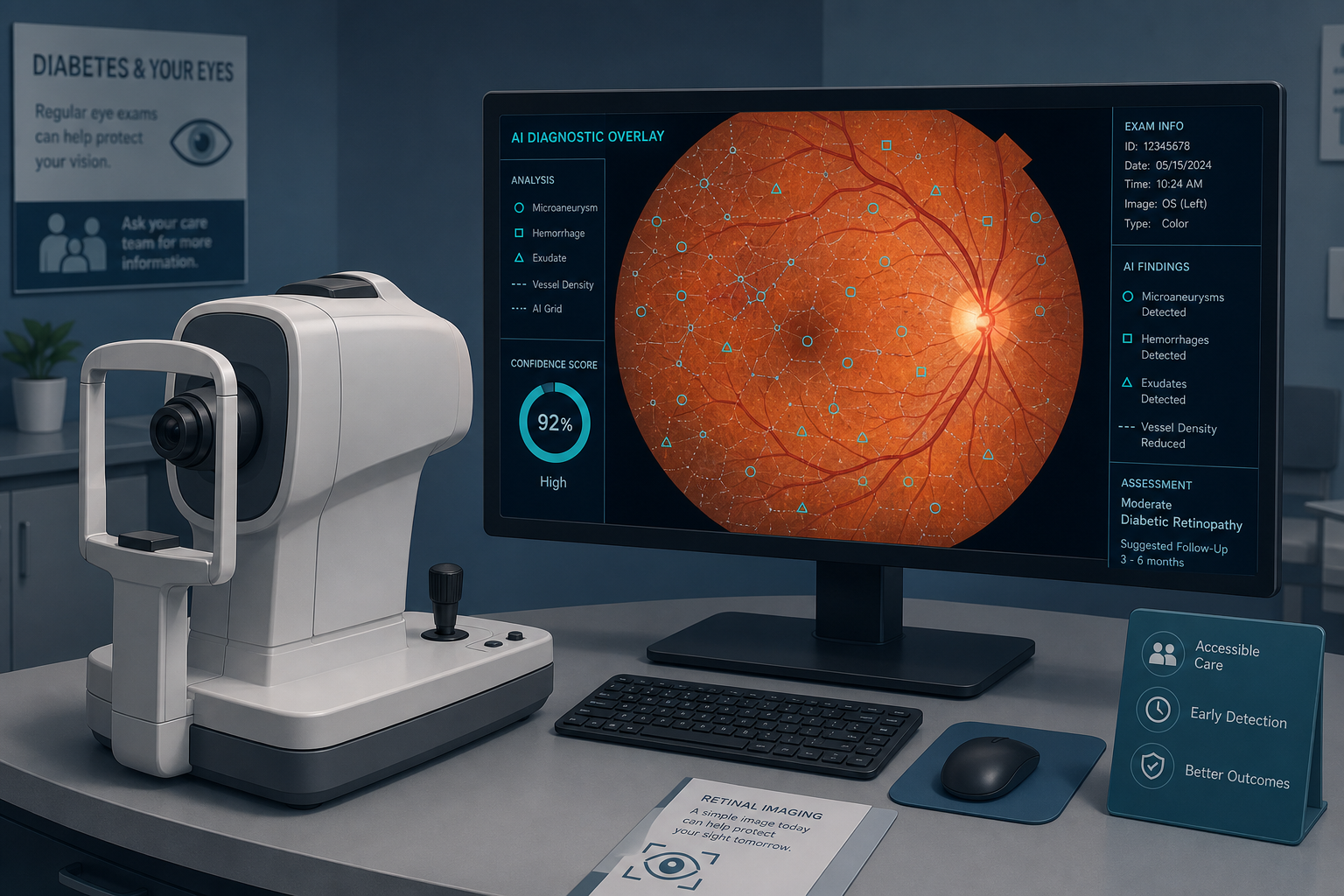
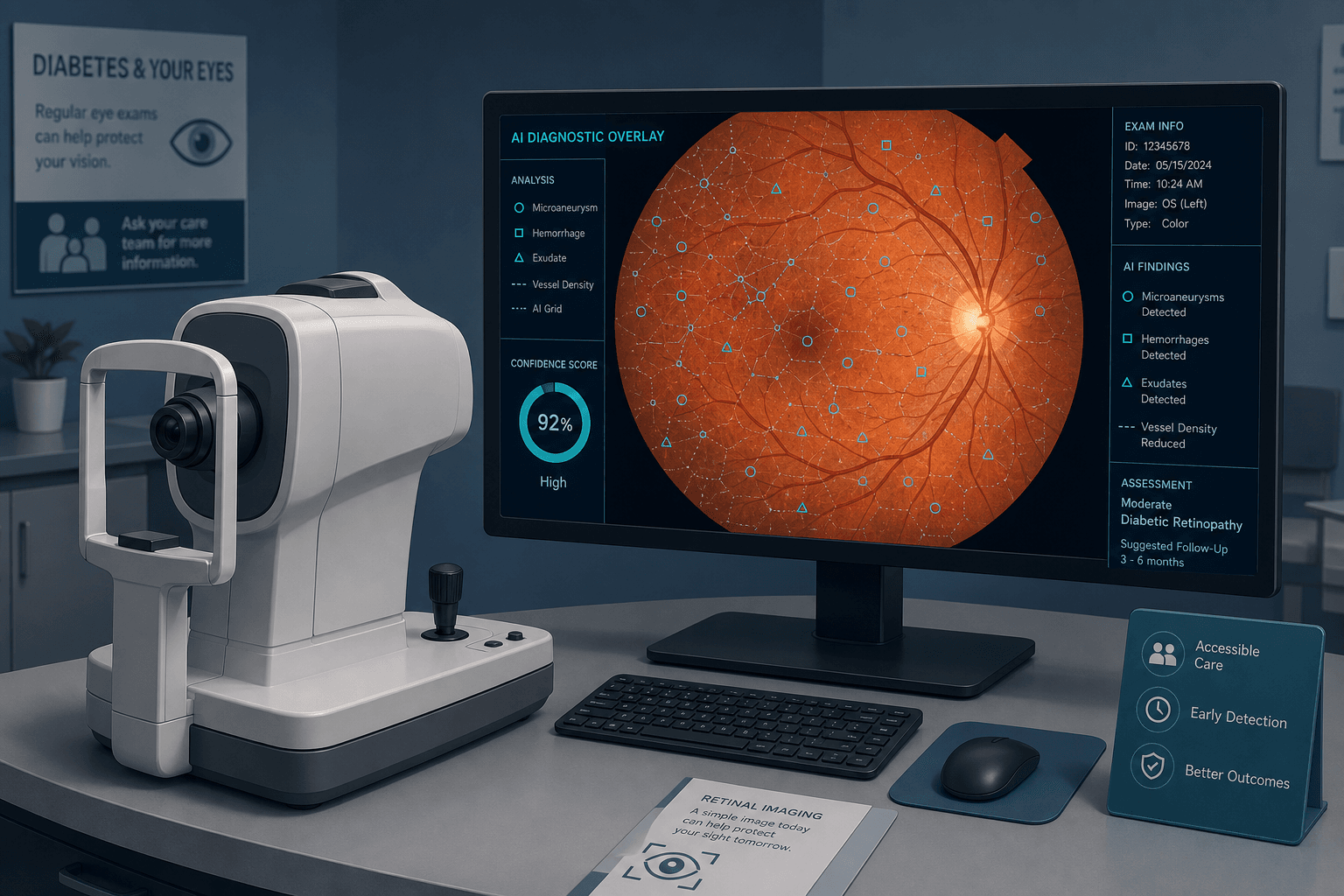
All three FDA-cleared DR screening systems in the US use convolutional neural networks (CNNs) trained on large labeled datasets of fundus photographs to detect retinal features associated with diabetic retinopathy — including microaneurysms, hemorrhages, hard exudates, and neovascularization. The camera captures one or two non-mydriatic (non-dilated) fundus images per eye, which are processed by the algorithm and returned as a binary or graded output: more-than-mild DR detected, or no more-than-mild DR detected.
A critical regulatory and clinical distinction applies to these systems: they are classified as autonomous AI, not assistive AI. An autonomous AI system produces a diagnostic output that stands on its own — no physician review of the image or AI output is required before the result is communicated. An assistive system, by contrast, provides decision support to a clinician who retains interpretive authority. This distinction matters both clinically and regulatorily: autonomous AI systems are held to a higher evidence standard at clearance, carry a different liability framework, and enable a different billing pathway.
The Three FDA-Cleared Systems: Regulatory Pathways and Technical Specifications
Three autonomous AI systems currently hold FDA clearance for DR screening in the United States. They share a common clinical purpose — detecting more-than-mild diabetic retinopathy in adults with diabetes — but differ meaningfully in regulatory history, camera compatibility, image requirements, grading scales, and published evidence base. They are not interchangeable.
LumineticsCore (marketed by Digital Diagnostics, formerly IDx-DR) received FDA clearance in April 2018 via the De Novo pathway — the first autonomous AI diagnostic device to receive FDA clearance in any specialty. The De Novo pathway applies to novel device types with no predicate, and clearance established a new device classification that all subsequent 510(k) submissions in this category could use as a predicate. LumineticsCore requires two fundus images per eye (macula-centered and disc-centered, 45° field of view) using the Topcon NW400 camera, and returns a result in under 30 seconds. It grades using the ETDRS/DRCR scale and is indicated for adults aged 22 and older with diabetes who have not previously been diagnosed with DR.
EyeArt (Eyenuk, Inc.) received 510(k) clearance in August 2020, using LumineticsCore as predicate. It supports a broader range of cameras: the Canon CR-2 AF, Canon CR-2 Plus AF, and Topcon NW400. EyeArt requires two images per eye, uses the International Clinical Diabetic Retinopathy (ICDR) scale, and differentiates between more-than-mild DR and vision-threatening DR — a clinically meaningful distinction for triage. It also holds CE marking (class IIb) and a Health Canada license, making it one of the few systems with multi-jurisdictional authorization.
AEYE-DS (AEYE Health) received 510(k) clearance in October 2022. It is compatible with the Topcon NW400 and the Optomed Aurora IQ portable camera. Notably, AEYE-DS requires only one image per eye (macula-centered), compared to two for both LumineticsCore and EyeArt — a potential workflow efficiency advantage. Dilation is required in fewer than 1% of patients. AEYE-DS has the most recent clearance of the three systems and the least published real-world clinical evidence as of mid-2026.
| System | Clearance | Pathway | Camera(s) | Images/Eye | Grading Scale | Pivotal Trial Performance |
|---|---|---|---|---|---|---|
| LumineticsCore (Digital Diagnostics) | April 2018 | De Novo (first autonomous AI clearance) | Topcon NW400 only | 2 (macula + disc) | ETDRS/DRCR | Sensitivity 87.2%, Specificity 90.7%, Gradability 96.1% (n=900) |
| EyeArt (Eyenuk) | August 2020 | 510(k) — LumineticsCore as predicate | Canon CR-2 AF, CR-2 Plus AF; Topcon NW400 | 2 | ICDR (incl. vision-threatening DR) | Sensitivity 96% (mtmDR) / 97% (vtDR); Specificity 88% / 90% (n>100,000 retrospective + prospective multicenter) |
| AEYE-DS (AEYE Health) | October 2022 | 510(k) — LumineticsCore as predicate | Topcon NW400; Optomed Aurora IQ | 1 (macula only) | Not specified in available sources | Sensitivity 93.0%, Specificity 91.4% (pivotal trial) |
Evidence Quality: Pivotal Trial Data vs. Real-World Implementation Performance
Pivotal trial performance figures are the numbers required to obtain FDA clearance. They are generated under controlled conditions — standardized camera operation, trained imaging technicians, selected patient populations, and curated image datasets. Real-world health system implementation introduces variables that consistently degrade performance, particularly gradability and specificity. Treating pivotal trial data as a proxy for real-world performance is a well-documented error in AI medical device evaluation.
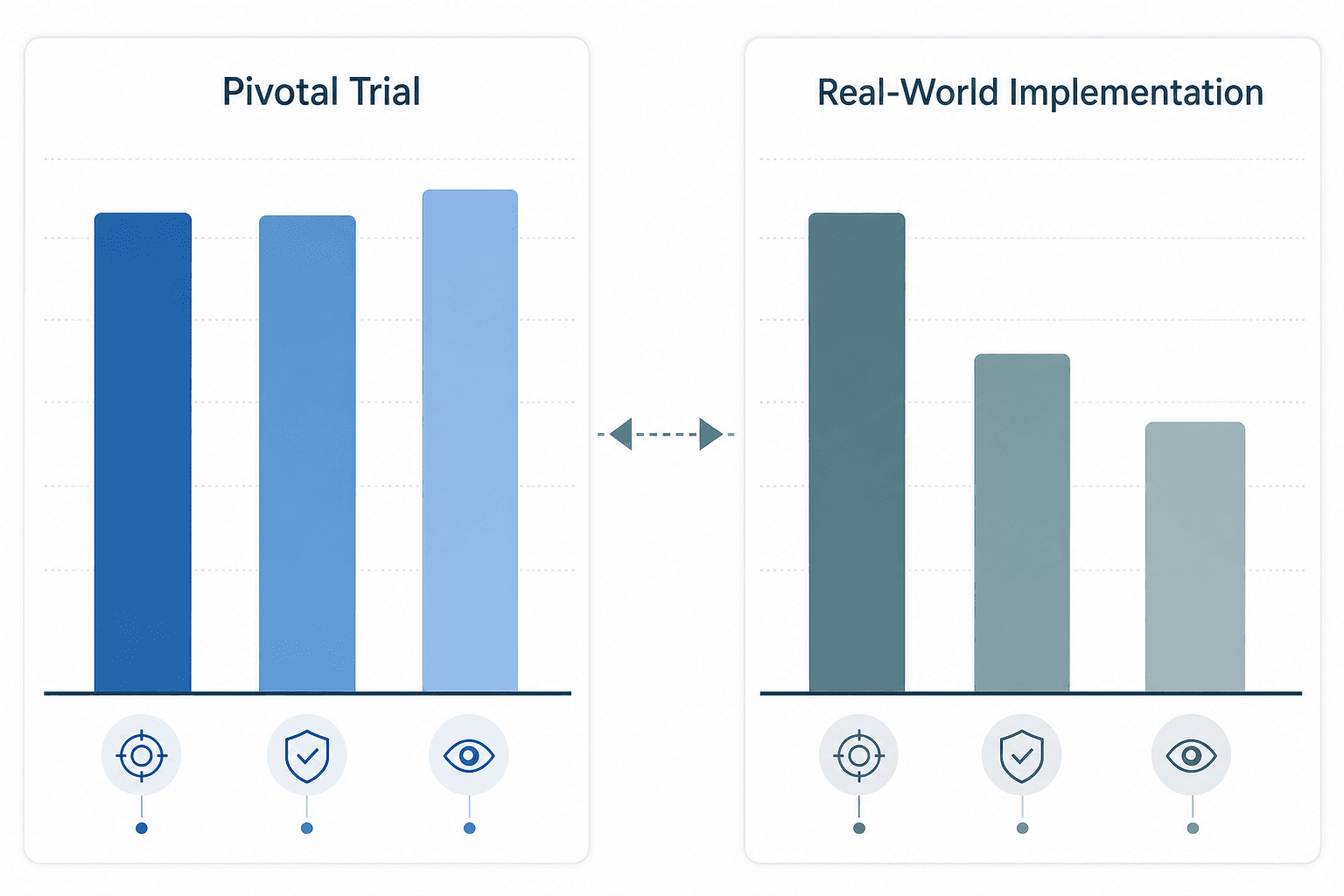
A 2025 literature review and expert interview study identified six publications reporting real-world diagnostic accuracy for FDA-cleared autonomous AI DR screening systems: five for LumineticsCore, one for EyeArt, and none for AEYE-DS in primary care settings. Across those studies — conducted at University of Iowa, Mayo Clinic, Johns Hopkins, Stanford, and Temple — the aggregate real-world results were markedly different from pivotal trial figures.
| Performance Metric | LumineticsCore Pivotal Trial | Real-World Range (Published Implementations) |
|---|---|---|
| Gradability (non-mydriatic) | 96.1% | 49–75% (n=5 studies) |
| Sensitivity | 87.2% | 87–100% (n=3 studies) |
| Specificity | 90.7% | 60–91% (n=4 studies) |
The gradability gap is the most operationally significant finding. In non-mydriatic settings, pupil size, cataracts, patient age, type 1 diabetes, and smoking all reduce image quality below the threshold the AI requires to produce a result. When an image is ungradable, the patient must return for a dilated exam — which recreates the access barrier the AI was intended to eliminate. A 49% gradability rate means roughly half of all patients screened require a follow-up appointment.
The specificity gap has different clinical consequences. Low specificity means a higher rate of false positives — patients flagged as having DR who do not. This drives unnecessary specialist referrals, increases downstream costs, and can erode clinician and patient trust in the system. At Stanford, real-world specificity for LumineticsCore was measured at 60.3% — substantially below the 90.7% pivotal trial figure.
Stanford's response to the low specificity finding was to implement a hybrid workflow: AI-positive cases were routed to a retina specialist for overread before referral was confirmed. This improved specificity from 60.3% to 98.2% while maintaining 95.5% sensitivity — a substantial operational improvement, though it introduces specialist time and partially offsets the efficiency gains of autonomous screening.
Regulatory and Guideline Context
LumineticsCore's 2018 De Novo clearance created a new regulatory classification for autonomous AI diagnostic devices in ophthalmology. The De Novo pathway is used when a device type is novel — no substantially equivalent predicate exists — and FDA determines that general controls and special controls are sufficient to provide reasonable assurance of safety and effectiveness. The clearance decision (DEN180001) established the performance benchmarks that subsequent 510(k) applicants must meet: sensitivity ≥87.4% and specificity ≥89.5% in a prospective trial. Both EyeArt and AEYE-DS cited LumineticsCore as their predicate device.
In terms of clinical guideline recognition, the American Academy of Ophthalmology's 2024 Preferred Practice Pattern — published in the journal Ophthalmology in February 2025 (PMID 39918521) — includes autonomous AI among validated methods for DR detection alongside dilated fundus examination. This is a meaningful signal of specialty acceptance, though readers should access the full document to review the precise wording of the AI-specific recommendation.
The liability framework for autonomous AI missed diagnoses is distinct from traditional clinical liability. Because the system produces a diagnostic output without physician interpretation, responsibility for a false negative result is attributed to the device manufacturer, not the ordering clinician. However, a significant and legally unresolved gap exists: none of the three FDA-cleared systems are trained to detect incidental ocular findings — including retinal detachment, choroidal melanoma, macular degeneration, or glaucoma. If such a finding is present in an image that the AI grades as "no more-than-mild DR," it will not be flagged. The liability for that missed incidental finding is currently unresolved.
- LumineticsCore: De Novo clearance April 2018 (DEN180001) — first autonomous AI FDA clearance in any specialty
- EyeArt: 510(k) clearance August 2020, using LumineticsCore as predicate; also holds CE mark (class IIb) and Health Canada license
- AEYE-DS: 510(k) clearance October 2022, using LumineticsCore as predicate
- AAO 2024 Preferred Practice Pattern (Ophthalmology, February 2025; PMID 39918521) includes autonomous AI among validated DR detection methods
- Model algorithms are frozen at clearance — any update to the AI model requires a new regulatory submission to FDA
Reimbursement and Value Framework
CPT code 92229 — "Imaging of retina for detection or monitoring of disease; with point-of-care automated analysis and report, unilateral or bilateral" — was created by the AMA in 2020 and became effective for CMS billing in 2021. It was the first CPT code in any medical specialty created specifically for an autonomous AI diagnostic service, and it is the primary reimbursement mechanism for all three FDA-cleared DR screening systems.
| Year | National Medicare Payment (Non-Facility) | Notes |
|---|---|---|
| 2022 | $47.06 | First full calendar year of widespread CPT 92229 billing |
| 2023 | $45.74 | Decline reflects annual CMS Physician Fee Schedule update |
| 2024 | $40.28 | Further decline; rate subject to annual CMS revision |
Private payer rates differ from Medicare. A median privately negotiated Anthem rate of $127.81 was reported for 2021 — approximately three times the Medicare rate in the same period. This variation is significant for health systems modeling the financial case for AI DR screening deployment.
Beyond fee-for-service reimbursement, AI-based DR screening qualifies for HEDIS Comprehensive Diabetes Care (CDC) gap closure and for MIPS measure 117 (Diabetes: Eye Exam). For health systems operating under value-based care contracts with quality incentive components, these pathways may represent a more significant financial driver than the per-encounter CPT 92229 payment alone.
Vendors offer two primary business models: a per-click fee (per completed screening) or a monthly subscription. Camera hardware — typically the Topcon NW400 — is available for lease in some vendor arrangements, reducing upfront capital requirements for primary care practices and FQHCs.
Deployment Context: Adoption Scale, Workflow Models, and Implementation Factors
LumineticsCore has the broadest documented deployment of the three systems, with over 1,000 US clinical sites as of mid-2026. Both LumineticsCore and EyeArt have five or more academic health system adopters with published implementation data. AEYE-DS has been adopted at select community-based organizations but has no published peer-reviewed real-world primary care implementation studies.
Adopter types span a wide range: Federally Qualified Health Centers (FQHCs) such as Cahaba Medical Care and Tarzana Treatment Centers; integrated delivery networks such as OSF Healthcare; large academic health systems including Stanford Medicine and Johns Hopkins Health System; and laboratory services (LabCorp). This range reflects the system's design for primary care deployment rather than specialty clinic use.
OhioHealth, which operates 16 hospitals and approximately 100 primary care offices in Central Ohio, began piloting LumineticsCore in 2022. Starting with 10 cameras and scaling to approximately 40, the health system achieved a 162% increase in diabetic eye exams within 12 months of adoption and a 1.7x year-over-year increase in positive diagnoses. Their baseline DR screening rate before deployment was 35%.
Two primary workflow models have emerged in published implementations:
- Autonomous workflow: The AI result stands alone. Negative results are communicated to the patient and documented in the EHR; positive results trigger a specialist referral. No physician review of the fundus image is required. This model maximizes throughput efficiency but accepts the lower real-world specificity seen in non-mydriatic settings.
- AI-human hybrid workflow: AI-positive cases are routed to a retina specialist for overread before referral is confirmed. Stanford's implementation of this model improved specificity from 60.3% to 98.2% while maintaining 95.5% sensitivity, at the cost of partial specialist involvement for positive cases.
Published expert review identifies the following as the strongest predictors of successful implementation:
- Top-down institutional leadership commitment — program champions at the department or C-suite level
- Co-ownership between primary care and ophthalmology — both specialties must be invested in the program's success
- Pilot-to-scale approach — starting with 4–6 high-volume sites before broader rollout
- Dedicated patient care navigators — to manage referral follow-through for positive results
- Prioritizing sites with high patient volumes and underserved populations — where the screening gap is widest
Known Limitations
The following limitations are documented in peer-reviewed literature and should be considered by any health system evaluating AI DR screening for adoption. They are presented as a structured set of named issues, not as incidental caveats.
- Real-world gradability variability: Non-mydriatic gradability ranges from 49% to 75% across published health system implementations, versus 96.1% in LumineticsCore's pivotal trial. Contributing factors include small pupil size, cataracts, older patient age, type 1 diabetes, and smoking. Ungradable images require follow-up dilated exams, partially recreating the access barriers AI was designed to eliminate.
- Low real-world specificity: Real-world specificity has been measured as low as 60% in non-mydriatic settings, compared to 89–91% in pivotal trials. This produces a meaningful false-positive rate, driving unnecessary specialist referrals and associated costs. Hybrid workflows can substantially improve specificity but require specialist time.
- Incidental findings detection gap: None of the three FDA-cleared systems are trained to detect incidental ocular findings — including retinal detachment, choroidal melanoma, macular degeneration, or glaucoma. A "no DR detected" result does not indicate a healthy retina. The medicolegal liability for undetected incidental findings is currently unresolved.
- Dataset bias and generalizability: Most training datasets for AI DR screening systems are drawn from specific geographic regions or ethnic groups. Performance may not generalize uniformly across all patient populations, camera environments, or clinical settings not represented in training data.
- No head-to-head comparison data: No published studies compare LumineticsCore, EyeArt, and AEYE-DS on the same patient dataset. Performance figures for each system come from different study populations and methodologies and cannot be used to rank the systems against each other.
- Frozen model algorithms: FDA-cleared AI algorithms are locked at the time of clearance. Any update to the model — including retraining on new data or improving performance — requires a new regulatory submission. This limits the ability of cleared systems to adapt to emerging evidence or population shifts without regulatory lag.
- Asymmetric real-world evidence base: Five peer-reviewed real-world implementation studies exist for LumineticsCore; one for EyeArt; none for AEYE-DS in primary care settings. AEYE-DS performance claims must be restricted to its pivotal trial data (sensitivity 93.0%, specificity 91.4%) and should not be extrapolated to real-world primary care deployment.
Health Equity Evidence
A propensity score-weighted retrospective study of more than 17,000 patients with diabetes at Johns Hopkins Medicine primary care sites, published in npj Digital Medicine in 2024, provides the most rigorous published evidence on equity outcomes from AI DR screening deployment. The study compared diabetic eye disease (DED) testing adherence at sites that switched to AI-based screening with sites that did not, using 2019 as the pre-AI baseline and 2021 as the post-implementation measurement year.
AI-switched sites experienced a 7.6 percentage-point greater increase in DED testing adherence than non-AI sites (p<0.001). The equity-specific findings were notable: Black and African American patients at AI-switched sites gained 12.2 percentage points in adherence, compared to a 0.6 percentage-point decline at non-AI sites. The adherence gap between Asian American and Black/African American patients narrowed from 15.6% in 2019 to 3.5% in 2021 at AI-switched sites.
| Patient Group | Adherence Change at AI-Switched Sites | Comparison (Non-AI Sites) |
|---|---|---|
| Overall | +7.6 percentage points | Reference |
| Black / African American | +12.2% | −0.6% at non-AI sites |
| Non-English speaking | +2.8% | Minimal gain |
| American Indian / Alaska Native | +2.3% | Minimal gain |
| Military-insured | +2.8% | Minimal gain |
Key Citations
- Teng et al. "Autonomous Artificial Intelligence in Diabetic Retinopathy Testing — Lessons Learned on Successful Health System Adoption." Ophthalmology Science, 2025. Full text (institutional access may be required)
- Rajalakshmi et al. "Autonomous Artificial Intelligence (AI)-Enhanced Detection of Diabetic Retinopathy From Fundus Images: The Current Landscape and Future Directions." PMC / PubMed Central, 2024. Open access via PMC
- Wang et al. "Autonomous artificial intelligence for diabetic eye disease increases access and health equity in underserved populations." npj Digital Medicine, 2024. Full text via Nature
- Nderitu & Keane. "Real-World Adoption of Artificial Intelligence in Diabetic Retinopathy Screening: What Is the Current Status?" Clinical & Experimental Ophthalmology, 2025. References Shah et al. (JAMA Ophthalmology 2024) for US adoption growth figures. Full text via Wiley
- "Revolutionizing Diabetic Retinopathy Screening: Integrating AI-Based Retinal Imaging in Primary Care" (Saving Sight program). Journal of CME, 2024. Funded by unrestricted educational grants from Regeneron Pharmaceuticals. Full text via Taylor & Francis
- American Academy of Ophthalmology. 2024 Preferred Practice Pattern: Diabetic Retinopathy. Ophthalmology, February 2025. PMID 39918521. Includes autonomous AI among validated DR detection methods. Full text access required to verify AI-specific wording.
- FDA CDRH De Novo Decision Summary DEN180001 (IDx-DR / LumineticsCore). Available at: accessdata.fda.gov/cdrh_docs/reviews/DEN180001.pdf. Note: PDF format; verify current access via FDA CDRH database.
- "AI for DR Screening: Where Are We in 2025?" Retina Specialist, 2025. Covers CPT 92229 claims data and liability framework. Full text
Comments
Join the discussion with an anonymous comment.