
The Clinical Problem: Skin Cancer, Diagnostic Access, and the Role of Primary Care
Skin cancer is the most common malignancy worldwide. In the United States, melanoma, basal cell carcinoma (BCC), and squamous cell carcinoma (SCC) together account for more new diagnoses annually than all other cancers combined. Early detection substantially improves outcomes, particularly for melanoma, where five-year survival rates drop sharply with stage at diagnosis.
The structural problem is one of access and accuracy at the point of first clinical contact. Primary care physicians (PCPs) routinely encounter pigmented and non-pigmented lesions during general examinations, yet diagnostic accuracy among non-specialists is markedly lower than among dermatologists. Dermatology referral wait times average 35 days in the United States, and more than one-third of patients face meaningful access barriers — geographic, financial, or capacity-related. By the time a suspicious lesion reaches specialist evaluation, the window for early-stage intervention may have narrowed.
This access gap is the clinical rationale for AI-enabled point-of-care tools in dermatology. The goal is not to replace dermatologists but to extend specialist-level detection capability to the primary care setting — enabling PCPs to identify which lesions warrant urgent referral and which can be safely monitored.
- Skin cancer is the most common malignancy; early detection is the primary lever for improved survival.
- PCP diagnostic accuracy for skin lesions is substantially lower than dermatologist accuracy, particularly for melanoma.
- Dermatology wait times average 35 days; access barriers affect more than one-third of patients.
- AI-enabled devices target the PCP-to-dermatologist triage gap, not autonomous diagnosis.
FDA Regulatory Pathways for AI Dermatology Devices
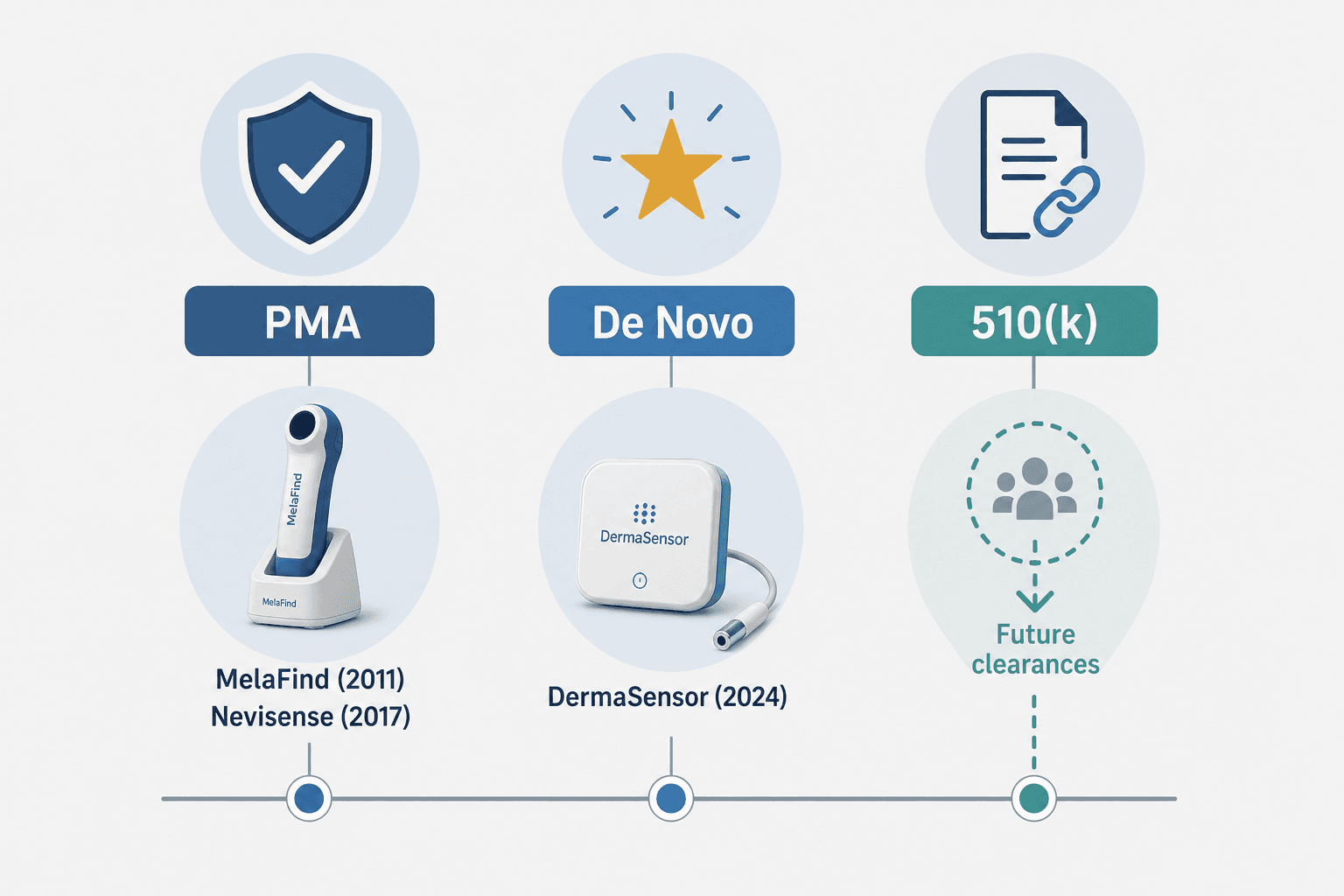
Three FDA authorization pathways are relevant to AI-enabled skin cancer detection devices, each with different evidentiary thresholds and post-market obligations.
The Premarket Approval (PMA) pathway applies to Class III high-risk devices. It requires clinical trial evidence of safety and effectiveness, and the FDA may impose post-approval study conditions. Both MelaFind and Nevisense were authorized through PMA.
The De Novo pathway (Section 513(f)(2)) applies to novel low-to-moderate risk devices with no legally marketed predicate. It requires the FDA to determine reasonable assurance of safety and effectiveness, and it may include post-market performance conditions. DermaSensor was authorized through De Novo in January 2024.
The 510(k) pathway applies to devices that are substantially equivalent to a legally marketed predicate. It primarily relies on non-clinical evidence and comparison to the predicate's performance. No dermatology AI skin cancer detection device has been cleared through 510(k) to date — but DermaSensor's De Novo authorization has created the first such predicate, with implications discussed in the pipeline section below.
A terminology distinction matters for procurement readers: devices that incorporate AI within physical hardware (such as a handheld probe) are classified as Software in a Medical Device (SiMD). Pure software products without an integral device component are classified as Software as a Medical Device (SaMD). All three FDA-authorized dermatology AI devices discussed here are SiMD.
| Pathway | Risk Class | Predicate Required | Primary Evidence Standard | Devices Authorized |
|---|---|---|---|---|
| PMA | Class III (high risk) | No | Clinical trial — safety and effectiveness | MelaFind (2011), Nevisense (2017) |
| De Novo | Class II (novel, moderate risk) | No | FDA determination of safety and effectiveness; may include post-market conditions | DermaSensor (2024) |
| 510(k) | Class II | Yes — substantial equivalence to predicate | Primarily non-clinical; predicate comparison | None to date in this device category |
The Three FDA-Authorized Devices: Structured Evidence Comparison
As of Q2 2026, three AI-enabled devices have received FDA authorization for skin cancer detection, confirmed by the FDA AI-Enabled Medical Device List (updated through December 2025): MelaFind (PMA P090012, November 2011), Nevisense (PMA P150046, June 2017), and DermaSensor (De Novo DEN230008, January 2024). All three are classified under the General and Plastic Surgery panel. The overall FDA AI/ML device list exceeds 1,400 entries as of December 2025 and is dominated by radiology devices; dermatology skin cancer detection devices remain a small and distinct subset.
| Device | Submission | Authorization Date | Pathway | Technology | Indication | Authorized User | Status |
|---|---|---|---|---|---|---|---|
| MelaFind | PMA P090012 | November 1, 2011 | PMA | Multispectral spectroscopy | Melanoma only | Dermatologist | Discontinued (~2017) |
| Nevisense | PMA P150046 | June 28, 2017 | PMA | Electrical impedance spectroscopy (EIS) | Melanoma only | Dermatologist | Active |
| DermaSensor | De Novo DEN230008 | January 12, 2024 | De Novo | Elastic scattering spectroscopy (ESS) | Melanoma, BCC, SCC; patients ≥40 years | Non-dermatologist physicians (PCPs) | Active |
MelaFind (PMA P090012, 2011 — Discontinued)
MelaFind used multispectral spectroscopy to evaluate pigmented lesions for melanoma in dermatologist hands. Its pivotal trial enrolled 1,383 patients and 1,631 lesions. The device achieved 98.3% sensitivity — but only 9.9% specificity. In practice, this meant the device flagged the vast majority of benign lesions as suspicious, generating high false-positive rates and driving unnecessary biopsy referrals.
MelaFind was discontinued approximately six years after approval. The reasons were structural: the low-specificity problem created a referral cascade that was difficult to justify clinically, the indication was narrow (melanoma only, dermatologist use only), workflow integration was poor, and reimbursement coverage was limited. Only 9 lesions (0.6%) in the pivotal trial came from Fitzpatrick V/VI patients — a demographic gap that would become a recurring issue across subsequent devices.
Nevisense (PMA P150046, 2017 — Active)
Nevisense uses electrical impedance spectroscopy (EIS) to measure the electrical properties of skin tissue, providing a score that correlates with cellular irregularity associated with malignancy. It is indicated for melanoma evaluation in dermatologist hands. The pivotal trial enrolled 1,951 patients and 2,416 lesions, reporting 97% sensitivity and 31.3% specificity.
Nevisense remains on the market as of Q2 2026. Its specificity improvement over MelaFind (31.3% vs. 9.9%) is meaningful but still low in absolute terms — approximately two-thirds of flagged lesions are benign. The pivotal trial included only 29 lesions (1.6%) from Fitzpatrick V/VI patients, continuing the demographic representation gap seen with MelaFind.
DermaSensor (De Novo DEN230008, January 2024 — Active)
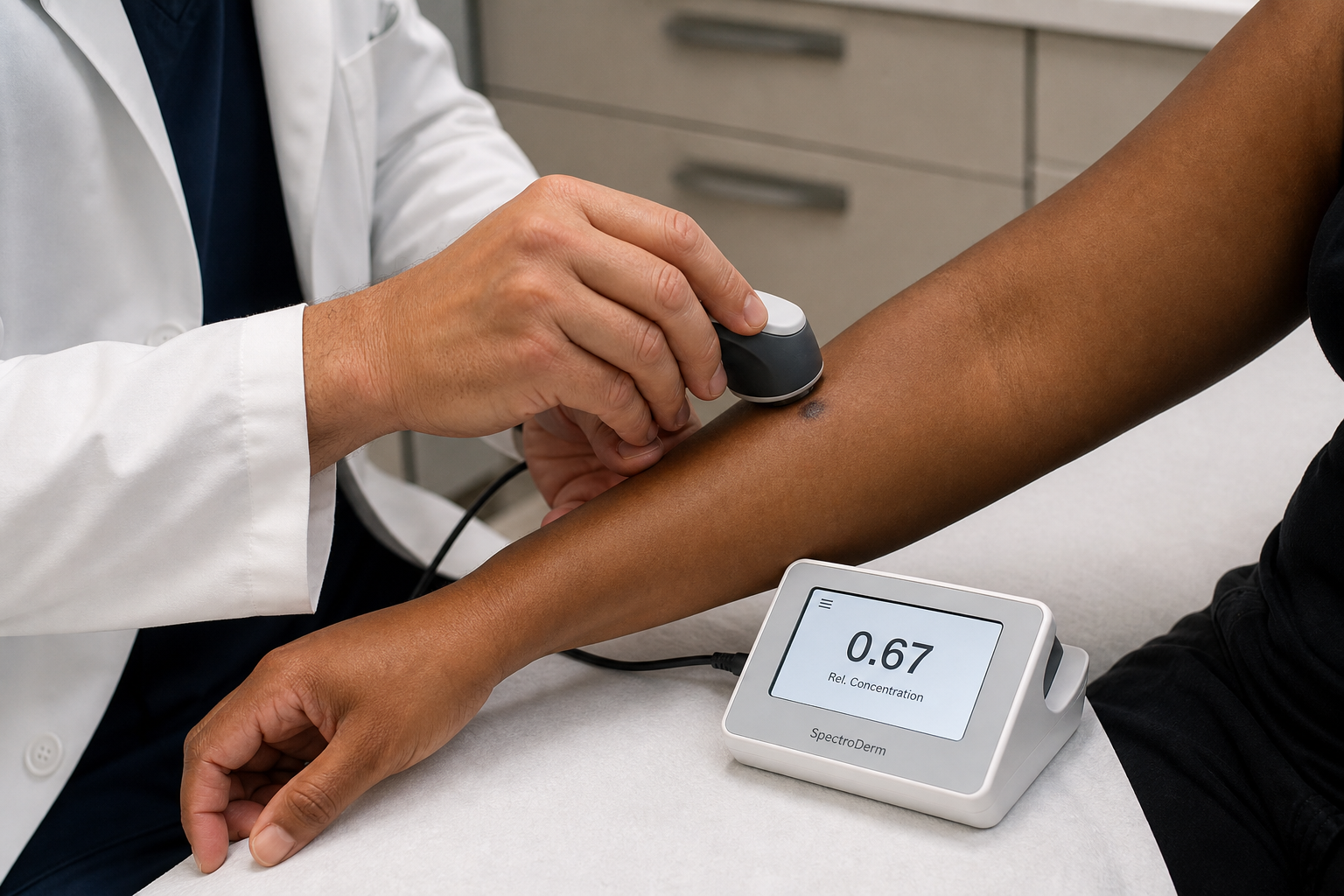
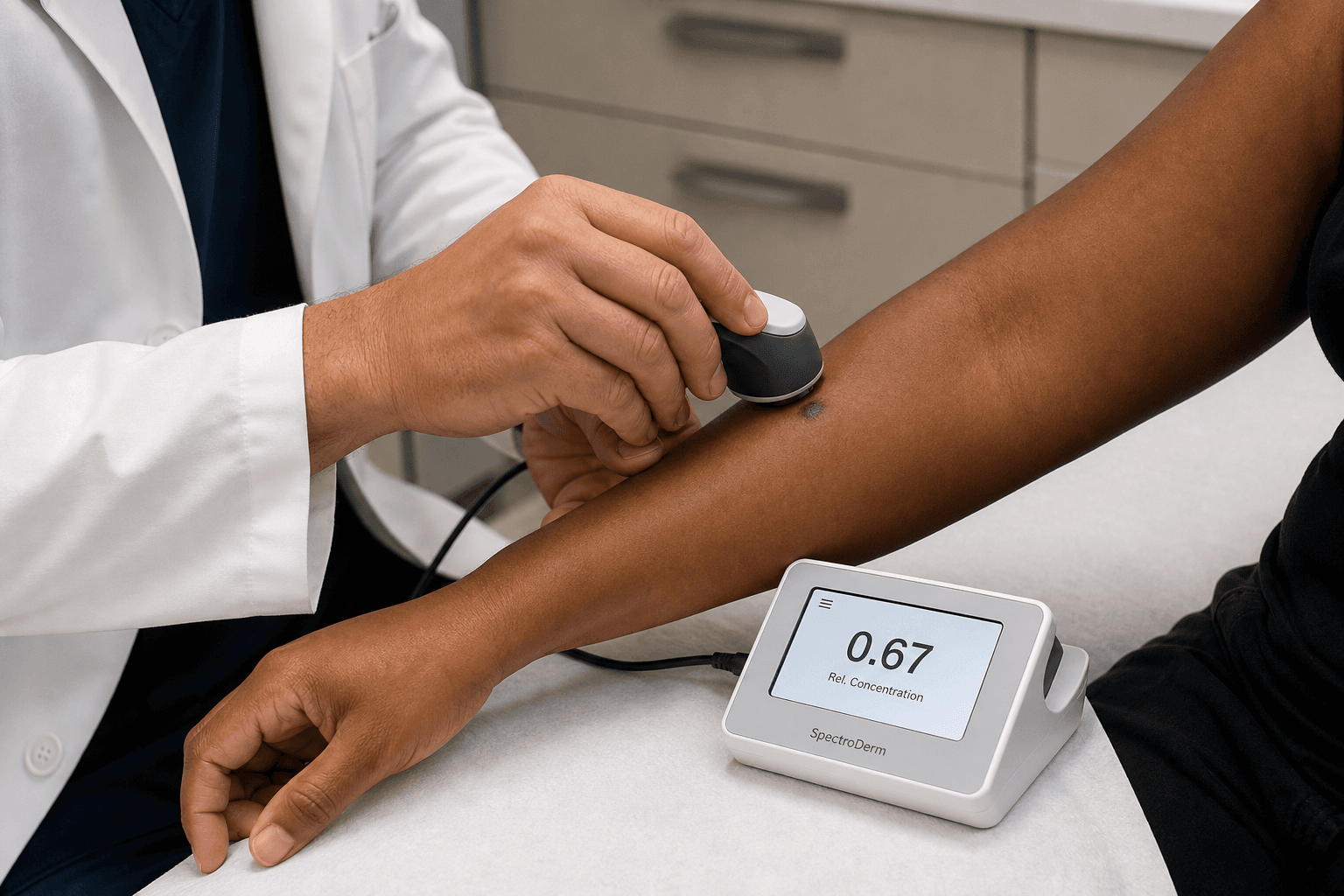
DermaSensor represents a meaningful regulatory and clinical departure from its predecessors. It is the first AI-enabled skin cancer detection device cleared for use by non-dermatologist physicians, specifically PCPs. Its indication covers melanoma, BCC, and SCC in patients aged 40 years and older — a broader scope than either MelaFind or Nevisense. The underlying technology is elastic scattering spectroscopy (ESS), which analyzes light scattering patterns from tissue at the cellular level.
The device was authorized under the De Novo pathway and received FDA Breakthrough Device Designation. The De Novo decision record (DEN230008) classifies the device as a "software-aided adjunctive diagnostic device for use by physicians on lesions suspicious for skin cancer" under regulation 878.1830, with product code QZS.
| Metric | MelaFind | Nevisense | DermaSensor |
|---|---|---|---|
| Technology | Multispectral spectroscopy | Electrical impedance spectroscopy | Elastic scattering spectroscopy |
| Indication | Melanoma | Melanoma | Melanoma, BCC, SCC (patients ≥40 years) |
| Authorized user | Dermatologist | Dermatologist | Non-dermatologist physician (PCP) |
| Pivotal trial patients | 1,383 | 1,951 | 1,005 |
| Pivotal trial lesions | 1,631 | 2,416 | 1,579 |
| Sensitivity | 98.3% | 97% | 96.6% |
| Specificity | 9.9% | 31.3% | 20.7% |
| NPV | Not reported | Not reported | 96.6% |
| Fitzpatrick V/VI lesions | 9 (0.6%) | 29 (1.6%) | 128 (12.7%) |
| Current status | Discontinued (~2017) | Active | Active |
DermaSensor in Depth: Pivotal Trial Data and Clinical Utility Evidence
DermaSensor's FDA authorization rests on two interconnected studies: the DERM-SUCCESS pivotal validation trial and a companion clinical utility study. Both were published in the Journal of Primary Care and Community Health in June 2025 and are the primary evidence base for the device's authorized indication.
DERM-SUCCESS Pivotal Trial
The DERM-SUCCESS trial was conducted across 22 primary care sites, enrolling 1,005 patients and evaluating 1,579 lesions. Dermatopathology confirmed 224 skin cancers in the cohort. The trial was led by investigators at Mayo Clinic. Key performance findings:
- Device sensitivity for skin cancer detection: 96.6% (published peer-reviewed value; some publication versions report 96% or 96.5% — minor rounding differences across versions of the same trial data).
- Negative predictive value (NPV): 96.6% (reported as 97% in some publication versions).
- Specificity: 20.7% — meaning approximately four out of five non-cancerous lesions evaluated by the device were flagged as suspicious.
- Positive predictive value (PPV): ranged from 6% at the lowest device score to 61% at the highest score, reflecting the score-stratified nature of the output.
- Fitzpatrick V/VI representation: 128 lesions (12.7% of the trial population) — an improvement over prior devices but still limited.
- Race composition: 97.1% of DERM-SUCCESS participants were White race.
A supplemental study (DERM-ASSESS) evaluated melanoma specifically across 311 patients and 440 lesions at 10 dermatology sites, providing additional performance data for the melanoma indication.
Clinical Utility Study: Impact on PCP Decision-Making
The clinical utility study enrolled 108 PCPs evaluating more than 10,000 lesions. It measured whether DermaSensor changed PCP management decisions in clinically meaningful ways. The findings show a genuine sensitivity benefit alongside a significant specificity cost:
| Outcome Measure | Without DermaSensor | With DermaSensor | Change |
|---|---|---|---|
| Management sensitivity (correct cancer referrals) | 82.0% | 91.4% | +9.4 percentage points |
| Diagnostic sensitivity | 71.1% | 81.7% | +10.6 percentage points |
| Missed cancer referrals (false-negative referrals) | 18.0% | 8.6% | −9.4 pp (approximately halved) |
| Referral specificity | 44.2% | 32.4% | −11.8 pp (statistically significant decrease) |
The clinical interpretation requires holding both findings simultaneously. DermaSensor approximately halved the rate at which PCPs missed skin cancers — a meaningful patient safety benefit for a population with limited specialist access. But it also produced a statistically significant decrease in referral specificity, meaning more patients without cancer were referred to dermatology. For health systems already managing dermatology capacity constraints, this trade-off has direct operational implications.
FDA's authorization included a post-market requirement for performance testing in underrepresented skin tone populations. As of June 2026, results from this equity study have not been published.
Broader Clinical Evidence: Meta-Analytic Benchmarks and Augmented Intelligence
Device-specific pivotal trial data should be read alongside the broader AI-versus-clinician evidence base. A 2024 systematic review and meta-analysis published in npj Digital Medicine (Salinas et al.) synthesized 53 comparative studies, with 19 meeting criteria for pooled meta-analysis. The literature search covered studies through August 2022, meaning it predates DermaSensor's January 2024 authorization. Its benchmarks reflect the pre-DermaSensor AI evidence landscape.
| Comparison Group | AI Sensitivity | Clinician Sensitivity | AI Specificity | Clinician Specificity |
|---|---|---|---|---|
| AI vs. all clinicians | 87.0% (95% CI 81.7–90.9%) | 79.8% (95% CI 73.2–85.1%) | 77.1% (95% CI 69.8–83.0%) | 73.6% (95% CI 66.5–79.6%) |
| AI vs. expert dermatologists | 86.3% | 84.2% | 78.4% | 74.4% |
| AI vs. generalist clinicians | 92.5% | 64.6% | Not reported separately | Not reported separately |
The generalist finding is particularly relevant for DermaSensor's primary care indication: across included studies, AI sensitivity was 92.5% compared to 64.6% for generalist clinicians — a 27.9 percentage point gap. This is the evidence base underpinning the rationale for PCP-facing tools.
The meta-analysis also evaluated "augmented intelligence" — studies in which clinicians used AI assistance rather than AI operating alone. All 11 such studies showed improved diagnostic accuracy when clinicians used AI, with improvement more pronounced for less experienced clinicians. This finding supports the adjunctive framing of FDA-cleared devices and is consistent with DermaSensor's clinical utility study results.
Real-World Performance Context: Skin Analytics DERM (CE Class III, NHS UK)
Skin Analytics DERM provides a useful real-world performance reference point, with an important caveat: DERM is a CE Class III AI medical device deployed within the UK NHS and is not FDA-authorized. It cannot be deployed in the United States under FDA jurisdiction and should not be conflated with FDA-cleared devices.
With that boundary established: post-market surveillance data from Skin Analytics covering December 2023 through November 2025 (260,000+ NHS patients assessed since 2020) reports sensitivity of 97% for melanoma, 98% for SCC and BCC, and an NPV of 99.9% for melanoma. These figures represent CE Class III post-market performance data, not FDA pivotal trial data, and are reported by the manufacturer rather than through independent peer-reviewed publication. They are included here as a real-world performance benchmark, not as evidence of FDA-cleared device performance.
Known Limitations Across the Authorized Device Landscape
Five structural limitations apply across the FDA-cleared device landscape and the supporting evidence base. These are not device-specific failure modes — they are systemic constraints that any clinical deployment decision must account for.
1. The Shared Low-Specificity Problem
All three FDA-cleared devices share high sensitivity but low specificity: MelaFind 9.9%, Nevisense 31.3%, DermaSensor 20.7%. In practical terms, these devices flag a substantial proportion of benign lesions as suspicious. For DermaSensor, approximately four out of five non-cancerous lesions evaluated by the device will receive a concerning score. This generates a referral cascade — increased dermatology consultations and biopsies for lesions that are ultimately benign.
MelaFind's discontinuation is directly traceable to this problem. The same dynamic is present in the DermaSensor clinical utility study, which showed a statistically significant decrease in referral specificity (44.2% to 32.4%) when PCPs used the device. Health systems with constrained dermatology capacity need to weigh this specificity cost explicitly when evaluating deployment.
2. Skin Tone Bias and Fitzpatrick Underrepresentation
All three pivotal trials enrolled populations that were overwhelmingly light-skinned. Fitzpatrick V/VI representation was 0.6% in MelaFind, 1.6% in Nevisense, and 12.7% in DermaSensor — an improvement trajectory but still limited. The DERM-SUCCESS trial was 97.1% White race.
A 2025 equity meta-analysis published in Medicina (18 studies, >70,000 test images, covering 2020–2025) quantified this performance gap across the broader AI dermatology evidence base. Pooled AUROC was 0.88 overall, but skin-tone subgroup analysis found a statistically significant difference: Fitzpatrick I–III AUROC 0.89 versus Fitzpatrick IV–VI AUROC 0.82 (ΔAUROC = −0.07, p<0.01). The performance gradient also extended across clinical settings: specialist AUROC 0.90 > community care 0.85 > smartphone 0.81.
3. Real-World vs. Controlled Performance Gaps
The Salinas meta-analysis found that 94.3% of included studies were retrospective and only 5.7% prospective. Retrospective studies using internal test sets substantially overestimate performance in real clinical environments. DermaSensor's pivotal trial was prospective and multi-site, which is a methodological strength — but the trial excluded key lesion types (crusted, ulcerated, and eroded lesions, and patients presenting with six or more concerning lesions simultaneously). Real-world PCP practice will encounter these excluded presentations.
4. Narrow Indications and Exclusion Criteria
Each device's authorized indication is narrower than its marketing context might suggest. DermaSensor is indicated for patients aged 40 and older, for lesions the PCP has already identified as suspicious — not as a general screening tool for all skin lesions in a primary care population. Applying the device outside its authorized indication or to unselected populations would be outside the scope of the evidence base and the FDA authorization.
5. AI Assistance Can Decrease Accuracy When AI Is Wrong
The Salinas meta-analysis and supporting literature note that clinician accuracy decreases when AI assistance is inaccurate. Less experienced clinicians are more susceptible to this effect; the most experienced dermatologists are least influenced by incorrect AI outputs. This has a direct implication for DermaSensor's primary care indication: PCPs using the device may be more likely than dermatologists to defer to device output — including erroneous output. Clinical training on appropriate device use and appropriate skepticism of device scores is a deployment prerequisite, not an optional add-on.
- Low specificity (9.9%–31.3%) is a shared structural limitation across all three FDA-cleared devices, not a device-specific failure.
- Skin tone bias is documented and quantified: AUROC 0.82 for Fitzpatrick IV–VI vs. 0.89 for I–III in the 2025 equity meta-analysis.
- Prospective real-world data is scarce; the majority of supporting literature is retrospective with internal validation.
- Authorized indications are narrow; DermaSensor is not a screening tool for unselected patients.
- AI assistance decreases clinician accuracy when AI output is incorrect — less experienced clinicians are more vulnerable to this effect.
Pipeline and Regulatory Developments
Enspectra Health VIO Skin Platform: Breakthrough Device Designation (June 2024)
In June 2024, FDA granted Breakthrough Device Designation to Enspectra Health's VIO Skin Platform (VIO.ai NMSC), which integrates reflectance confocal and multiphoton laser scanning microscopy with AI-powered CADx/CADt software for classifying lesions suspicious for BCC and SCC in select high-risk populations. The platform generates real-time, multispectral cellular-level images without incision.
DermaSensor's De Novo Predicate: Regulatory Implications for Future Clearances
DermaSensor's De Novo authorization created product code QZS under regulation 878.1830 — the first legally marketed predicate in the AI-enabled skin cancer detection device category. This has a specific regulatory consequence: future manufacturers developing devices substantially equivalent to DermaSensor's intended use may seek FDA clearance through the 510(k) pathway using QZS as their predicate.
The 510(k) pathway requires a lower evidentiary standard than either PMA or De Novo — primarily non-clinical evidence and predicate comparison rather than a new clinical trial. If future dermatology AI devices are cleared through 510(k) using DermaSensor as predicate, the clinical evidence supporting those devices may be substantially thinner than the evidence supporting MelaFind, Nevisense, or DermaSensor itself.
Deployment Context: Primary Care Workflow Integration and Post-Market Obligations
For health system administrators and procurement decision-makers, DermaSensor's clinical utility data translates into a specific workflow framing: the device is a triage aid for PCPs evaluating lesions they have already identified as concerning, not a first-pass screening instrument for all patients.
Workflow Integration Considerations
- DermaSensor is indicated for use on lesions already identified as suspicious — it should be positioned in the workflow after initial PCP lesion identification, not as a population screening step.
- The device's primary benefit in the clinical utility study was reducing missed cancer referrals (from 18.0% to 8.6%), which is meaningful for patient safety in settings with limited dermatology access.
- The device's primary cost is increased false-positive referrals — health systems should model the downstream capacity impact on dermatology before broad deployment.
- Training on score interpretation is essential: the PPV range (6% at score 1 to 61% at score 10) means that device output requires clinical interpretation, not binary referral decisions.
- Patients with crusted, ulcerated, or eroded lesions, or those presenting with six or more concerning lesions, were excluded from the pivotal trial — the device's performance in these presentations is not characterized.
Post-Market Surveillance Obligations
FDA's De Novo authorization for DermaSensor included post-market performance testing requirements specifically addressing the demographic limitations of the DERM-SUCCESS trial. The requirement mandates performance evaluation in underrepresented skin tone populations — a direct regulatory response to the 97.1% White race composition of the pivotal trial cohort and the 12.7% Fitzpatrick V/VI lesion representation.
As of June 2026, results from this post-market equity study have not been published. The absence of published results does not indicate failure — post-market study timelines routinely extend two to four years after authorization. But it does mean that DermaSensor's performance in patients with darker skin tones remains an open evidence question. Health systems serving predominantly non-White patient populations should weigh this gap explicitly in deployment decisions.
Access Equity Implications
DermaSensor's primary care indication carries a genuine access equity opportunity: by enabling PCPs in underserved areas to identify suspicious lesions with near-specialist sensitivity, the device could reduce the diagnostic gap that currently disadvantages patients without timely dermatology access. The 50% reduction in missed cancer referrals observed in the clinical utility study, if replicated in real-world settings, represents a meaningful patient safety benefit for this population.
That opportunity is constrained, however, by the same equity limitation it is meant to address: the device was developed and validated primarily on light-skinned populations, and skin cancer presentation and detection characteristics differ across Fitzpatrick skin types. The communities most likely to benefit from expanded PCP-level access are also the communities whose skin tones are least represented in the current evidence base.
Comments
Join the discussion with an anonymous comment.