For healthcare professionals and researchers only. ClinicalMind content does not constitute clinical guidance, diagnosis, or treatment advice. See full disclaimer

ClinicalMind logoClinicalMind
  • Clinical Applications
  • Research & Evidence
  • Regulatory & Policy
  • Policy Tracker
  • Company Profiles
  • Glossary
  • Log In
  • Sign Up
  • Clinical Applications
  • Research & Evidence
  • Regulatory & Policy
  • Policy Tracker
  • Company Profiles
  • Glossary
  • Search
  • Log In
  • Sign Up
  1. Home
  2. Clinical Applications
  3. GI Genius AI Polyp Detection: FDA De Novo Clearance, RCT Evidence, and Real-World Deployment Considerations
GI Genius AI Polyp Detection: FDA De Novo Clearance, RCT Evidence, and Real-World Deployment Considerations
GastroenterologyDeep learning convolutional neural network, computer vision, real-time video inferenceBroad clinical use

GI Genius AI Polyp Detection: FDA De Novo Clearance, RCT Evidence, and Real-World Deployment Considerations

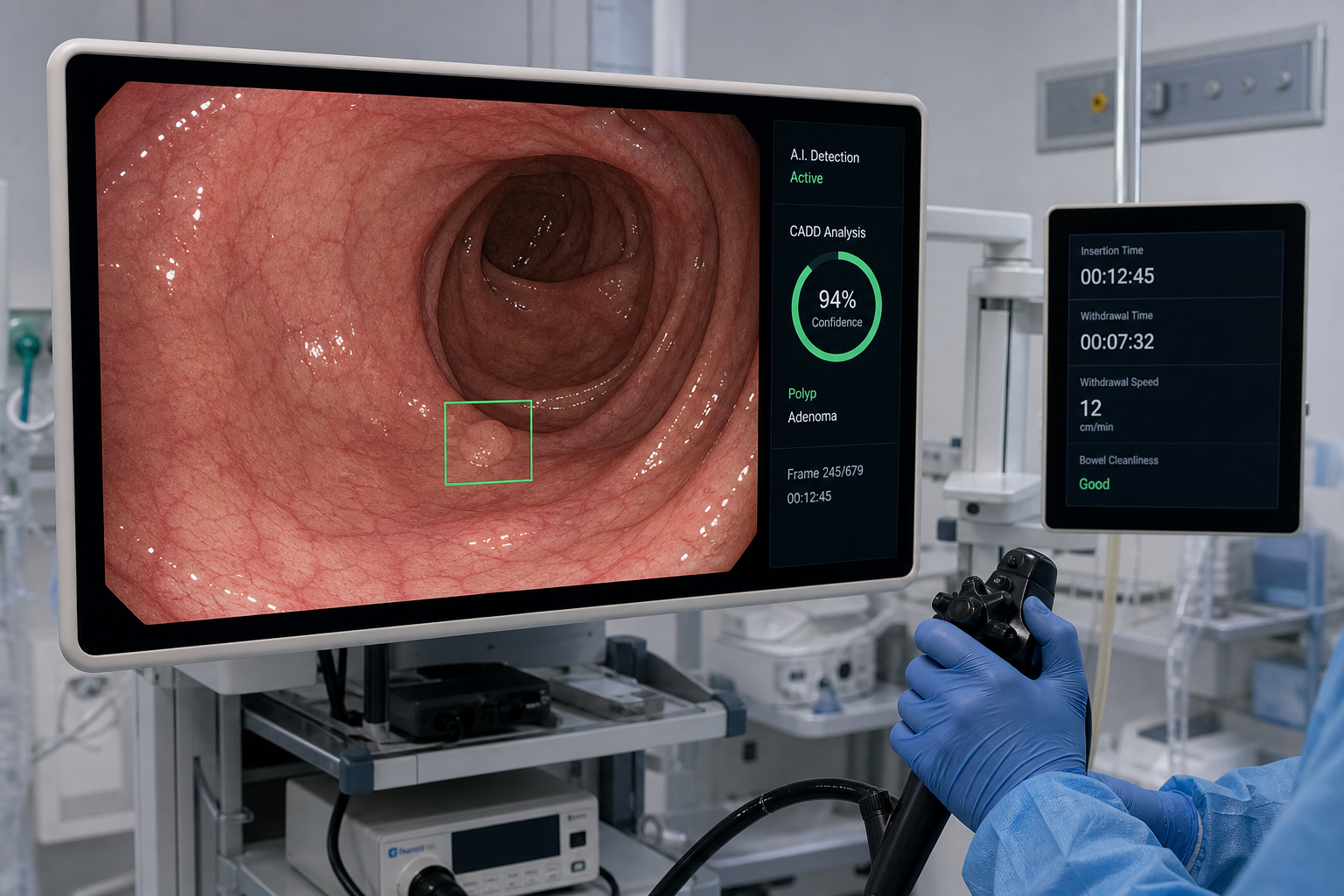
A structured clinical application profile of GI Genius (Medtronic/Cosmo Pharmaceuticals), the first FDA De Novo-cleared AI colonoscopy CADe system, covering its regulatory authorization, deep learning architecture, evidence from seven device-specific RCTs and two major meta-analyses, documented efficacy-to-effectiveness gaps in pragmatic deployment, and operational guidance for endoscopy units evaluating adoption.

By Editorial TeamUpdated Jun 5, 2026
  • medical imaging
  • clinical decision support
  • oncology AI
  • radiology AI
  • FDA

Evidence & Regulatory Summary

Clinical Specialty
Gastroenterology
AI Approach
Deep learning convolutional neural network, computer vision, real-time video inference
Evidence Quality
Multiple RCTs, prospective multi-center studies, two meta-analyses (device-specific: 7 RCTs n=9,639; mixed-platform: 28 RCTs n=23,861); GRADE moderate for ADR, high for PDR and SSLDR
Regulatory Status
FDA De Novo clearance DEN200055, April 9, 2021; classification 876.1520 gastrointestinal lesion software detection system; CE mark (Europe); authorized in select Asia-Pacific and Middle East markets
Deployment Stage
Broad clinical use
Known Limitations
No significant benefit for advanced adenoma detection (RR 1.01); I²=64% heterogeneity in ADR meta-analysis; predominantly European and Asian RCT populations limiting US generalizability; ~39% increase in non-neoplastic resection rate; false-positive fatigue and audio alert muting in real-world use; ceiling effects in high-baseline-ADR endoscopists; CADe cannot compensate for inadequate mucosal exposure
Key Citations
Sattar et al., Cureus 2025 (PMC12616575); Seager et al. COLO-DETECT, Lancet GH 2024; Makar et al., GIE 2024; Ladabaum et al., iGIE 2024; Kim et al., Clinical Endoscopy 2025; Bustamante-Balén et al., Endoscopy International Open 2025 (PMC11922311)

Related Content

Related Research

  • Archives of Pathology and Laboratory MedicinePaige Prostate AI: A Critical Appraisal of the Raciti et al. 2023 Pivotal Clinical Validation Study
  • npj Digital MedicineAI in Computational Pathology: What the First Cross-Disease Systematic Review of Whole Slide Image Diagnostics Actually Shows

Company Profiles

  • iCAD ProFound AI Mammography: FDA Clearance History and Device Record

Related Applications

  • AI Sepsis Prediction in Hospitals: Epic Sepsis Model Evidence, Alert Burden, and FDA-Cleared Alternatives
  • Ambient AI Scribes in Epic EHR: Real-World Deployment Evidence and Clinical Governance
  • AI for Health: A Clinical Application Brief Across Key Medical Domains
← All Clinical Applications← Gastroenterology entries

Discussion

Reminder: Comments do not constitute clinical guidance. Please do not share patient-identifiable information. ClinicalMind is not a clinical consultation channel.

Comments

Join the discussion with an anonymous comment.

Loading comments...
ClinicalMind

Rigorous coverage of AI in healthcare — evidence, regulation, clinical applications, and industry intelligence for healthcare professionals and researchers.

Content Areas

  • Clinical Applications
  • Research & Evidence
  • Regulatory & Policy
  • Policy Tracker
  • Company Profiles
  • Glossary
  • Education & Courses
  • Industry Intelligence
  • About
  • Contact
  • Newsletter

Editorial Standards

ClinicalMind sources its content from peer-reviewed literature, primary regulatory documents (FDA, CMS, WHO, CHAI, EMA), and independently verified sources. Content does not constitute clinical guidance, diagnosis, treatment recommendations, or medication advice. Readers must consult qualified healthcare professionals for all clinical decisions.

Company profiles carry a Profile Last Verified date. Policy Tracker entries link directly to primary regulatory sources. Market figures are cited with source organization and methodology caveats. Vendor-supplied data is distinguished from independently corroborated evidence.

  • Privacy Policy
  • Terms of Use
  • Disclaimer

© 2026 ClinicalMind. For healthcare professionals and researchers. Not clinical guidance.