
 Microsoft Dragon Copilot (formerly Nuance DAX Copilot)
Product Snapshot: What Dragon Copilot Is Today
If you arrived here searching for DAX Copilot, you are in the right place. As of March 2025, the capabilities marketed under the DAX Copilot name were unified with Dragon Medical One into a single platform now called Microsoft Dragon Copilot. The commercial product is Dragon Copilot. The term "DAX Copilot" remains the dominant search term, continues to appear in Microsoft's own support documentation, and is still widely used by health systems that deployed the tool before the rebrand — but no new customer buys a product called DAX Copilot. The legacy Physician Practice offer reached end-of-sale on May 1, 2026.
Dragon Copilot is an ambient AI clinical documentation platform deployed by 600+ healthcare organizations as of 2025, making it the market-leading enterprise ambient AI documentation tool by deployment scale. It listens to clinician-patient conversations, generates specialty-specific draft clinical notes, and surfaces suggested orders — all within the clinician's existing EHR workflow, most commonly Epic. The platform sits within Microsoft's health solutions portfolio following the 2022 Nuance acquisition and is built on Microsoft Azure infrastructure.
For readers who want category-level context on ambient clinical intelligence more broadly, the Ambient Clinical Intelligence capability landscape for health systems covers the full taxonomy of ACI tools and use cases. This profile focuses exclusively on Dragon Copilot.
Company and Platform History
The platform's roots trace to Nuance Communications, a speech recognition and AI company that built Dragon Medical One into the dominant clinical voice documentation tool worldwide — with 550,000+ users at the time of the Epic general availability announcement in January 2024. Dragon Medical One had earned Best in KLAS recognition for four consecutive years before the Microsoft acquisition.
Microsoft completed the acquisition of Nuance Communications in March 2022 for approximately $19.7 billion — the largest healthcare AI acquisition at that time. The strategic rationale was to combine Microsoft's Azure cloud infrastructure, enterprise relationships, and AI model capabilities (including the GPT-4 lineage) with Nuance's entrenched position in clinical voice documentation and its existing relationships with 77% of U.S. hospitals.
The ambient documentation product had an earlier form called DAX Express before the full DAX Copilot release. DAX Copilot reached general availability embedded in Epic in January 2024, with Lifespan Health, OCHIN, and UNC Health among the first 150+ health systems. Stanford Health Care announced enterprise-wide deployment in March 2024. By March 2025, Microsoft unified DAX Copilot and Dragon Medical One under the single Dragon Copilot brand.
| Date | Event |
|---|---|
| March 2022 | Microsoft completes acquisition of Nuance Communications (~$19.7B) |
| Pre-2024 | DAX Express predecessor product available; Dragon Medical One at 550,000+ users worldwide |
| January 2024 | DAX Copilot reaches general availability embedded in Epic; 150+ health systems at launch |
| March 2024 | Stanford Health Care deploys DAX Copilot enterprise-wide; 200+ organizations total |
| March 2025 | DAX Copilot and Dragon Medical One unified into Microsoft Dragon Copilot brand |
| December 2025 | athenahealth integration announced |
| May 1, 2026 | Legacy Physician Practice offer reaches end-of-sale; Dragon Copilot is the sole current offer; new list prices published on Microsoft commercial marketplace |
How the Platform Works: Ambient Capture to EHR Note
Dragon Copilot's core workflow is designed to be invisible to the clinical encounter. The clinician initiates recording — it does not run continuously in the background — and the system captures the natural conversation between clinician and patient. The generated note then appears in the EHR for clinician review before it is ever finalized.
For Epic users, the workflow documented in Microsoft's official support documentation proceeds as follows:
- The clinician opens Epic Haiku or Canto on a mobile device (or accesses Dragon Copilot via Epic Hyperdrive on desktop) and taps the Dragon Copilot icon in the patient's chart.
- The clinician confirms patient consent for ambient recording before beginning.
- The clinician taps the ambient recording button. The encounter conversation — including multi-party dialogue — is captured.
- After the encounter ends and recording is stopped, Dragon Copilot processes the audio and generates a draft clinical note.
- An alert appears in Epic Hyperdrive when the note is ready. The clinician navigates to the Notes activity and opens the embedded Dragon Copilot panel via the SmartSection Actions menu.
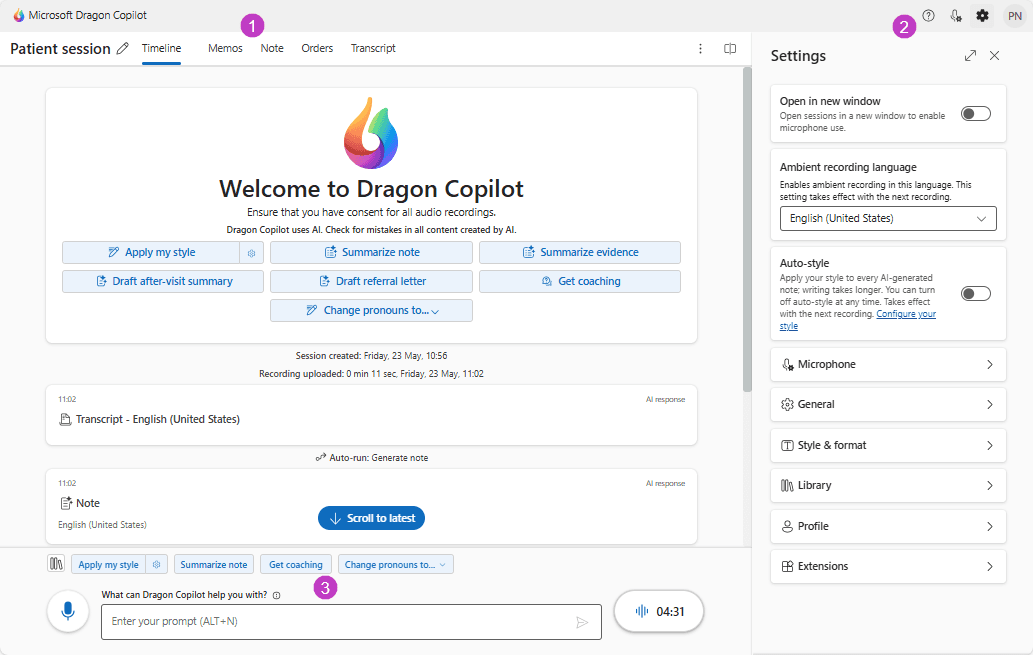
- The panel displays four session tabs: Timeline (default view), Note (the AI-generated clinical summary), Orders (suggested medications, lab tests, imaging, and procedures surfaced from the conversation), and Transcript.
- The clinician reviews the draft note, makes any edits, and accepts it. SmartSections populated include HPI (.hpisec), Assessment and Plan (.apsec), Physical Exam (.pesec), and Results (.resultsec).
- The finalized note is committed to the Epic chart in the normal documentation workflow.
Technical Architecture and Specialty Optimization
Dragon Copilot runs on Microsoft Azure infrastructure. The platform's AI layer is built on a core medical model fine-tuned on millions of real-world patient encounters. Microsoft describes the development process as involving a network of physicians, advanced care practitioners, coders, and in-house clinical experts — including MDs, RNs, and APPs — who co-design and refine the product alongside specialty clinical consultants.
Above the core medical model, Microsoft has built specialty-specific fine-tuned layers. Published examples include ophthalmology (documenting lens implant decision-making), psychiatry (mental status exam capture), orthopedics, and behavioral health. The specialty optimization is configured in the clinician's profile settings within Dragon Copilot and shapes how the model structures and prioritizes note content for that clinical context.
The Dragon Medical One voice dictation engine — which underpins the 550,000+ user installed base — is now integrated into the Dragon Copilot platform, meaning health systems that had existing Dragon Medical One deployments can upgrade to Dragon Copilot while retaining that infrastructure investment.
EHR Integration and Deployment Model
Epic integration is the flagship deployment path and the most deeply embedded. Dragon Copilot is native to Epic Hyperdrive, Haiku (iPhone), and Canto (iPad), with SmartSections populating directly into the Epic chart. This native embedding — rather than a side-panel overlay or copy-paste workflow — is a meaningful architectural distinction for clinical informatics teams evaluating workflow friction.
| EHR / Platform | Integration Status | Notes |
|---|---|---|
| Epic | Generally available (GA) | Native embedding in Hyperdrive, Haiku, Canto; SmartSection population; Orders tab integration |
| athenahealth | Announced December 2025 | Availability timeline should be confirmed with Microsoft at time of procurement evaluation |
| MEDITECH | Available | Integration depth and SmartSection equivalents should be verified with Microsoft |
| Web browser | Available | Dragon Copilot accessible via web app for non-EHR-embedded workflows |
| Desktop (Windows) | Available | Runs through Dragon Medical One on Windows; macOS support per Commure review — verify with Microsoft |
| Mobile (iOS) | Available via PowerMic Mobile (iPhone) | Confirmed in Microsoft technical documentation |
| Mobile (Android) | Disputed — verify with Microsoft | TryTwoFold (last verified January 2026) states Android not supported; Commure review suggests broader device support post-rebrand; confirm before deployment planning |
Clinical Evidence: What Independent Studies Show
Dragon Copilot has a larger independent evidence base than most competing ambient AI documentation tools — but what that evidence actually demonstrates is more nuanced than vendor marketing suggests. The consistent finding across rigorous studies is burnout reduction and documentation burden relief, not statistically significant documentation time savings. Procurement teams and clinical informatics leaders should understand this distinction before building ROI models around efficiency gains.
For a broader synthesis of the ambient AI documentation evidence landscape beyond DAX-specific studies, see Ambient AI Clinical Documentation: What Peer-Reviewed Evidence Actually Shows. The three studies below are specific to DAX Copilot or the Dragon Copilot platform.
| Study | Design | Population | Key Findings | Limitations |
|---|---|---|---|---|
| Lukac et al., NEJM AI, November 2025 (UCLA Health) | Parallel three-group pragmatic RCT | 238 outpatient physicians, 14 specialties, ~72,000 encounters; November 2024–January 2025; DAX used in 33.5% of 24,696 visits | DAX arm: documentation time change −1.7% vs. control (95% CI −9.4% to +5.9%; P=0.66) — NOT statistically significant. Burnout (Mini-Z): +2.83 points (95% CI +1.28 to +4.37) — statistically significant. Physician task load (PTL): −39.9 points. Occasional clinically significant inaccuracies noted; one mild patient safety event. | Single academic medical center; two-month study window; external validity to community hospitals limited; DAX usage rate (33.5% of visits) may underestimate effect in high-adoption scenarios |
| Atrium Health / Wake Forest, NEJM AI, 2024 | Observational cohort with control group (not randomized) | 238 outpatient clinicians (family medicine, internal medicine, general pediatrics); five enrollment waves June–August 2023; 180-day follow-up; final analytic sample: 112 DAX users, 103 controls | No statistically significant differences in documentation efficiency between DAX users and controls across the full user population. High DAX users (top-usage quartile): approximately 7% reduction in documentation hours vs. control. | Non-randomized design; self-selection into high-usage group confounds the 7% finding; enrolled in early-adoption period (2023); may not reflect current model performance |
| Wendt et al., Future Healthcare Journal, September 2025 (Providence) | Randomized step-wedge controlled study | Providers at Providence health system randomly assigned to use ACI (Nuance DAX) early or late in the study period; medical records metadata captured objective documentation time | ACI significantly reduced documentation burden, provider frustration, and burnout. Providers spent 2.5 fewer hours per week on off-hours ('pajama time') documentation. Both subjective and objective documentation time reductions documented. | Step-wedge design limits blinding; Providence is a large integrated health system — generalizability to smaller or differently structured organizations should be considered |
Vendor-Reported Health System Outcomes (Not RCT Findings)
Several named health systems have published or shared operational outcomes through Microsoft customer stories and press releases. These figures are health-system-reported, not independently validated, and should be treated as directional rather than evidentiary. They are included here for completeness, clearly labeled as such:
- Stanford Health Care (enterprise deployment, March 2024): 96% of physicians found DAX Copilot easy to use; 78% reported it expedited clinical notetaking; approximately two-thirds reported time savings. Source: Nuance/Microsoft press release.
- Intermountain Health (2,500+ active users): 27% reduction in time in notes per appointment. Source: Microsoft customer story.
- Northwestern Medicine: 24% less time drafting notes; 11.3 more patients seen per day on average. Source: vendor-reported via Healthcare IT News coverage of the Atrium Health study.
- Mercy: Nurses reported saving approximately 2 hours of charting per 12-hour shift. Source: Microsoft customer story.
Known Limitations and Procurement Considerations
- Documentation time savings are not consistently demonstrated in RCTs. The primary RCT (UCLA, 2025) found a 1.7% reduction that was not statistically significant (P=0.66). The Atrium Health study found no significant efficiency gains across the full user population. ROI models built primarily around time-savings assumptions are not supported by the current RCT evidence base.
- Multilingual mode requires manual pre-encounter setup. Dragon Copilot supports 50+ languages, but the language must be manually selected by an admin-enabled setting before each encounter. Language cannot be changed mid-session. Microsoft's own documentation explicitly notes that accuracy "might not be as accurate as documentation generated from conversations recorded in English or Spanish" for multilingual recordings. For health systems serving linguistically diverse populations, this is a meaningful workflow and accuracy constraint.
- No self-serve trial or free tier. Evaluation requires enterprise sales engagement. This limits the ability to run small-scale pilots before committing to a contract.
- Note inaccuracies require active physician review. The UCLA RCT reported clinically significant inaccuracies "occasionally" (Likert mean 2.7 on a five-point scale for DAX), most commonly omissions and pronoun errors. One mild patient safety event was documented. The platform does not operate as a passive automation layer — it requires genuine clinician engagement at the review step.
- ICD-10/CPT coding automation is not confirmed in core DAX Copilot documentation. Newer Dragon Copilot versions include coding accessible by voice query, but this is not the same as automated coding integrated into the documentation workflow. Health systems evaluating Dragon Copilot for coding automation should verify current capabilities directly with Microsoft.
- Mobile device support should be verified before deployment planning. iOS capture via PowerMic Mobile on iPhone is confirmed in Microsoft technical documentation. Android support status is disputed between sources as of early 2026 — one review states it is not supported while another suggests post-rebrand expansion. Confirm current device support with Microsoft before finalizing deployment architecture.
- Audio recordings are not retained beyond 30 days. Patient recordings older than 30 days are not retrievable from the app, which has implications for audit and quality review workflows.
Regulatory and Compliance Status
| Framework | Status | What It Covers |
|---|---|---|
| FDA Medical Device Clearance | NOT applicable — not FDA-cleared | Dragon Copilot operates as administrative software; no 510(k), De Novo, or PMA authorization |
| HIPAA Business Associate Agreement (BAA) | Available through Microsoft Azure | Governs PHI handling in Azure-hosted services; Microsoft signs BAA with covered entities |
| HITRUST CSF Certification | Certified | Information security and privacy framework; applies to Nuance-hosted environments |
| SOC 2 Type II | Certified | Security, availability, and confidentiality controls on hosted environments |
The HIPAA BAA is executed with Microsoft for Azure-hosted services. Health systems should confirm BAA coverage scope with their Microsoft account team, particularly for any data processing that occurs outside the Azure environment or involves third-party integrations.
Pricing and Access Model
Microsoft published Dragon Copilot list prices on the commercial marketplace following a significant pricing change on May 1, 2026. The prior Per-User list price of $3,528/user/month was reduced by 57% to $1,512/user/month. A Flex pricing tier is listed at $604.80/user/month. These are Microsoft's published list prices; actual enterprise contract pricing is not publicly disclosed and is negotiated separately.
| Pricing Tier | List Price (as of May 2026) | Source / Notes |
|---|---|---|
| Per-User (Microsoft marketplace list) | $1,512/user/month | Reduced 57% from prior $3,528 on May 1, 2026; Microsoft commercial marketplace |
| Flex (Microsoft marketplace list) | $604.80/user/month | Microsoft commercial marketplace; usage-based structure |
| Authorized reseller — low end | ~$369/provider/month + ~$700 setup fee | Dictation Direct reseller listing; 12-month commitment; pre-May 2026 figure — may not reflect current pricing |
| Authorized reseller — mid range | ~$600/provider/month | DictationOne reseller listing; 12-month commitment; pre-May 2026 figure |
| Enterprise contract pricing | Not publicly disclosed | Negotiated directly with Microsoft; may differ substantially from list prices |
Named Deployments and Reported Outcomes
The following health systems have confirmed Dragon Copilot (or DAX Copilot) deployments with reported outcomes. All figures below are health-system-reported operational metrics, not findings from controlled studies. They are included to provide deployment context, not as clinical evidence.
- Stanford Health Care — Enterprise-wide deployment announced March 2024. Preliminary survey: 96% of physicians found DAX Copilot easy to use; 78% reported it expedited clinical notetaking; approximately two-thirds reported time savings.
- Intermountain Health — 2,500+ active users. Reported 27% reduction in time in notes per appointment.
- Northwestern Medicine — Used DAX in at least 50% of patient encounters. Clinicians reported an average 24% less time drafting notes and an increase of 11.3 more patients seen per day on average (vendor-reported).
- Mercy — Nursing use case: nurses reported saving approximately 2 hours of charting per 12-hour shift.
- Lifespan Health, OCHIN, UNC Health — Among the first 150+ health systems at the January 2024 Epic GA launch.
- Cooper University Health Care, WellSpan Health — Confirmed deployments; detailed outcome metrics not publicly available.
Competitive Positioning in the Enterprise Ambient AI Segment
Dragon Copilot competes primarily with Abridge, Suki, and Nabla in the enterprise ambient AI documentation segment. By deployment scale — 600+ organizations — Dragon Copilot holds the largest confirmed footprint. Notably, Nabla appeared as a comparator arm in the same UCLA NEJM AI RCT (Lukac et al., 2025), where it showed a statistically significant 9.5% reduction in average note time versus control, compared to DAX's non-significant 1.7% reduction; both showed approximately equivalent burnout improvement. That single-center RCT is not sufficient to draw durable head-to-head conclusions, but it is the most rigorous direct comparison available in the peer-reviewed literature as of mid-2026. For a structured profile of the leading independent competitor, see the Abridge company and product profile.
Comments
Join the discussion with an anonymous comment.