
Definition
A Predetermined Change Control Plan (PCCP) is a document submitted to the FDA as part of an initial marketing submission for an AI-enabled medical device that pre-specifies planned algorithm modifications, the methodology for developing and validating those modifications, and an assessment of their impact on device safety and effectiveness. Once the FDA reviews and accepts the PCCP as part of that original submission, the manufacturer may implement future modifications that fall within the pre-approved parameters without filing a new 510(k), De Novo, or PMA submission.
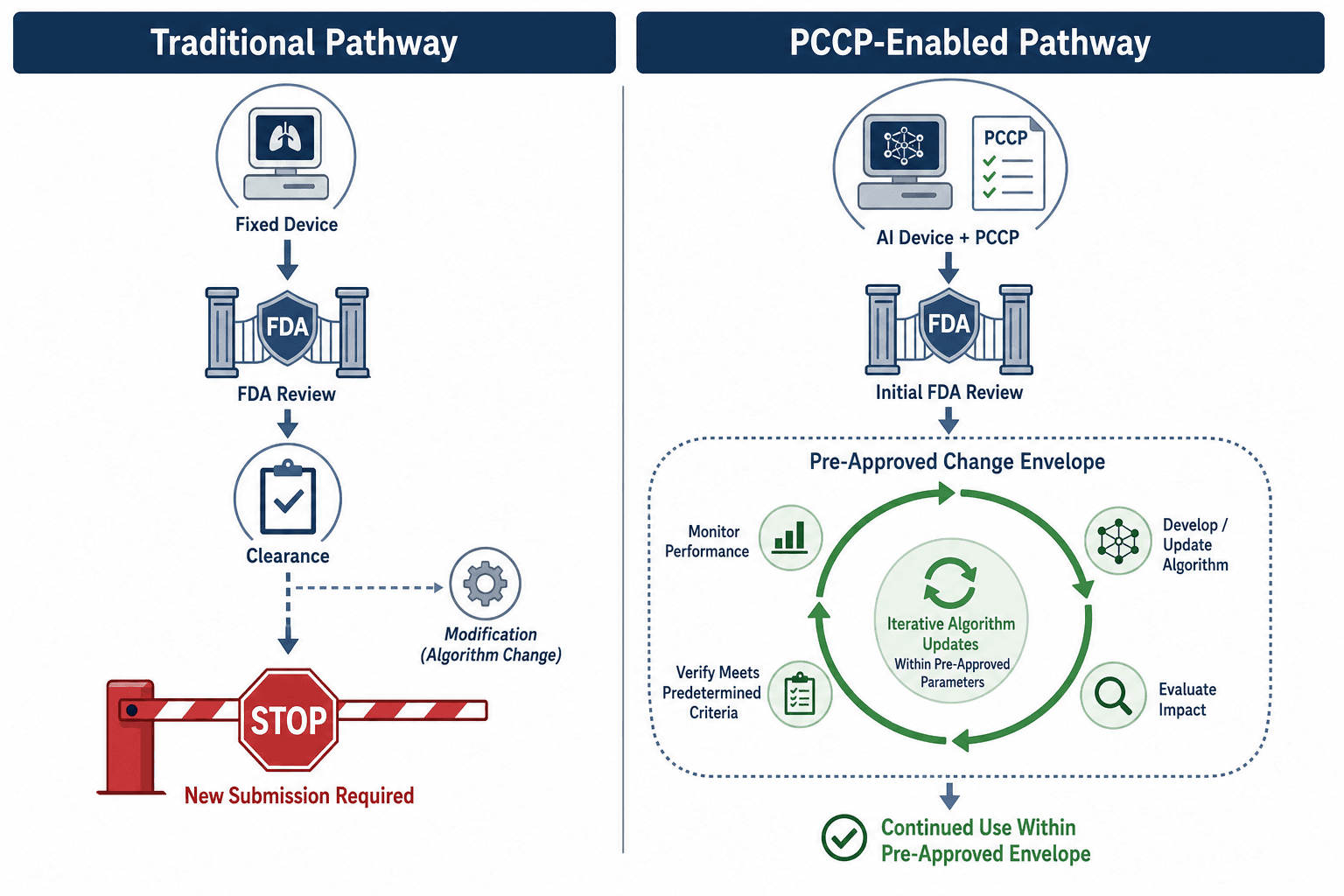
The PCCP does not reduce or remove FDA oversight. It restructures the timing of that oversight: instead of reviewing each modification after it is proposed, FDA evaluates the full scope of planned changes upfront, during the original marketing review. Modifications that stay within the approved envelope proceed without a new submission; modifications outside that envelope still require one.
The Regulatory Problem PCCP Solves
Traditional FDA medical device regulation was built around a fixed design assumption: a device submitted for clearance has a defined, stable configuration, and any meaningful change to that configuration requires a new or supplemental marketing submission. This model works well for hardware-centric devices whose performance does not change after manufacture.
AI/ML-enabled devices do not fit that assumption. Many AI systems are designed to improve continuously by incorporating new data — a property the FDA terms continual machine learning: the ability of a model to adapt its performance by incorporating new data or experiences over time while retaining prior knowledge. Under the traditional framework, each such adaptation could constitute a device modification requiring a new submission — creating a regulatory cycle that is poorly matched to how these systems actually develop and improve.
The contrast is with a locked model: one that provides the same output each time the same input is applied, because its parameters cannot be updated after deployment. Locked models are compatible with the traditional submission-per-change framework, but they cannot take advantage of the performance gains that come from exposure to real-world data over time.
The practical consequence of deploying a locked model is that as the patient population, clinical environment, or data acquisition practices shift over time, the model's performance may degrade — a phenomenon covered in depth in the Model Drift in Deployed Clinical AI glossary entry. PCCP-governed algorithm updates are one of the mechanisms manufacturers can use to address that degradation in a regulatorily structured way.
The Three Required Components of a PCCP
The August 2025 FDA final guidance specifies that a complete PCCP must contain three required elements. Each element serves a distinct function in the FDA's review of whether the planned modification pathway is safe and appropriate.
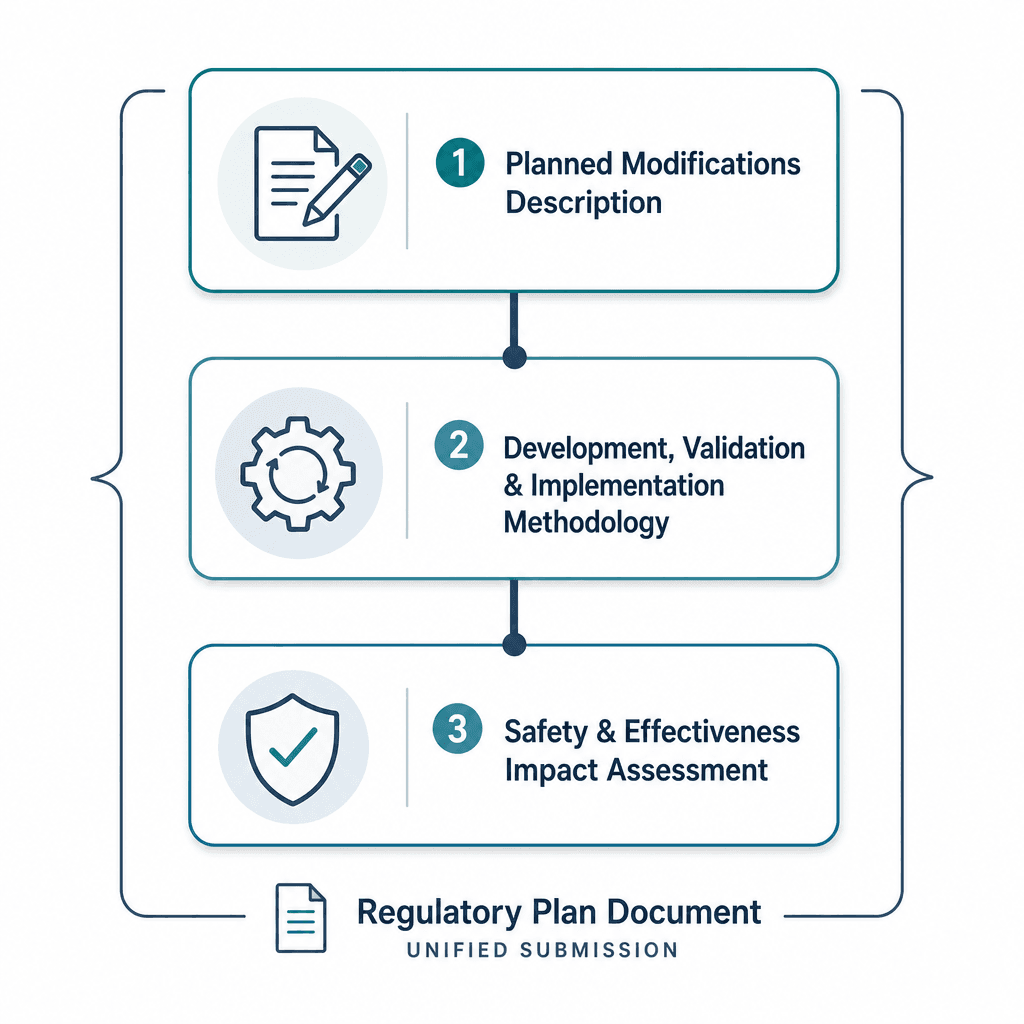
- Description of planned device modifications. The manufacturer must specify what modifications are anticipated — for example, retraining the algorithm on a new or expanded dataset, adjusting model architecture, or updating decision thresholds. This description defines the outer boundary of the pre-approved change envelope. Modifications outside this description are not covered by the PCCP and would require a new marketing submission.
- Methodology for developing, validating, and implementing those modifications. The manufacturer must document the process by which each planned modification will be developed and tested before deployment. This includes the data sources and curation approach, the validation protocol, the performance benchmarks that must be met, and the implementation controls that ensure the modification is applied as intended. FDA reviews this methodology to assess whether the process itself is rigorous enough to maintain safety and effectiveness.
- Assessment of the impact of those modifications on device safety and effectiveness. The manufacturer must analyze how each category of planned modification could affect the device's safety and effectiveness profile — including potential failure modes, the clinical consequences of degraded performance, and the controls in place to detect and respond to unexpected outcomes. This element ensures that the manufacturer has systematically considered risk before modifications occur, not after.
Applicable Regulatory Pathways
A PCCP can be included in marketing submissions under four FDA review pathways. The mechanism is pathway-agnostic in the sense that it is available regardless of which submission type is used, but the scope of what FDA will accept in a PCCP may reflect the risk profile associated with each pathway.
| Pathway | Brief characterization | PCCP applicable |
|---|---|---|
| 510(k) Premarket Notification | Demonstrates substantial equivalence to a legally marketed predicate device; most common pathway for AI-enabled devices | Yes |
| De Novo Classification Request | Establishes a new device classification for novel low-to-moderate risk devices without a predicate; see the De Novo-cleared | Yes |
| Premarket Approval (PMA) | Applies to high-risk devices requiring demonstration of reasonable assurance of safety and effectiveness through valid scientific evidence | Yes |
| Device constituent part of a device-led combination product | Applies when the primary mode of action of a combination product is attributable to the device component | Yes |
The De Novo pathway is particularly relevant for novel AI applications without a predicate device. The Paige Prostate De Novo authorization (DEN200080) — the first FDA-authorized AI device in computational pathology — illustrates how the De Novo pathway works for a genuinely novel AI application. A manufacturer pursuing De Novo authorization for an AI device could include a PCCP in that submission to pre-specify a future algorithm improvement pathway from the outset.
PCCP in the Device Lifecycle: Pre-Clearance Design Through Post-Market Operations
A PCCP is not a post-market document. It must be designed during the pre-clearance phase and submitted as part of the original marketing submission. This means the manufacturer must think prospectively about algorithm improvement pathways before the device is cleared — not after deployment reveals performance gaps.
During FDA review of the marketing submission, the agency evaluates the PCCP alongside the device's safety and effectiveness data. FDA may accept the PCCP as submitted, request modifications to it, limit the scope of planned modifications it will accept, or decline to authorize the PCCP while still clearing the underlying device. A cleared device with an authorized PCCP will reflect that status in the FDA's records.
After clearance, the manufacturer operationalizes the PCCP by executing the pre-specified development and validation methodology when a planned modification is ready for implementation. If the modification falls within the approved PCCP parameters and the manufacturer follows the approved methodology, no new marketing submission is required before deployment.
- Pre-clearance: Manufacturer designs the PCCP, specifying planned modifications, validation methodology, and impact assessment as part of the marketing submission package.
- FDA review: FDA evaluates the PCCP as a component of the marketing submission. The agency may accept, limit, or decline to authorize the PCCP. Clearance of the device does not automatically mean the PCCP is authorized.
- Post-clearance implementation: Manufacturer implements modifications within the pre-approved envelope using the approved methodology. No new submission is required for in-scope modifications.
- Post-market monitoring: PCCP clearance does not discharge post-market surveillance obligations. Manufacturers must continue to monitor device performance in deployment, track real-world outcomes, and respond to performance degradation or safety signals regardless of PCCP status.
Real-World Adoption: Fibresolve (K252041)
As of the FDA's AI-Enabled Medical Device List updated through early 2026, Fibresolve by Imvaria, Inc. (Berkeley, CA) is among the first confirmed AI-enabled devices cleared with an authorized PCCP. The device appears in the FDA list under the designation "Fibresolve (with PCCP)," which distinguishes it from devices cleared without this mechanism.
| Field | Fibresolve | ScreenDx |
|---|---|---|
| FDA submission number | K252041 | K241891 |
| Applicant | Imvaria, Inc. | Imvaria, Inc. |
| Device classification | Radiology Software For Referral Of Findings Related To Fibrotic Lung Disease | Radiology Software For Referral Of Findings Related To Fibrotic Lung Disease |
| Decision date | November 7, 2025 | January 10, 2025 |
| Decision | Substantially Equivalent (SESE) | Substantially Equivalent (SESE) |
| PCCP authorized | Yes | No |
Fibresolve is classified as radiology software for referral of findings related to fibrotic lung disease — a clinical area where AI-assisted detection of interstitial lung disease patterns in CT imaging has been an active area of development. The 510(k) record K252041 confirms the PCCP authorization as part of a traditional 510(k) submission.
The contrast with ScreenDx is instructive. ScreenDx — also by Imvaria, in the same product classification — was cleared in January 2025 without an authorized PCCP. The 510(k) record K241891 explicitly shows "Predetermined Change Control Plan Authorized: No." The same manufacturer, in the same device classification, chose to include a PCCP in its subsequent submission — illustrating that the decision to pursue PCCP authorization is made at the submission design stage, not automatically applied to all AI devices.
The August 2025 Final FDA Guidance
The formal regulatory foundation for PCCP as applied to AI-enabled devices is the Marketing Submission Recommendations for a Predetermined Change Control Plan for Artificial Intelligence-Enabled Device Software Functions, published in August 2025 under docket number FDA-2022-D-2628.
The guidance was issued jointly by the Center for Devices and Radiological Health (CDRH), the Center for Biologics Evaluation and Research (CBER), the Center for Drug Evaluation and Research (CDER), and the Office of Combination Products. Its joint issuance reflects the fact that PCCP applies across device types that may fall under different FDA centers, including the device constituent parts of combination products.
The August 2025 document finalized a framework that had been proposed in draft form, with the docket number indicating the rulemaking process began in 2022. A detailed comparison of what changed between the draft and final versions is a policy analysis task that falls outside the scope of this glossary entry; that analysis belongs in the Policy & Regulation section of this site.
What PCCP Does Not Cover: Limits and Ongoing Obligations
PCCP is sometimes described informally as a mechanism that allows manufacturers to update AI devices without FDA review. That framing is inaccurate in an important way: FDA review does occur — it takes place during the original marketing submission, when the agency evaluates the full PCCP document. What PCCP eliminates is the requirement for a new submission at the time each modification is implemented, not FDA oversight of those modifications in principle.
- FDA can limit the scope of the PCCP. During review of the original submission, FDA may accept only a subset of the planned modifications, require additional validation requirements, or impose conditions on implementation. The manufacturer cannot unilaterally expand the PCCP scope after clearance.
- PCCP does not guarantee that planned modifications will be accepted. FDA may decline to authorize the PCCP while still clearing the underlying device, or may authorize a narrower version than submitted. Manufacturers should not assume PCCP approval is automatic.
- Post-market monitoring obligations remain in full force. PCCP clearance does not discharge the manufacturer's obligation to monitor AI device performance in real-world deployment. Active performance monitoring — tracking how the device performs on actual patient populations over time, detecting data drift, and identifying unexpected failure modes — remains required. The model drift monitoring framework describes the methods used to detect and respond to performance degradation in deployed AI systems.
- Out-of-scope modifications still require a new submission. If a manufacturer wants to make a modification not described in the approved PCCP, or wants to change the intended use of the device, a new or supplemental marketing submission is required regardless of PCCP status.
- PCCP does not apply retroactively. A device that was cleared without a PCCP cannot simply add one post-clearance. PCCP must be included in the original marketing submission or in a subsequent submission that updates the device's authorization.
Related Terms
The following terms appear frequently in PCCP discussions and in the broader FDA AI/ML device regulatory framework. Definitions below draw on FDA's own published terminology where available.
| Term | Definition in FDA context | Relationship to PCCP |
|---|---|---|
| Locked model | A model that provides the same output each time the same input is applied, because its parameters cannot be updated after deployment. | The traditional regulatory assumption. PCCP enables a structured alternative for models that are intended to be updated over time. |
| Continual machine learning | The ability of a model to adapt its performance by incorporating new data or experiences over time while retaining prior knowledge. | The AI capability that creates the regulatory mismatch PCCP is designed to resolve. A PCCP can pre-specify the parameters under which continual learning updates are permitted. |
| Data drift | Change in the input data distribution a deployed model receives over time, which can cause the model's performance to degrade. | A primary trigger for planned modifications under a PCCP. If input data characteristics shift — due to changes in patient population, imaging equipment, or clinical practice — a PCCP-governed update may be used to retrain the model on more representative data. |
| Model drift | Degradation in a deployed AI model's real-world performance over time, often caused by data drift or changes in the clinical environment. | The performance problem that PCCP-governed algorithm updates are designed to address. Post-market monitoring for model drift remains required even after PCCP clearance. See the dedicated glossary entry for full treatment. |
| SaMD (Software as a Medical Device) | Software intended to be used for one or more medical purposes that performs those purposes without being part of a hardware medical device. | The broader regulatory category that encompasses AI-enabled medical devices subject to PCCP. All AI-enabled devices with a PCCP are classified as SaMD or contain a SaMD component. |