
The Institutional Gap: Drift Awareness Without Monitoring Infrastructure
Healthcare institutions have broadly accepted that deployed AI models degrade over time. The literature is unambiguous, the mechanism is well understood, and the regulatory expectation for post-market surveillance is documented. Yet most health systems have not translated that awareness into a functioning monitoring program.
Industry data cited by Censinet's AI governance analysis suggests that only around 16% of health systems have a system-wide AI governance policy that specifically addresses AI usage and data access. Formal drift monitoring protocols — with defined detection thresholds, escalation paths, and retraining governance — are rarer still.
The gap is not primarily technical. The statistical methods for detecting distributional shift are well established, and several have been validated in clinical settings. The gap is institutional: no assigned roles, no documented thresholds, no workflow connecting a statistical alert to a clinical or compliance decision. When drift occurs — and it will — the institution has no mechanism to detect it, investigate it, or act on it.
This article addresses the operational question: how do you actually build that program? Not what drift is, but what your institution needs to put in place before the next model degrades silently.
What to Monitor: Three Layers of a Clinical AI Surveillance Program
A complete monitoring program operates across three distinct layers. Each layer provides information the others cannot, and none is sufficient on its own.
| Monitoring Layer | What It Tracks | Primary Limitation in Clinical Settings |
|---|---|---|
| Performance metric monitoring | AUROC, F1, calibration, sensitivity/specificity against ground-truth labels | Outcome labels are often delayed days to weeks — or require long follow-up — making real-time evaluation impractical for most clinical prediction tasks |
| Data-based input distribution monitoring | Statistical shifts in the distribution of input features (demographics, lab values, imaging characteristics, EHR fields) | Requires baseline reference distributions and appropriate statistical tests; does not directly measure whether model output quality has changed |
| Label-agnostic output monitoring | Changes in the model's output distribution (predicted scores, class probabilities) compared to a reference window, without requiring ground-truth labels | Can detect that something has changed without identifying what or why; requires follow-up investigation to determine clinical significance |
The fundamental constraint shaping method selection is label delay. For a sepsis prediction model, the outcome label — whether a patient developed sepsis — may not be confirmed until days after the prediction was made. For a mortality risk model, the label may require months of follow-up. This makes performance metric monitoring impractical as a real-time or near-real-time surveillance strategy for many high-acuity applications.
The practical consequence is that data-based and label-agnostic methods must carry the primary monitoring burden in most clinical AI deployments — with performance monitoring serving as a lagging confirmation signal when labels eventually become available.
Why Performance Metrics Alone Are Not Enough
The inadequacy of performance monitoring as a sole drift signal is not a theoretical concern — it has been demonstrated empirically in a clinical imaging context. A large-scale study of 239,235 chest radiographs spanning COVID-era data found that AUROC remained relatively stable even as COVID-19 drove clinically obvious shifts in the input data distribution. An institution relying solely on AUROC monitoring would have received no alert. Data-based methods — specifically a combined autoencoder and black-box shift detection approach — detected the drift that performance monitoring missed.
This finding has a direct institutional implication: if your monitoring program consists primarily of tracking aggregate performance metrics on a dashboard, you may be measuring the wrong thing. AUROC is a useful summary statistic, but it aggregates performance across a population in ways that can obscure meaningful subgroup shifts and input distribution changes. For a deeper explanation of what AUROC measures and what it cannot tell you, see the AUROC glossary entry.
Choosing Detection Methods for Your Clinical Context
No single detection method is universally appropriate. Selection should be driven by the clinical context: what type of data the model ingests, how quickly outcome labels become available, and what kinds of shifts are most clinically consequential.
| Method | What It Detects | Best Suited For | Key Limitation |
|---|---|---|---|
| Kolmogorov-Smirnov (KS) Test | Distributional shifts in individual continuous variables | Monitoring single input features (e.g., age distribution, lab value ranges); demographic shift detection | Univariate only — does not capture joint distributional shifts across correlated features |
| Population Stability Index (PSI) | Magnitude of distributional shift in a feature compared to a reference baseline | Monitoring categorical or binned features; vendor-facing reporting; interpretable threshold convention (PSI > 0.25) | Requires binning decisions that affect sensitivity; does not account for feature correlations |
| Maximum Mean Discrepancy (MMD) | High-dimensional distributional differences between reference and current data windows | Complex, high-dimensional inputs such as imaging features or multi-feature EHR embeddings; label-agnostic monitoring | Computationally intensive for large feature spaces without dimensionality reduction; requires pre-trained encoders for imaging data |
| Black Box Shift Detection (BBSD) | Shifts in the model's internal output or representation without requiring ground-truth labels | High-label-delay settings: sepsis prediction, ICU deterioration, mortality risk; any application where outcomes are delayed | Detects that a shift has occurred but does not identify its source or clinical significance without further investigation |
For high-label-delay settings — which include most EHR-based prediction models for sepsis, ICU deterioration, and mortality — the strongest validated approach is BBSD combined with MMD testing. A prospective validation study across 143,049 adult inpatients at seven Toronto hospitals confirmed that this pipeline detected significant data shifts — including those driven by demographic changes, hospital type transfers, and critical laboratory assay changes — and outperformed KS-based approaches on both synthetic and real-world COVID-era shifts.
For imaging-based models, a combined autoencoder and BBSD approach has been validated for real-time DICOM monitoring. The KS test remains useful for monitoring individual continuous input features such as patient age distributions or laboratory reference ranges, where its univariate limitation is less constraining.
- Before deploying any shift detector in production, benchmark it against synthetically induced shifts of known magnitude. This establishes the detector's sensitivity floor and informs threshold-setting. The chest radiograph study found that detection sensitivity varied substantially by which patient feature was enriched — a 5% increase in patients aged 18–35 was detectable, while a 30% increase in patients aged 65+ was required for reliable detection.
- Do not rely on a single method. Layering input distribution monitoring (PSI or KS for individual features) with label-agnostic output monitoring (BBSD + MMD) provides complementary signals and reduces the risk of missed shifts.
- Match method complexity to your data infrastructure. MMD and BBSD require access to model internals or embeddings. If your institution does not have that access through vendor contracts, PSI and KS tests on observable input features are a practical starting point while access is negotiated.
Setting Risk-Tiered Thresholds and Monitoring Cadence
A common institutional mistake is to apply uniform drift thresholds across all deployed models. The appropriate threshold — and the speed of escalation it triggers — depends on the application type, the patient safety stakes, and the volume of cases available for detection.
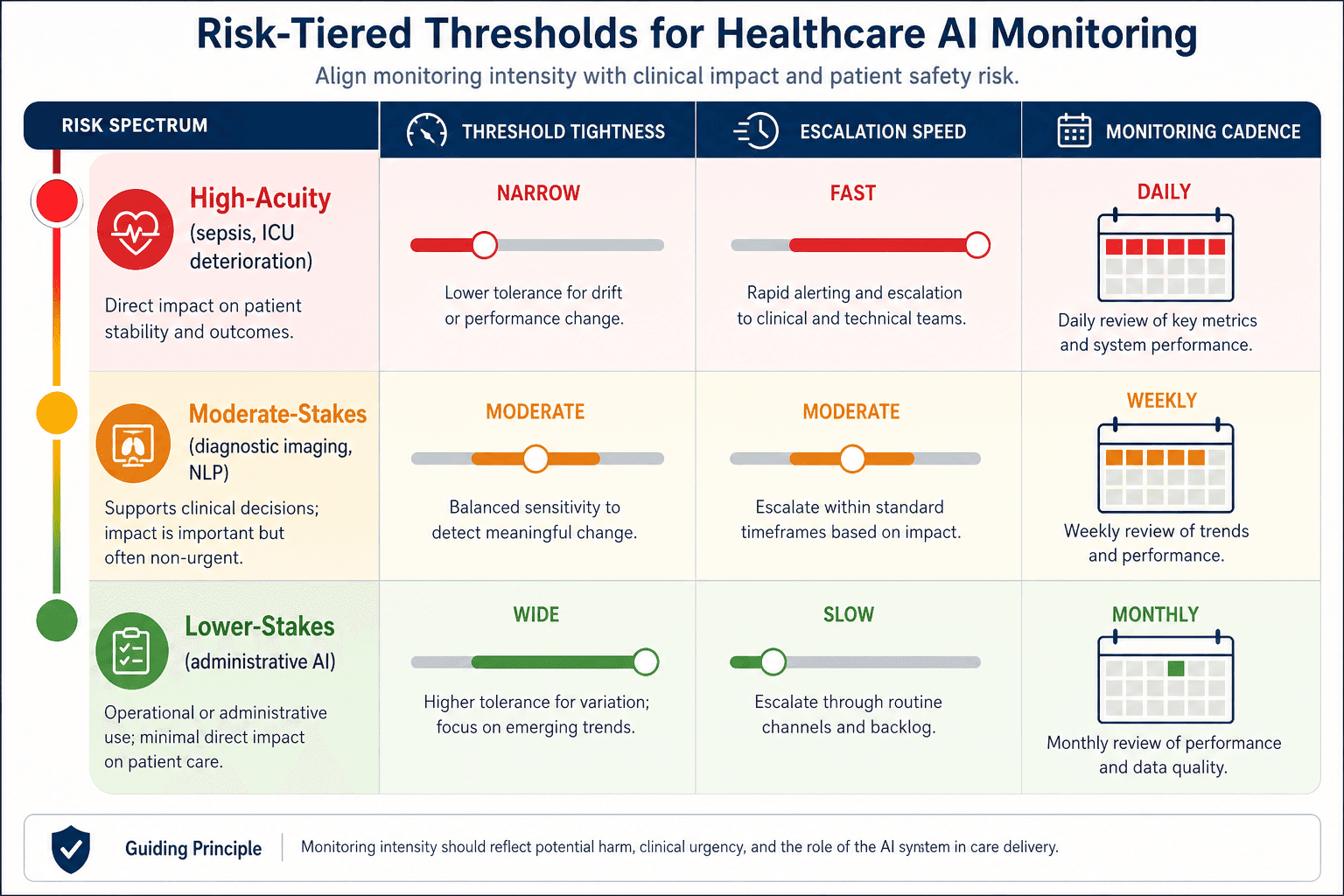
| Application Tier | Example Applications | PSI Threshold | Recommended Cadence | Escalation Speed |
|---|---|---|---|---|
| High-acuity | Sepsis prediction, ICU deterioration, mortality risk scoring | < 0.10 triggers review; < 0.25 triggers escalation | Daily rolling window (14-day lookback) | Same-day alert to clinical champion and data science team |
| Moderate-stakes | Diagnostic imaging triage, readmission risk, NLP-based coding | 0.10–0.25 triggers review; > 0.25 triggers escalation | Weekly batch review | 48–72 hour escalation to clinical and compliance review |
| Lower-stakes | Administrative AI, scheduling optimization, prior authorization support | > 0.25 triggers review | Monthly batch review | Scheduled review cycle; no immediate escalation required |
The PSI > 0.25 convention is widely cited as a signal of significant drift warranting investigation. It is a reasonable starting point, but it is not a universal clinical standard. The appropriate action threshold must account for what the model is doing and what the consequences of undetected degradation are. For high-acuity applications such as sepsis prediction, waiting until PSI exceeds 0.25 before escalating may mean that the model has been producing degraded outputs for weeks.
The Toronto multi-hospital validation study found that a p-value threshold of 0.01, combined with a minimum of 1,000 encounters for shift detection testing, provided the best balance between detection sensitivity and false alarm rate. The study used a 14-day rolling window aligned with the average length of stay in the general internal medicine cohort — a design choice that balanced case volume, detection responsiveness, and clinical workflow cycles.
Escalation Workflows and Institutional Role Assignment
A drift alert that reaches no one — or reaches everyone without clear ownership — is functionally equivalent to no alert at all. Diffusion of responsibility is the primary operational failure mode in monitoring programs that have detection infrastructure but no governance layer.
An effective escalation workflow requires four named roles with distinct, non-overlapping decision responsibilities:
- Data science team: Receives the initial statistical alert. Responsible for confirming the shift signal is not a data pipeline artifact, characterizing the nature and magnitude of the shift, and preparing a root cause hypothesis for clinical review. Does not make clinical deployment decisions.
- Clinical champion: The designated clinician with domain expertise in the application area. Responsible for assessing whether the detected shift is clinically significant, whether current model outputs remain safe to use, and whether clinical workflows should be adjusted pending investigation. Holds authority to recommend temporary suspension of model-assisted decision support.
- Compliance officer: Responsible for assessing whether the shift and its potential impact trigger documentation, reporting, or notification obligations — including FDA adverse event reporting for cleared devices and internal incident documentation. Also responsible for ensuring vendor contract obligations are enforced when drift is attributable to a vendor-managed model.
- AI vendor: Notified when shift investigation implicates model internals, training data, or algorithm updates outside the institution's control. Contractually obligated to provide audit trail access, performance testing documentation, and algorithm update notification. Responsible for retraining or recalibration if the root cause is within the vendor's scope.
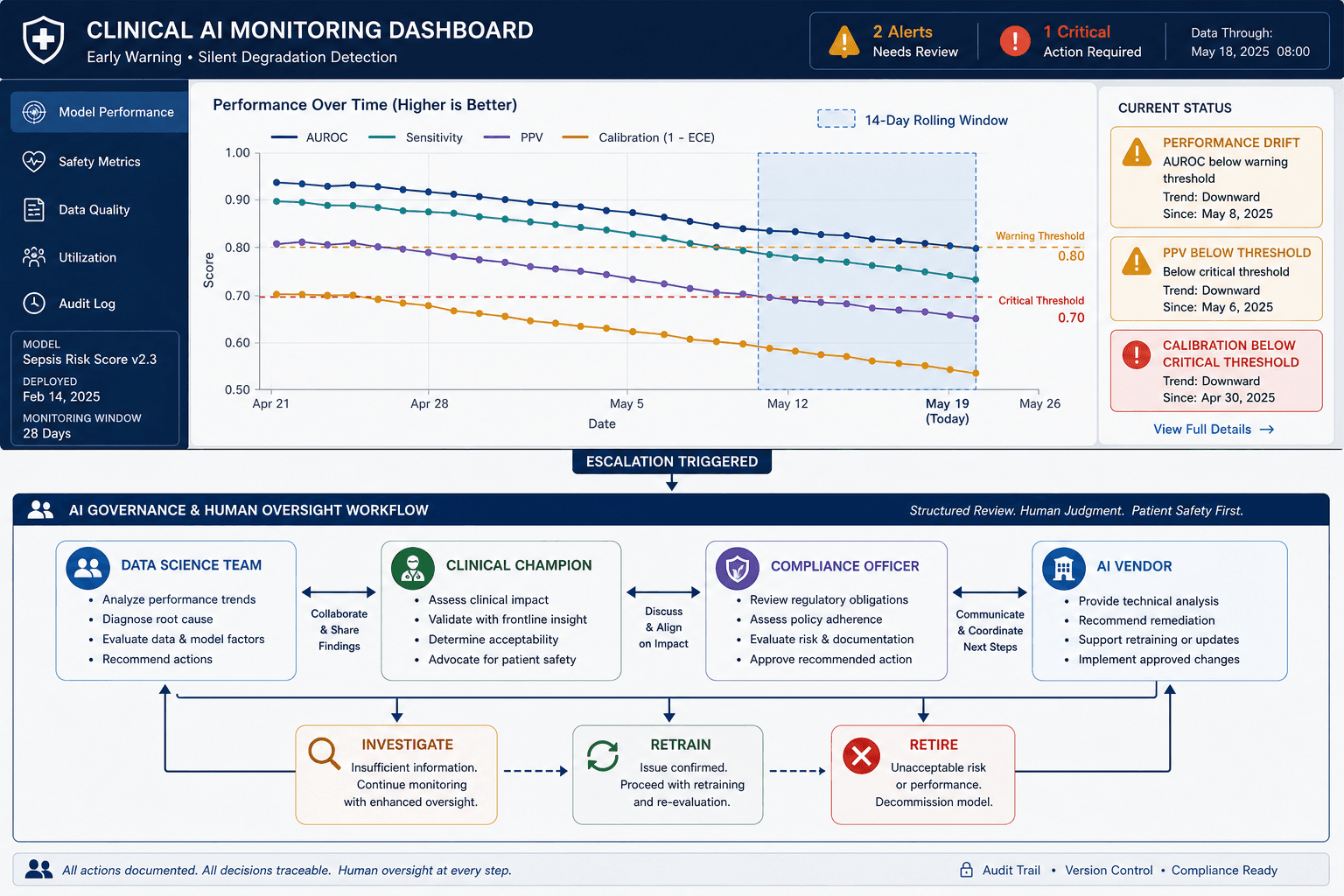
The governance model described by Censinet frames this as an air traffic control structure: a human-in-the-loop platform routes uncertain predictions and drift alerts to designated stakeholders rather than automating critical decisions. The key design principle is that no alert should be self-resolving. Every alert that clears a detection threshold must reach a named person with authority to act on it within a defined timeframe.
The Retraining Decision Framework: When and How to Update
Not every detected shift requires retraining. The appropriate response depends on the magnitude and character of the shift, the availability of recent labeled data, and whether the model's current outputs remain clinically acceptable.
The Toronto multi-hospital study provides the most directly applicable evidence on retraining strategy in a clinical EHR setting. Drift-triggered continual learning — updating the model when a shift is detected rather than on a fixed calendar schedule — produced a ΔAUROC of 0.44 (p = 0.007) compared to locked models during the COVID-19 pandemic. Fixed-schedule retraining and locked models both underperformed the drift-triggered approach.
| Update Strategy | When Appropriate | Key Risk | Evidence Basis |
|---|---|---|---|
| Simple recalibration | Moderate distributional shift with stable model structure; output scores have shifted but rank ordering remains valid | May be insufficient for major structural shifts in input data | Brigham and Women's/Harvard review (preprint, 2025): recalibration often performs as well as full retraining for moderate shifts |
| Drift-triggered continual learning | Detected shift exceeds threshold; recent labeled data available; model performance has degraded or is at risk | Requires governance approval before each update; catastrophic forgetting risk if training window is too long | Subasri et al. (JAMA Network Open, 2025): ΔAUROC 0.44 vs. locked models during COVID-19 |
| Fixed-schedule retraining | Stable environments with predictable data cycles; lower-stakes applications | Misses shifts that occur between scheduled updates; may retrain unnecessarily when no shift has occurred | Outperformed by drift-triggered approach in dynamic clinical environments |
| Model retirement | Shift is irreversible; no suitable retraining data available; clinical champion recommends suspension | Requires clinical workflow fallback plan before retirement | Governance decision; no single evidence basis |
The Toronto study also identified an important constraint on continual learning: longer training periods introduced catastrophic forgetting and overfitting. The empirically optimal configuration updated every 120 days using 60 days of recent data. This specific configuration was derived from a general internal medicine inpatient cohort and may not generalize directly to other clinical contexts, but the principle — that training lookback windows should be bounded — applies broadly.
Governance Architecture: Linking Technical, Clinical, and Compliance Functions
A monitoring program that lives entirely within the data science team will not survive its first significant clinical escalation. Sustained drift governance requires a cross-functional structure that connects technical detection, clinical judgment, compliance accountability, and vendor management — with defined escalation paths between them.
The governance architecture should address four structural questions:
- Who owns the monitoring program? A named program owner — typically a clinical informaticist, CMIO, or AI governance committee chair — is accountable for program design, staffing, and periodic review. Without a named owner, the program will not be maintained as models are added, updated, or retired.
- How does a drift alert become a governance decision? Document the escalation path from statistical alert to clinical review to compliance assessment to vendor engagement. Each step should have a named role, a defined timeframe, and a documented decision output.
- What are the vendor obligations? Vendor contracts should mandate access to audit trails, performance testing documentation, and notification of algorithm updates. If a vendor updates a model without notifying the institution, the institution's monitoring baseline is invalidated. This is a contract requirement, not a courtesy.
- How is the program reviewed and updated? Monitoring programs themselves require maintenance. Thresholds calibrated to a 2024 patient population may be miscalibrated by 2026. Schedule annual program reviews that reassess detection method selection, threshold calibration, and role assignments.
Drift monitoring and algorithmic bias monitoring are distinct governance functions and should not be conflated. Drift monitoring addresses changes in data distributions over time; bias monitoring addresses systematic underperformance across demographic subgroups. Both are necessary, but they require different methods and different remediation pathways. For the bias monitoring framework, see the algorithmic bias in healthcare AI entry.
The NIST AI Risk Management Framework's MEASURE and MANAGE functions provide a complementary governance scaffold for institutions building out their broader AI oversight infrastructure. The MEASURE function maps to the detection and threshold-setting layer of a monitoring program; the MANAGE function maps to escalation, retraining governance, and model retirement decisions.
Regulatory Alignment: FDA Post-Market Surveillance and the PCCP Pathway
FDA CDRH has active regulatory science research programs specifically focused on drift monitoring for AI-enabled medical devices. The agency's AI Program under the Office of Science and Engineering Laboratories includes three active projects: detection of out-of-distribution inputs, proactive monitoring of data drift and model performance, and real-world monitoring using federated evaluation. FDA frames these tools as benefiting both clinicians and device sponsors aiming to maintain performance as clinical practice conditions and patient populations evolve.
For institutions deploying FDA-cleared AI devices, this means that building a drift monitoring program is not merely good practice — it aligns with the regulatory direction CDRH is signaling for post-market surveillance of AI/ML-enabled software as a medical device. Institutions that have documented monitoring programs, defined escalation workflows, and retraining governance are better positioned for the post-market surveillance expectations that accompany cleared devices.
For institutions planning model updates — including retraining cycles — the Predetermined Change Control Plan (PCCP) mechanism provides a pre-approval pathway that allows planned modifications to be reviewed by FDA before they occur, rather than requiring a new submission each time. Institutions can anchor their retraining governance to a PCCP, defining in advance the conditions under which updates will be made, the validation requirements, and the performance boundaries that trigger a submission. For a full explanation of how PCCP works and what it requires, see the dedicated PCCP entry.
Building a monitoring program that aligns with FDA's post-market surveillance direction does not require waiting for formal regulatory mandates. The detection methods, governance structures, and escalation workflows described in this article are implementable now — and the cost of not implementing them is a model that degrades silently until a clinical event makes the failure visible.
Comments
Join the discussion with an anonymous comment.